 |
 A Bamana maternity sits on a one-legged stool and holds her child close in front of her stomach, who in turn hugs the mother's body with both arms. Original cord wraps on both arms and two plaits that could be authentic repairs have passed into the general patina through the long aging process, elongated plaits point to a high-ranking woman such as the wife of the "Chief de Village" or the "Warlord ', traditionally wearing a cap in the manner of Bamana women up until the early 1920s. These headgear no longer exist. Even through the age patina, a beautiful face shimmers that draws attention. Provenance: Daba Diarra, Segou.
The Dogon place wood figures depicting men and women on many different kinds of altars, most of which are dedicated to ancestors, either real or mythical. Although figurative sculptures, called dege, are perhaps the most interesting types of Dogon art, varied in form and rich in imagery, they are also among the least well documented. Few altars have been described in detail or illustrated; those that have been scribed do not suggest any consistent pattern linking a particular style of figure or a specific posture or gesture with any one kind of altar. There is also little information with which to identify the persons represented by the figures.
Each lineage possesses an altar containing figurative sculpture, which is dedicated to its founders and to subsequent members who have died, known as vageu. In recounting the myth of the first person to die in human form, Griaule tells of how a wooden sculpture representing the dead man was carved in order to provide a support for his soul and his vital force (nyama), which were released at his death. The figure wasplaced on the man's rooftop terrace along with a pottery bowl for libations. As death spread throughout the land, similar figures and bowls were placed on altars established by each lineage (Griaule, 1938: 171-72; Dieterlen, 1941: 18,22, 140; also Desplagnes, 1907:273). Photographs and drawings of vageu altars show rather simplified, even cylindrical, stick like figures leaning against the wall of the shrine (Dieterlen, 1941: pis. Vb and Vc, fig. 10). Along with the figures one also sees pottery bowls and small cups in which sacrificial liquids are offered to the
ancestors and small notched ladders so the spirits can climb to the rooftop altar; iron hooks (gobo), cylinders of red ocher, iron ornaments, and pots of roots soaking in water are kept there also and are used in healing. Sacrifices are performed collectively on all these objects at planting and harvest times, as well as by individuals who have inherited the souls of particular ancestors. The altars are kept in the ginna, orlineage head's house, of which there are several in each village. An altar can be found on the upper story of the house, in a corner of the living quarters, in the granary, in the courtyard, or even in a separate structure nearby (Paulme, 1940: 109-11; Dieterlen, 1941: 141-47).
1.600 - 2.000,- Euro
Height: 97 cm
Weight: 6,3 kg |
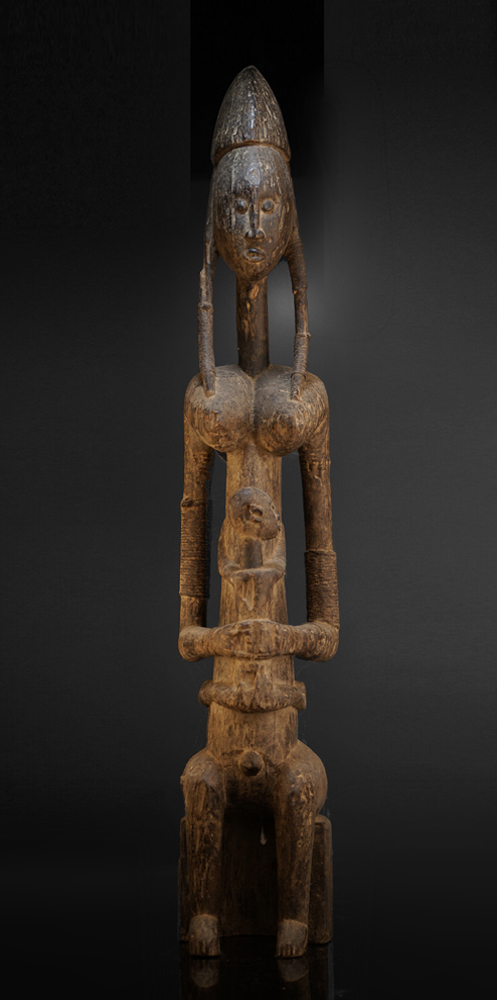 photo: tribalartforum.com/ identification no. DSC01276.jpg
 |
|
