 |
 A large Bamana Gwandusu scupture of the Tumakoro village, Kuruma region, about 80km from Segou on the other side of the Niger river, close to the borderdestrict of the Kala region, heavy, hard Lenke wood. It is the Chief de famille, who is giving the order to the Blacksmith. The Height is determined by a stick who is given to the "forgeron". On a Thursday the wood will be cut early in the morning. Important is the moment, when the part of the tree, which will become the sculpture, is falling down. If the movement of the shadow is touching a man, this person will die in a short time. "Is it possible to make a replacement of this sculpture, if I go to a Blackmith to make the same Gwandusu like this one for me?" "No, absolutly no. A Chief de village and a Blacksmith know, what is important to make such a sculpture. I mean all the things, which are really important and which you don´t know, you can´t see. You can´t give the Blacksmith an order, because you don´t know which medicine such a sculpture needs. You can give him the order to make a "wooden object", but not a "real sculpture." "Yes, it is like in the Lobi country, where I had several discussions with carvers about this topic: the carver is making the things according the order you give to him. If you don´t know the secrets, you can give him only the order to make a so called "wooden object". Is it a problem for a Bamana Blacksmith to make "a wooden object" ?" "No it isn´t a problem, I could see the carving procedure of this Bamana-sculpture made for the Judge of Doila. But it is not a real sculpture. This "making of sculpture" is like carving a piece of wood. There is no secret anymore. It has nothing to do with creating a ritual object, which needs a lot of spiritual knowledge, which you don´t know. "This sculpture is coming from ritual use. Has it still the force of a ritual object?" "Yes, it has, but you don´t know how to handle this force, which sacrifices you have to make so the sculpture is working for you. This is the problem you have without any Bamana initiation." "Some Bamana sculptures I collected have necklaces like this one around the neck of the mother and the child. But many have only remnants of the former wearing, the real necklace doesn´t exist anymore. What does it mean? "If the necklace and other signs of adoration like earrings, don´t exist anymore the force of the sculpture is decreased.." "is it against sorcery? The fear, the sculpture becomes an object of witchcraft? "No, it shows the sculpture isn´t a ritual object anymore and you don´t know how to make new necklaces, because you don´t know, what is behind such a "decoration". "Why are Gwandiki sculptures much rarer than the female pendant, called Gwandusu?" " A powerful Bamana man has several women, even sometime more than four, and each has a Gwandusu, but for his person only one Gwandiki exist. So old Gwandiki are rare, because in the past many powerful men had many women." "In the Lobi country I have collected ritual used objects and objects without any traces of sacrifications - both obvious from the same carver. Is this the same in the Bamana country? Can a caver - a Blacksmith - make ritual objects and objects without spiritual power at the same time?" " I don´t know, what is going on the Lobi-country. Of course a Blacksmith can make both. But it isn´t the same. If a Chief de famille goes to a Blacksmith he wants a spiritual sculpture and not a "wooden object" like you - maybe - are interesting in: this is the difference. It is the order you are giving. The carver is fulfilling your charge, in this way he is creating the sculpture. But many Blacksmiths in remote villages will never understand you are interesting in a "wooden object". Nobody would give them such a "crazy order". This interview will be continued in the upcoming blog. sold Height: 133 cm |
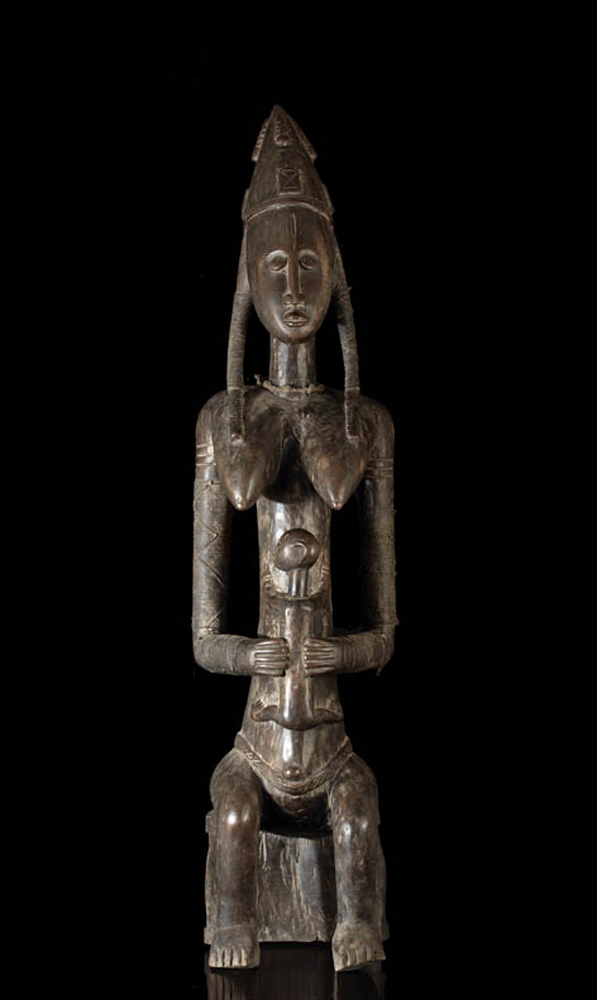 photo: tribalartforum.com/ identification no. P3225732.jpg |
 |