 |
 A Dogon maternity, in kneeing position, posted on a circular base, with a child close to the abdomen, the helmet-like head with a comblike coiffure at the back a openwokl-zig-zag-carving; thick, encrusted sacrification patina. 500 - 600,- Euro Dogon art presents a broad range of object types and styles. Among the human figures alone, some are well over life-size, while others are barely a few inches in height. Their repertoire of gestures is also varied, and includes figures standing, kneeling, sitting, or riding, raising one both arms in a variety of poses, and holding or wearing articles related to their gender, age, occupation, or social status. In style they vary from full-volumed, sensitively modeled sculptures that are highly descriptive in their details to works that are reduced to abstract geometric shapes stripped of all but the barest references to human anatomy. The surfaces of Dogon sculptures also suggest that they are treated in a variety of ways and may therefore have a range of meanings. While some works are smooth, oiled, and polished, others are thickly coated with sacrificial materials, sometimes to the point of obscuring their sculptural form. The range of styles and imagery seen in Dogon sculpture The Dogon place wood figures depicting men and women on many different kinds of altars, most of which are dedicated to ancestors, either real or mythical. Although figurative sculptures, called dege, are perhaps the most interesting types of Dogon art, varied in form and rich in imagery, they are also among the least well documented. Few altars have been described in detail or illustrated; those that have been scribed do not suggest any consistent pattern linking a particular style of figure or a specific posture or gesture with any one kind of altar. There is also little information with which to identify the persons represented by the figures. Each lineage possesses an altar containing figurative sculpture, which is dedicated to its founders and to subsequent members who have died, known as vageu. In recounting the myth of the first person to die in human form, Griaule tells of how a wooden sculpture representing the dead man was carved in order to provide a support for his soul and his vital force (nyama), which were released at his death. The figure wasplaced on the man's rooftop terrace along with a pottery bowl for libations. As death spread throughout the land, similar figures and bowls were placed on altars established by each lineage (Griaule, 1938: 171-72; Dieterlen, 1941: 18,22, 140; also Desplagnes, 1907:273). Photographs and drawings of vageu altars show rather simplified, even cylindrical, stick like figures leaning against the wall of the shrine (Dieterlen, 1941: pis. Vb and Vc, fig. 10). Along with the figures one also sees pottery bowls and small cups in which sacrificial liquids are offered to the Height: 83 cm |
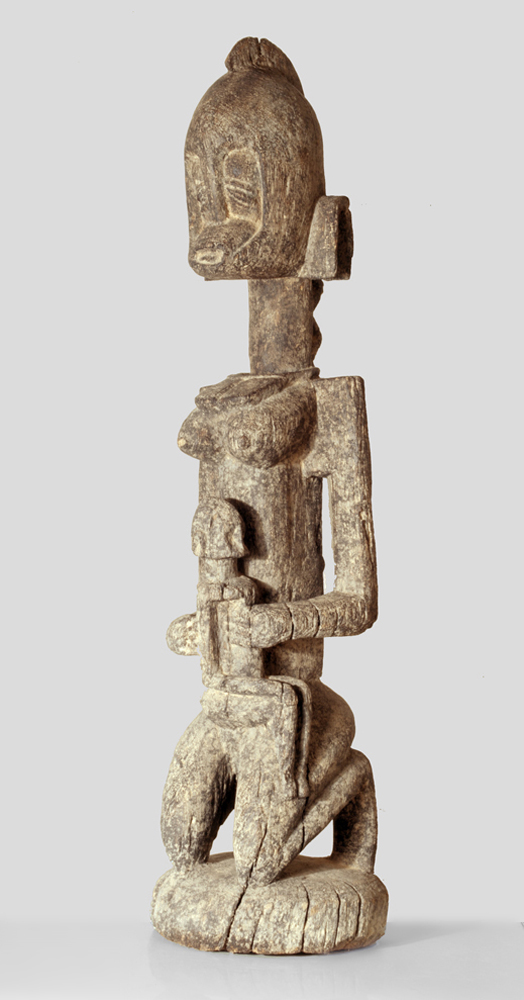 photo: tribalartforum.com/ identification no. P5068454.jpg |
 |