 |
 A Gwandusu Maternity of the Doila region, seated on a four leg stool, the torso with a protruding abdomen, prominent conical breasts beneath rounded shoulders, an elongated neck supporting the oval head with a cap- or crownlike coiffure, the hair dressed as three tresses falling over each shoulder and down to the back below the crested cap, extremly heavy hard wood with signs of high age dark, partly glossy patina, in particular at the child. When Bamana sculptures of dignified men and women first appeared in Western collections in the 1950sthe female figures were to as "Queens". They all came from the villages near Dioila and Bougouni in the region of the Baoule river before it joins the Bagoe to form the Bami, a tributary of the Niger river, but none arrived with any documentation (Kate Ezra, A Human Ideal in African Art. Bamana Figurative Sculpture (New York, 1986) Youssouf Tata Cissé ( Arts d´ Afrique, Paris 2000, p.15) told us, that the female figures represent the goddess of water and the primordial mother and that the groups were displayed every seven years in relevant ceremonies. In the years after 1950 till the beginning of the 1960s most of the Bamana Jo sculptures were stolen from the fields. It is more or less unknown how the cult of the Jo/Gwan society is practicing their knowledge nowdays. The last important fieldworks in the Bamana Region are done by Kate Ezra and Sarah Brett-Smith more than twenty years ago. A wellknown Parisian Tribal Art dealer told me, that the Jo statuettes, which were placed on the fields, and which have a special weathered patina, doesn´t exist anymore in the Bamana region. Only the statues, which were protected in the huts of the villages have "survived". They have a different patina, they are extremly rare but sometimes it is possible to find one of this authentic big Bamana-statues. sold Height: 115 cm |
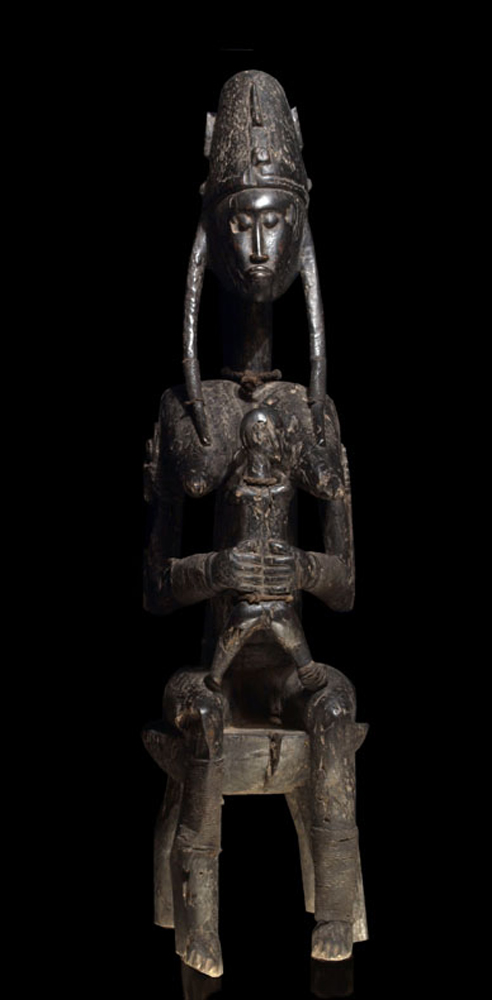 photo: tribalartforum.com/ identification no. P5285851.jpg |
 |