 |
 A seated Lobi sculpture, this sculpture is from the workshop around Dihunthe Palenfo, which was born in 1925 in Tambili, 6 kilometer southwest from Gaoua....s. Piet Meyer page 151: "Dort lebte er bis heute als Bauer und Bildhauer. Sein Vater, der Werkzeugschäfte schnitzte, versuchte dem Soh, der in jungen Jahren von sich aus bateba zu schnitzen begann, dise Tätifgkeit zu verbieten. Erst als Diunthe einen, wie er sagt, "sehr schönen bateba" an Europäer verkaufen konnte, lenkte der Vater ein. Seither hat Dihunthe auch Tanzstäbe (Katalog Nr. 203) und Schemel und Janusköpfe (Katalog Nr. 106) , Gabel und Löffel mit Rehköpfen geschnitzt und sowohl an Einheimische als auch an Händler und Touristen verkauft. Auch wenn er heute zu den zwei Bildhauern zählt, die im Lobiland am meisten Werke an Touristen verkaufen, versichert er, daß er auch schnitzen würde,wenn er damit kein Geld verdienen könnte. Masken soll er nach eigenen Angaben nicht geschnitzt haben. (alle Informationen nach Malichin 1981). Dihuntes Stil ist weicher und unbestimmter als der von Sikire (Kambire)..." Fortsetzung siehe Piet Meyer...Page 152 We don't know if Dihunthe or Doho, as he calls himself, showed his work to Sikire for criticism and evaluation. But we do count him as one of the Sikire school because he obviously adopted the repertoire and style of the great master of Gaoua. Dihunthe Palenfo, a Birifo, was born in 1925 in Tambili, a village lying about six kilometers southwest of Gaoua. There he still lives today as a farmer and sculptor. His father was carving tool shafts and he tried to prohibit his son from carving when he saw him trying to carve bateba in early years. His father only consented when Dihunthe sold a, as he says, "very beautiful bateba" to a European. Since then Dihunthe has also sold dancing staffs (catalog no. 203), stools with Janus heads (ill. 106), forks and spoons with deer heads to natives as well as traders and tourists. Even though today he is one of the two sculptors among the Lobi who sell most of their works to tourists, he assures us that he would also like carving if he could not make any money with it. According to the information he himself gave us, he has never carved any masks (all information from Malichin, 1981). Dihunthe's style is softer and more vague. His figures do not have the strength and vigorous precision which mark Sikire's style. Typical for example is that Dihunthe puts a hole in the ears of his statues like his master, but the pupils are only circled and not drilled out like Sikire's. This gives them a rather uncertain look.Piet Meyer...Page 152 sold Height: 69 cm |
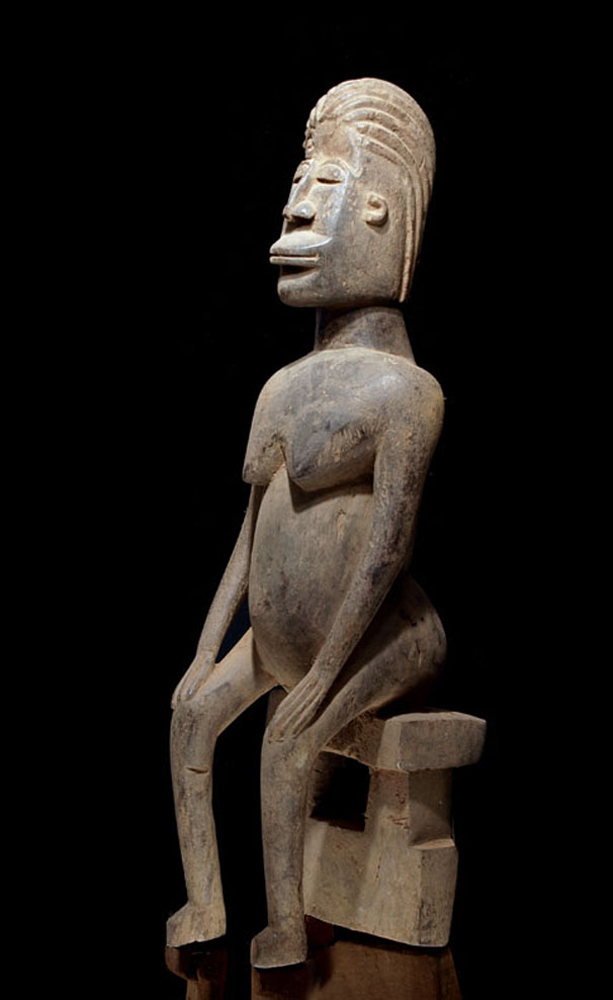 photo: tribalartforum.com/ identification no. P8288406.jpg |
 |