 |
A fragmentary Ekoi, Ejagham, puppet, arms and legs missing, wooden teeth, eyes partially covered with kaolin, remains of unidentifiable hair on chin; the patina consists of skin material and covers the surface.
The most remarkable feature of this sculpture are the tufted hairs at the backside of the head. They are strongly reminiscent of the human hair growth of the Africans. The skin is extremely thin and does not have the normal strength of animal skin (antelopes).
It is proved that the Ekoi were head-hunters*, and one suspects that the heads were once related to human skin in pre-colonial times. Even if it was not human skin, the scalp was imitated by the distibution of the human hair and is therefore an indication of the original leather covering of these sculptures, in which not animal- but human skin was used.
The head was collected in 2003 in Cameroon
Source: Wikipedia: Kopfjagd gab es auch bei den Ekoi (Westafrika),
Sandy Ojang Onor, The Ejagham nation in the Cross River Region of Nigeria, Kraft Books, Ibadan, 1994, S. 214 ISBN 978-2081-51-5. (d’après une thèse de l’Université de Calabar, 1993)
Wooden headdress in form of human head and covered with hide. There are notches down the center of forehead and on either side of face. Mouth is open and teeth are indicated. Around chin and extending and extending from ear to earis a short raffia beard. A braid hangs from the center of the beard. Eyes are inset with nail studs for pupils. Four braids are attached by wooden pegs to back of head. At base of neck is a rattan collar with one handle on either side. CONDITION: Skin covering is split: around base of skull extending to corner of mouth, also at back of neck, on left side and right side of head, on right temple, and on top of forehead. Raffia beard is flaking. Deep check inside left side of mouth.
English: Headdresses covered with leather are found only in the Cross River area of Cameroon. Some are fiercely stylized while others are startlingly realistic and may in fact have been portraits of individuals.The artist carves the form from a single piece of wood and then covers it with untanned antelope skin that has been soaked for several days, scraped, and smoothed. He stitches, pegs, and ties the skin into place and allows it to dry. Eyes, ears, scarification patterns, and hair are carved and covered separately, then pegged onto the finished piece. Finally, the piece is painted prior to performance.
Source: Brooklyn Museum
500 - 600,- Euro
Height: 24 cm
Weight: 500 g
|
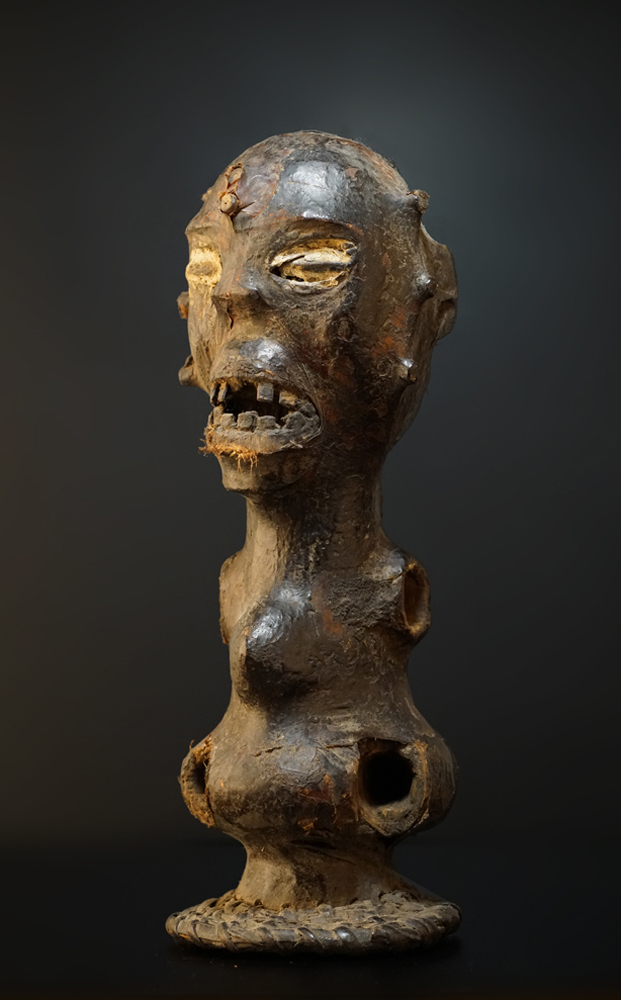 photo: tribalartforum.com/ identification no. DSC03647.jpg |
|

