|
 A male Baule sculpture seated on a stool, based on large, wedgeshaped feet, the legs wraped by fabric for ritual medicine, the small torso with arms and hands close to the hips, the large head with fine fascial features, the domed coiffure extremly accurately striated with a pigtail at the back; a shiny patina is verifying a high age and intensive ritual use. Collected 1991 near Abingoro, region of Bouaké, Ivory Coast 500 - 600,- Euro Height: 37 cm
Nguessan: If you had two girlfriends and one had a blolo bian and the other didn´t, wich would you take to marry? Baule Art Western Eyes, Susan Vogel, New Haven, Yale University Press 1997: 258
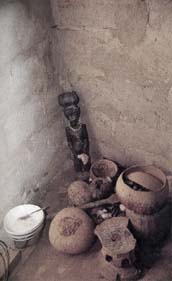
Photo Susan Vogel, Baule |
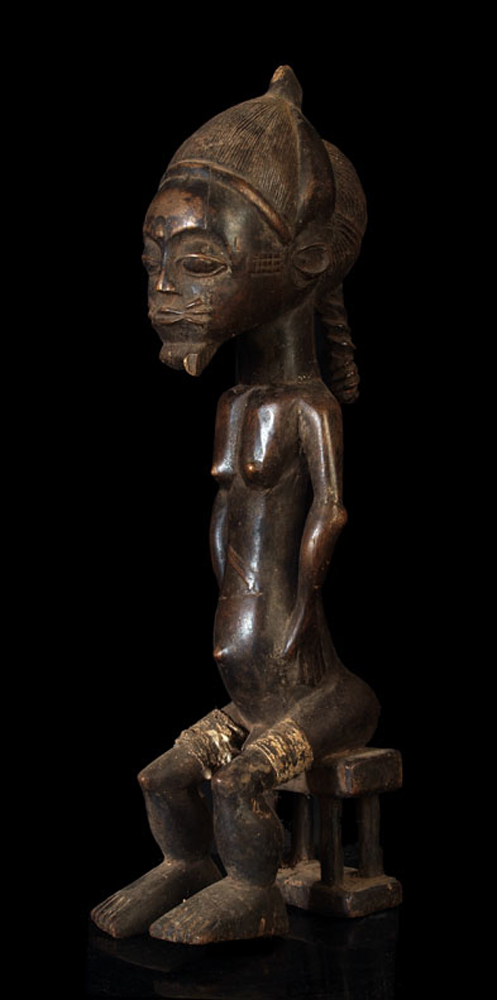 photo: tribalartforum.com/ identification no. P3128909.jpg |
 ...An other common utterance that one hears often in Baule villages ist the question: N ti a stran? "Am I not a person?" Most often , this question -cum-statement is hurled rhetorically as a challenge to someone who has totally failed to take into account anothers´s presence - to someone who has failed to acknowledge and formally recognize by a proper greeting the company, indeed, the existence of another human being.From the point of view of American society, where greetings are often minimal ("Hi"), or completly nonverbal (upraised eyebrows or a slight movement of the head), how can one begin to understand the complexities and underlying realities of a formal system of greetings such as that of the Baule? Among them there are greetings that differentiate men from women, old from young, that differ depending on time of day (morning, noon, afternoon, and evening), that recognize an activity that is under way (Nja mo o, "Men, thank you for the work"), that acknowledge someone´s return from the fields, that remember the previous encounter or exchange (Anuman Kwlao, "Thank you for - the good you did me - yesterday"), that acknowledge the extended falily, or that recognize that since the previsious encounter a child has been born or a relative has died. The exchange of greetings may sometimes seem formulaic and predictable to the outsider, but any failure to initiate the exchange is perceived as a most profound insult: "Am I not a person?" N ti a stran?" "The Self and the Other", Philip L. Ravenhill, Fowler Museum of Cultural History, University of California, Los Angeles, 1994:11 |