 |
A female Rhythmen Pounder - called Déblé - of slender, elongated form; touch patina in particular on the arms.
According of Gottschalk, who tryed to make a typolgy of the Senufo Déblé these exemplares would be probably submitted to the group of the kulibèlè and not the fonombèlè.
"While the former (fonombèlè), either due to lack of ability to finer work (the fonombèlè are the blacksmiths in the Senufo society) or deliberately used stylistic device, the clear and powerful forms, the contrasting horizontal and vertical as largely in the determination the proportions were created, the kulibèlè (the traditional carver) sought a soft flowing of body parts, as far as they did not take the style of their older brothers in their work or copied him more or less. Gottschalk Burkhard, "Senufo, Massa and the statues of poro" 2002: 43.
More realistic sounds the opinion of Glaze, who described the difficulties of a stylistic typology according of both ethnic groups after she did fieldwork around kufulo (region of Dikodougou)Glaze Anita J., "Art and Death in a Senufo Village", Indiana University Press, Bloomington 1981: 214.
sold
Height: 137 cm
Weight: 5,5 kg |
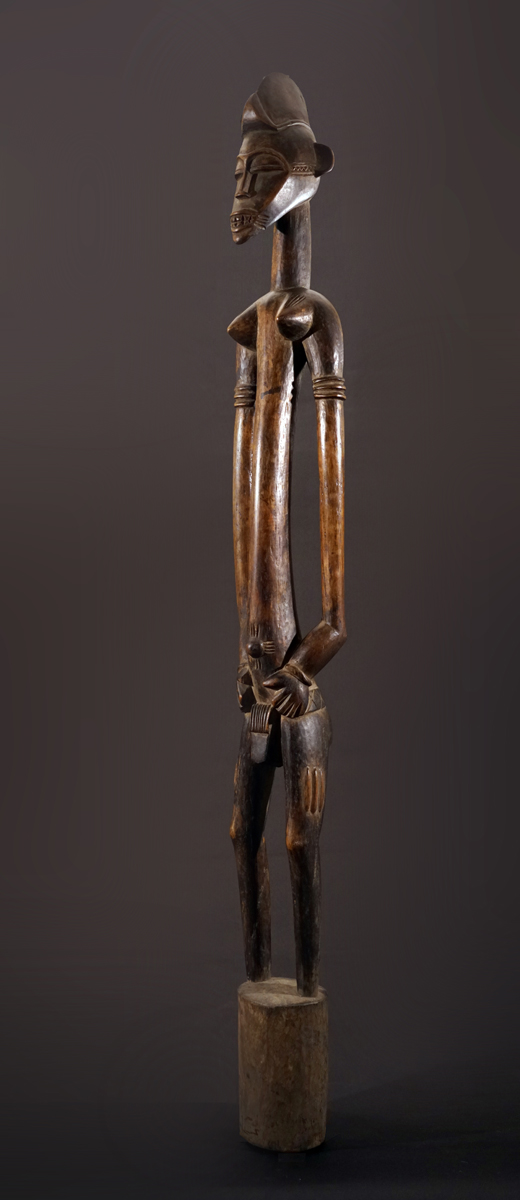 photo: tribalartforum.com/ identification no. DSC09118.jpg
 |
|

