 |
 An Ibedji couple, Yoruba, Nigeria. An Ere Ibeji couple, standing on oval bases, the arms touch the thighs, a helmet-like domed and blackened coiffure, prolongued expressive faces, bulged eyes, v-shaped dominant mouth and scarifications on the cheeks and forehead. Both wear bead chains of different materials and metal armlets; Brownish, partly shinny patina, traces of age and ritual use, little chip on his left ear, round hole in the base of her left leg. The Yoruba have one of the highest rates of twining in the world—it is estimated that out of every 1,000 births, 45-50 result in twins. Twins are revered among the Yoruba and come into this world with the protection of the orisha (deity) Shango who is evoked at the baby’s naming ceremony when he or she is a few months old. Due to the low birth weight of twins and the high infant mortality rates in Nigeria, many twin babies do not live long. If a baby dies during childbirth, in the months leading up to the naming ceremony, the parents will seek consultation with an Ifá diviner, a Babalawo. If the Babalawo ascertains a spiritual cause, he will help the parents find a carver to create an Ere ibeji figure. An Ere ibeji is a wooden carving of a male or female figure once used by the Yoruba. The figure is thought to be a focal point for the spiritual energy of the deceased twin who, according to Yoruba traditional thought, resides in the supernatural realm where he/she is cared for by a spiritual mother. Families, particularly grieving mothers, take comfort in the belief that a spiritual mother is caring for and guarding the departed child. The Ere ibeji is ritually washed, fed, clothed and carried in a cloth wrapper on the mother’s back as a real baby would be carried. The Ere ibeji might also be decorated with camwood powder, blue paint, beads, shells, and precious textiles. But despite the fact that this carving can serve as a receptacle for the spirit of the dead child, Ere ibeji figures do not look like children. These figures are carved to represent an ideal type within the Yoruba criteria of beauty and in the prime of life—neither a child nor an old person.“ Dr. Peri Klemm, "Ere Ibeji Figures (Yoruba peoples)," in Smarthistory, December 11, 2016, accessed October 28, 2019, https://smarthistory.org/ere-figures-yoruba-peoples/ Literature: Yoruba Customs and Beliefs Pertaining to Twins. Fernand Leroy, Taiwo Olaleye-Oruene, Gesina Koeppen-Schomerus and Elizabeth Bryan, Cambridge University Press, Volume 5, Issue 2 , 01 April 2002, p. 132ff. Ibeji Custom in Yorubaland. Timothy Mobolade, Volume 4, Issue 3, 1971. 500 - 600,- Euro Height: 29 cm / 29 cm |
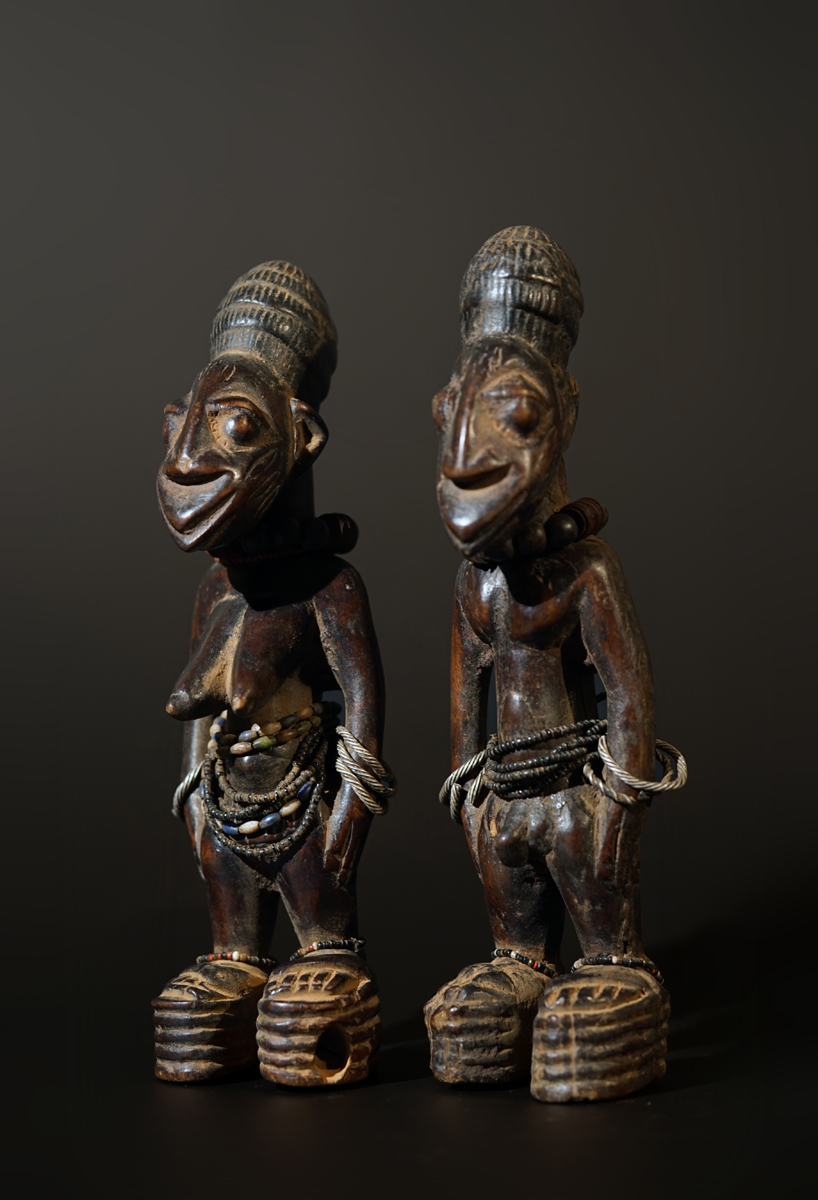 photo: tribalartforum.com/ identification no. BSC08508.jpg |
 |