 |
 A large Rhythtm-Pounder, called Déblé, of the Boundiali region, about 100 km westwards from Korhogo, greyish partly eroded surface, touch-patina on arms and neck, prominent "hands" resting on the abdomen. This type of sculptures - kown under the name deble - is one of the most famous works of West African Art. After the early 1960th, when the Massa-movement destroyed most of the important Senufo objects, only a few old, authentic Rhythm Pounder were saved and came to Western world. There are no sculptures from the time before 1960 existing anymore in the Senufo region of Ivory Coast, Burkina and Mali. But in some rural regions the old animistic tradition is still existing and also the funeral ceremonies, in which the deble rhythm pounder has it's ritual function. There are differences in the ceremonies in comparison to the years before 1960. In particular the holy groves, doesn´t exist anymore or arn´t known by Western ethnologists. It were secret fields, where the Senufo placed their ritual sculptures in the forest.These precious objects would probably be stolen immediately, because in nearly every village the Islamic influence becomes stronger and there are more people, who are against the old animistic tradion than decades before. Now these objects are protected in huts close to the village. Many of these Rythm Pounders were used like a hammer to open symbolically or more or less directly a hole in the thick adobe wall of a hut, to carry the dead body of a man - it´s a male sculpture - outside for funaral purpose. In the literature is only described the pounding on earth and the swinging over the ground, but not the described function, which is the reason for the desolat conditions of many déblé bases. This sculpture showes signs of use at the base but is in a rather good condition.W.J. Gottschalk Burkhard, "Senufo, Massa und die Statuen des poro", Glaze Anita J. , "Art and Death in a Senufo Village", Indiana University Press, Bloomington 1981, Goldwater Robert, "Senufo Sculpture from West Africa" - The Museum of Primitive Art New York, 1964. 1.600 - 2.000,- Euro Height: 135 cm |
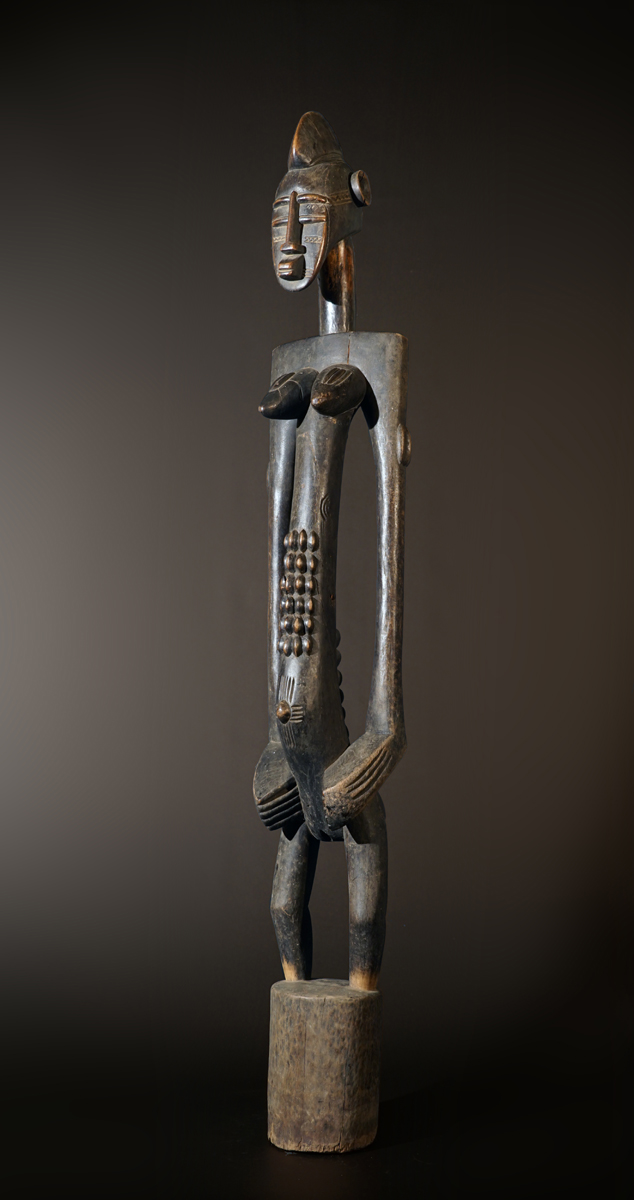 photo: tribalartforum.com/ identification no. CSC02455.jpg |
 |