 |
 This example of a Baule heddle pulley depicts a male head with a beard on the chin as the handle of the scroll, with finely carved facial features and keloid scars on the forehead and cheeks. The forehead is high and arched, the nose long and narrow. The serene effect of the face is enhanced by the small pursed lips that protrude from the apex of the straight jaw. The hairstyle is elaborate, with crosshatched steps. The pulley is decorated with bands of square, crosshatched and diamond patterns, brown patina.
The art of the Baule is not limited to the ritually bound. They also enjoy decorating utilitarian objects such as containers, sticks and today's strand reel. These objects are still used to weave the dense, colourful fabrics that are characteristic of Central West Africa, and the artisans hardly miss an opportunity to decorate these everyday objects with naturalistic or geometric motifs that make them works of art in their own right.
The Baule (or Baoule) are one of the largest and most powerful ethnic groups in West Africa. They subsist mainly by sedentary agriculture, and have thus achieved political and economic strength, which in turn has led to a strong ritual and artistic heritage. Their own creation story refers to an ancient migration (apparently from Ghana, fleeing the Asante) in which the queen was forced to sacrifice her son to cross a mighty river. She was so distraught by this that she could only say "baouli" ("the child is dead"), which gave rise to the name of the tribe.
sold
|
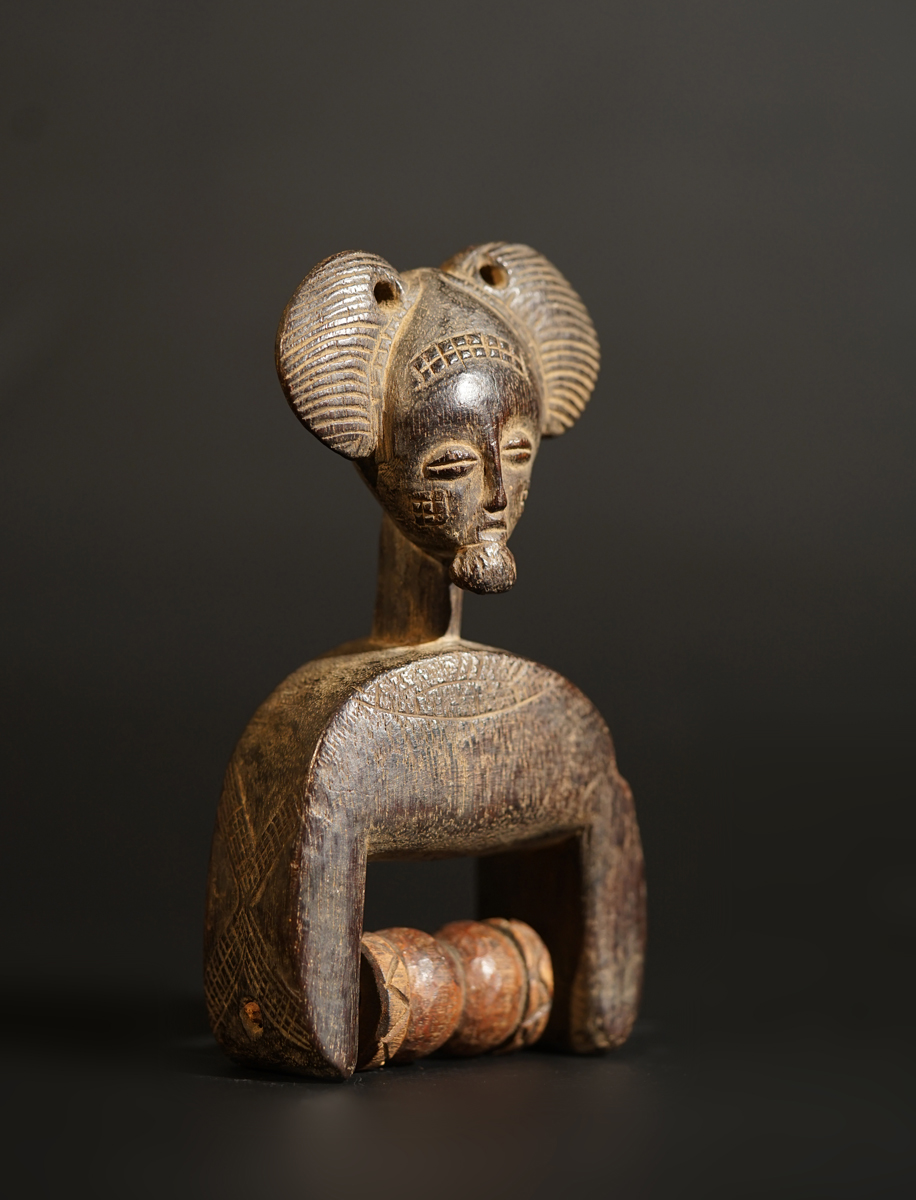 photo: wolfgang-jaenicke.com, for more information, please write us an e-mail with the identification number of the photo identification no. CSC03856.jpg |
|
