 |
 A rare Ere Ibeji couple that recalls the outstanding work of the Awori tribe from the Ado Odo area near Lagos standing on a square base with rounded corners. The elongated arms hang loosely beside the body, not touching it, with the hands at the height of the hips. The tips of the four fingers are bent upwards, the thumb points straight down. Both wear a kind of wraparound pants. The heads are oval, their whole bodyshape is elongued. Only their legs are short, but the feet are long again. Broad shoulders, the chest of the male figure is muscular, the breasts of the female figure are long and sagging. Elliptical eyes, bordered all around, pierced in the middle. The nose broad as the mouth, the lips are gently closed, giving the face a peaceful, almost cheerful expression. Both have three horizontal scarification marks on each cheek. The female figure has a high and elaborate hairstyle, the male figure wears his hair turban-like. Both have beads around their necks, the male figure wears four more strings around his hips; shiny dark brown patina, lighter areas on protruding body parts due to intensive use. The aluminium eyes are missing, which is a termination-sign of the ritual use The created ere ibeji must be cared for, fed, bathed and spoken to as if the child was still alive; this is to maintain the spiritual link between the physical, living child and the deceased twin. Ere ibeji figures are also expected to ward off evil from the household and to instead bring good fortune to the home. It is believed that mothers and family members that fail to respect and care for the ere ibeji provoke curses from the gods. (Chemeche, 2006) ‘IBEJI. THE CULT OF YORUBA TWINSs’ BY GEORGE CHEMECHE sold Height: 28 cm / 27 cm |
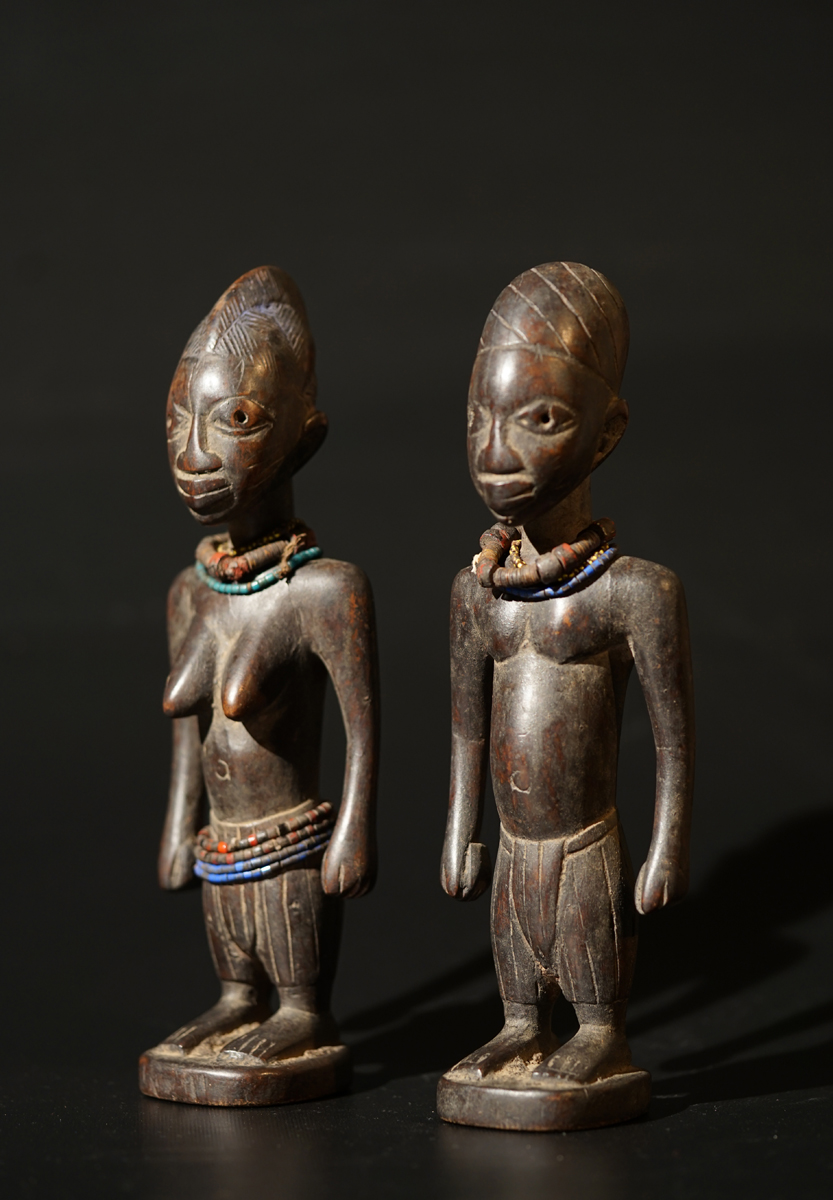 photo: wolfgang-jaenicke.com, for more information, please write us an e-mail with the identification number of the photo identification no. FSC00318.jpg |
 |