 |
 A Karan-wemba mask, Mossi nyonyosé, region de Kaya, village Boulsa, Burkina Faso, of stylized, hollowed oval form, a flat concave face with a vertical, jagged central ridge and triangular pierced eyes, surrounded by a carved jagged line along the rim, surmounted with a carved head of an antelope with curved, striated horns beneath a female figure of the Mossi representing a female ancestor (tribe or clan mother), the figure has bent legs ending up in prominent buttocks, a slender torso with a pointed navel and hanging, tapering breasts, rounded shoulders leading to an elongated slightly bent arms, displays typical tribal scarification marks on the face and the body, capped by a single crested coiffure, the mask pierced through at the rim for attachment; carved from a single piece, brown patina, traces of use and age, several cracks and old authentic repairs around the mask. "The female figure above the face of the mask represents a woman who has married, had children and grandchildren, and, whose, husband having died, has return to the home where she grew up. There she is regarded as a living ancestress, and when she dies her funeral is celebrated with a mask like this example." Lit.: Christopher D. Roy/Thomas G.B. Wheelock: Land of the Flying Masks. Art and Culture in Burkina Faso. The Thomas G. B. Wheelock Collection, Prestel 2007, p. 406; Stanley Museum Uiowa, Collections African-Art, Burkina Faso, Mossi Peoples; Tiziana & Gianni Baldizzone: Die Regenmacher. Maskenzauber und Stammesriten, Paris 2020; Till Förster: Skulptur in Westafrika. Masken und Figuren aus Burkina Faso. Sammlung "Burkina Faso" aus dem Morat-Institut für Kunst und Kunstwissenschaft, Freiburg im Breisgau, Bremen 1995. sold Height: 110 cm
|
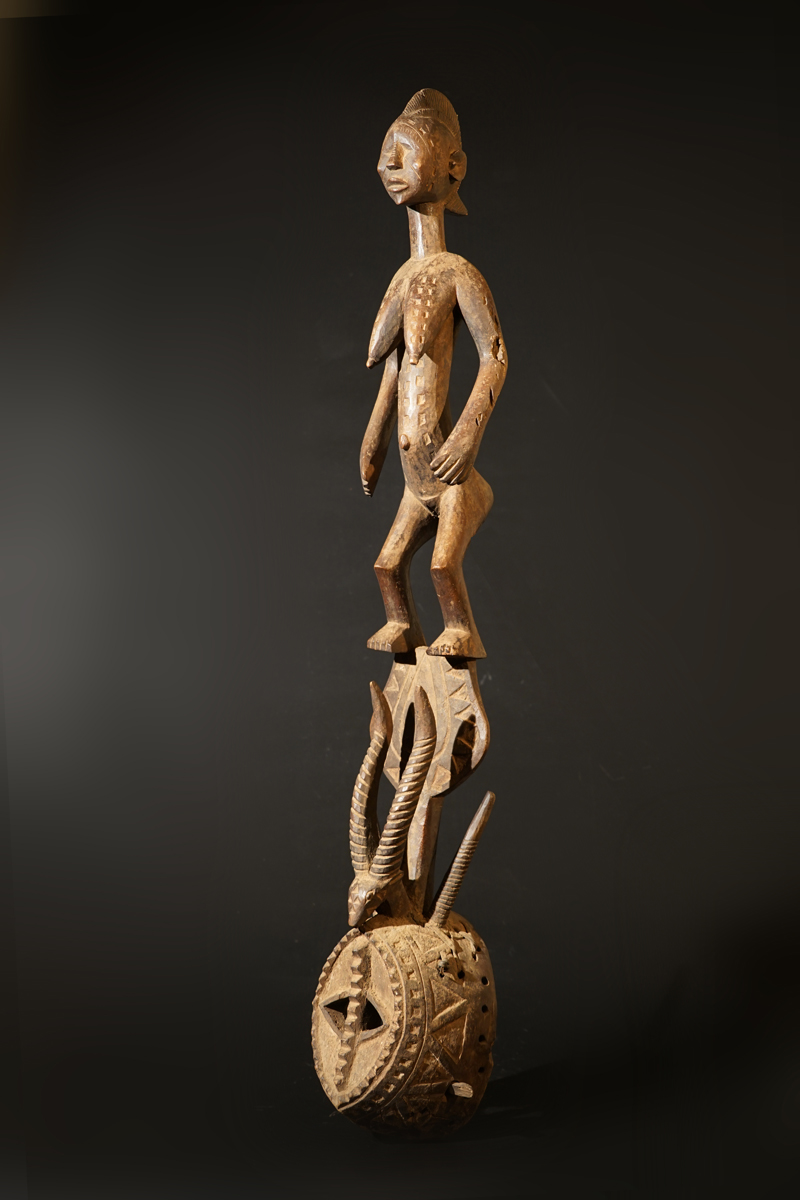 photo: tribalartforum.com/ identification no. FSB04482.jpg |
 |