|
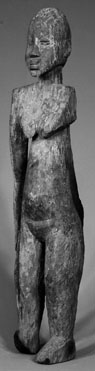
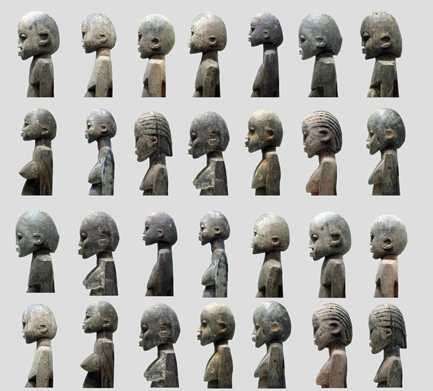
 A male Lobi sculpture of an almost unknown carver; standing on partly fragmentary feet, short, slightly bent legs under an elongated torso with characteristically angular chest and shoulders, the neck is short and the head ovoid, a rectangular, two-parted mouth under a saddle nose, framed by heavy lids and u-shaped ears; heavy, hard wood with greyish surface. We collected eight of these figures - probably from the same master - last year. 900 - 1.200,- Euro Height: 118 cm
A fragmentary sculpture of this
|
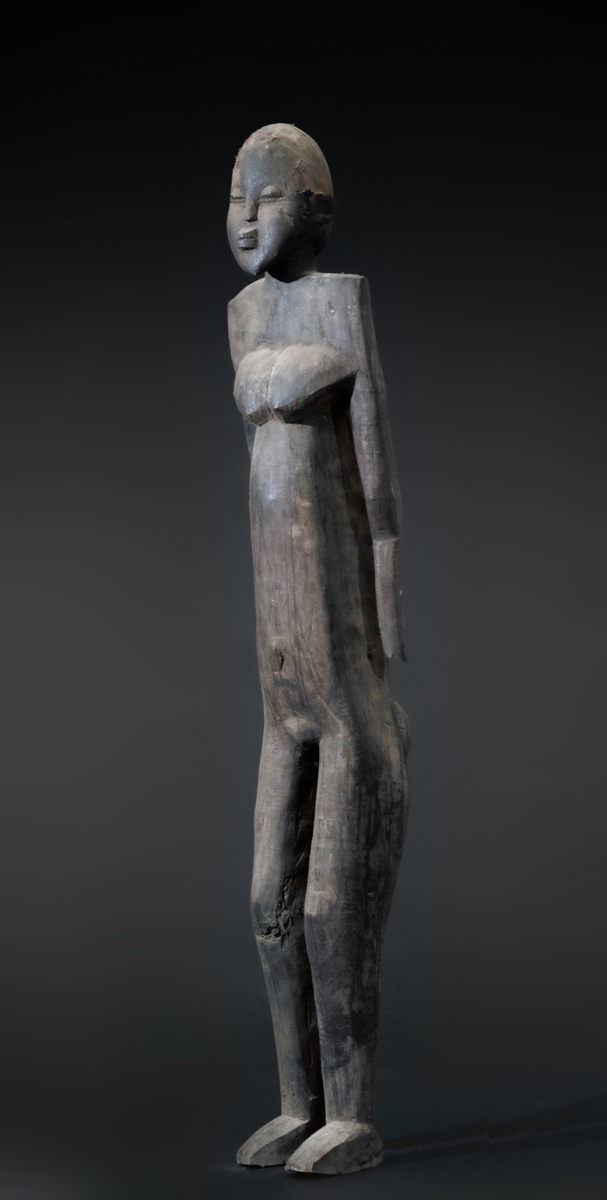 photo: wolfgang-jaenicke.com, for more information, please write us an e-mail with the identification number of the photo identification no. GSC00650.jpg |
 Lobi sculpture which, according to the fortune teller and sculptor Loupité Pale, born in 1938, was carved by his father Some Binlarè, who died in 1980 or 1981 near Gongonbili, southwest of Gaoua. The first sculptures of this carver and information about his living conditions were discovered in 2007. At that time we collected the first five sculptures and now another eleven statues. Five of the recently discovered statues were purchased directly from Loupité Pale. They are over one meter high and encrusted with blood sacrifices. Only one fragmentary sculpture of this carver was discovered by a Spanish art dealer a few months before we were able to collect this large number of sculptures. In March 2008 we were able to identify this carver and his living conditions through his family: "Now we have collected more than 70 pieces. It is strange that a carver of this quality was "discovered" so late, although some of these works of art - according to the encrusted patina and the condition of the wood - are probably highly aged. I suspect the reason: The style of this carver/workshop is not typical for the Lobi figures that are established in western collections. Recently a collector told me that he bought a copy of this carver years ago, but that it is now kept in the basement where he keeps his tribal art skeletons in his closet. Until now I have not seen this figure, probably it is a piece that is of lesser importance for Lobiart in the eyes of the collector, or it is even subsumed under the label "decadent style", a judgement I have heard more than once. Of course there are skeletons that are present in tribal collections. But for me, these "skeletons" perhaps have more to do with a certain kind of "provenance collecting" than with the artworks themselves.
On the basis of various sculptural characteristics, we try to find out which sculptures were made by Some Binlare, by his sons or other people around the master carver. |