|
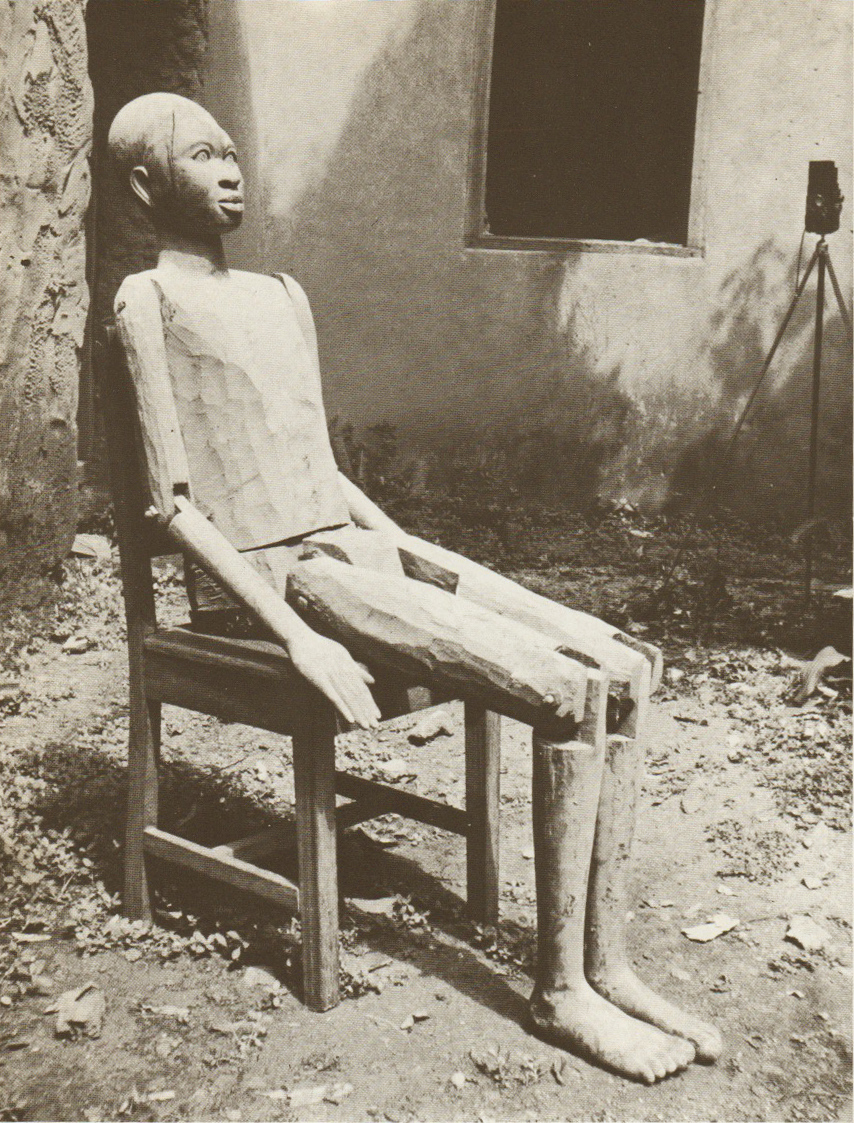
 Ife bronze head of a young Oba, characterized by the typical Ife style features: The corners of the upper eyelids hang over those of the lower ones. Around the lips is an accentuated edge, here especially around the upper lip. There are grooves around the neck. Very narrow vertical scarification marks cover the whole face; the bronze is heavily encrusted with various layers of reddish brown patina, in the hair area thick black patina, partly eroded, various defects on the nostrils, forehead and coiffure, extremely thin-walled, numerous dents, especially on the back of the head, four openings in the neck for nails, with which the head was probably originally attached to a wooden body. Similar bronze heads like the one of the Wunmonije Compound type are quite often found, which raises the question of their use. It is assumed that they were attached to a life-size wooden figure, possibly with movable limbs. These figures were dressed in the same way as the person depicted would have been. Perhaps the Oba was thus able to attend ceremonies and burials without being personally present. When a new Oba came into power perhaps only the bronze head was replaced. „ … vier Öffnungen, die für Nägel bestimmt waren, mit denen man den Kopf wahrscheinlich ursprünglich an einem hölzernen Rumpf befestigt hatte.“ Frank Willet, Ife, pl. 3. „Die lebensgroßen Bronzeköpfe aus Ife mögen für denselben Zweck an ähnlichen Körpern befestigt gewesen sein.“ Frank Willet, Ife, pl. 2. Lit.: Wolfgang Jaenicke, video, „Taking samples to analyze Ife and Benin Bronzes by Ralf Kotalla“. Frank Willet, Ife. Neue Entdeckungen der Archäologie, 2. Auflage 1975, Tafel 2 und 3. H. Meyerowitz and V. Meyerowitz, Bronzes and Terra-Cottas from Ile-Ife, The Burlington Magazine for Connoisseurs (Oct., 1939). Arts de L'Afrique Noire, Jean Laude, translated by Jean Decock, University of California Press Berkeley, 1966, 1. Paperback-Edition 1973.
More infos on request Height: 32 cm |
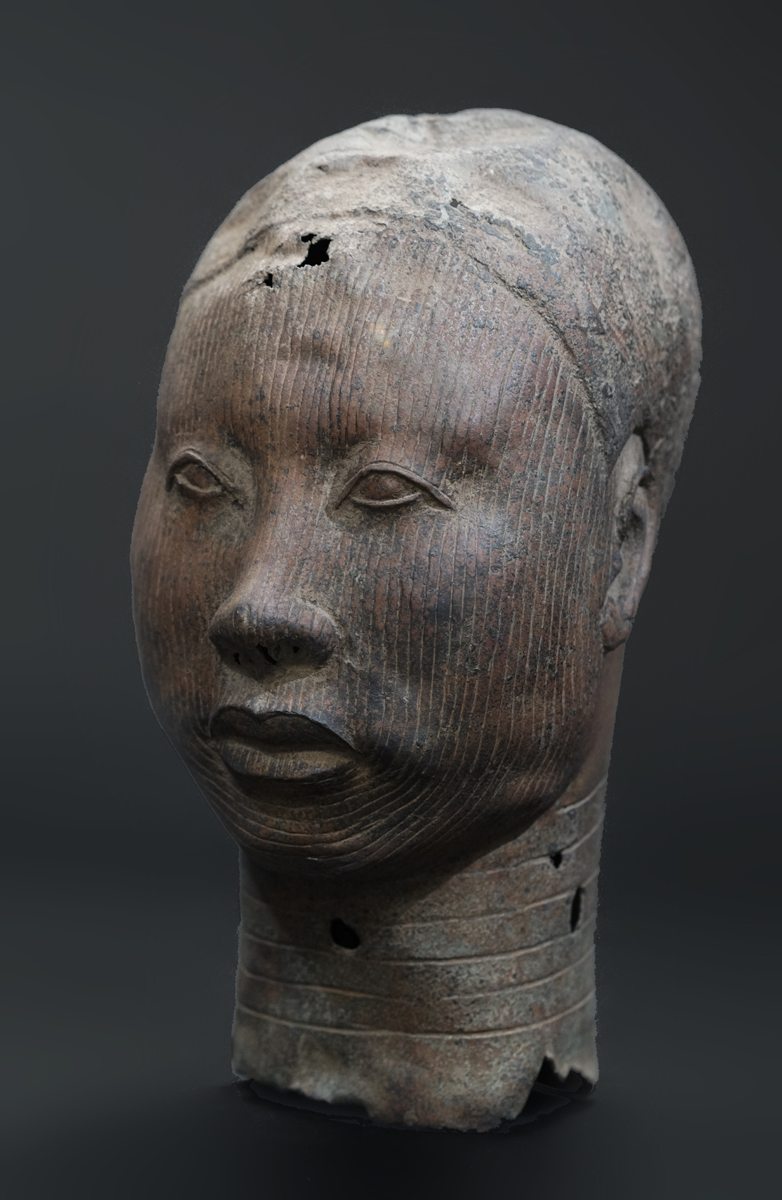 photo: wolfgang-jaenicke.com, for more information, please write us an e-mail with the identification number of the photo identification no. GSC00728.jpg |
 According to the 1970 UNESCO Convention, the right to repatriation expires one year after the authorities of a country of origin have learned where and with whom a cultural asset is located. The Wolfgang Jaenicke Gallery therefore always provided information about each newly imported object. Especially about the bronzes from Nigeria shown on this page, which are published on the Internet and are accessible to everyone. Organizations that deal with restitution matters, as well as free art historians employed by the state, such as restitution experts such as Benedicte Savoy, are regularly informed about objects in the Wolfgang Jaenicke Gallery. Every buyer of an art object, regardless of whether it is made of wood, clay or bronze, must be aware that, from a European legal perspective, traditional African art usually came with inadequate export documents from the respective African country of origin. The Wolfgang Jaenicke Gallery, Berlin, tries to do justice to this dilemma by acting with the greatest possible transparency. The export policy of African states is problematic for art-historical research, because African and European traders usually work under cover due to diffuse legal situations and important information that was passed on from trade to research before 1970 tends to be lost. In the event of any uncertainty, please contact the managing director of Jaenicke-Njoya GmbH - Wolfgang Jaenicke. It is in the gallery's interest to clarify any questionable situation with all available means. |