 |
 A large seated Nok sculpture, both knees bent while squatting, the left knee and foot broken off, as well as the left arm, the right arm resting gently on the right knee, the left arm probably had an identical position, (see: Bernard de Gruenne, The Birth of Art in Africa.Nok Statuary in Nigeria, 1999, 119, III/b), a voluminous ruff/collar, the head elongated, an elaborate coiffure with incorporated tassels; inside the core filled with earth, without base. Lit.: Schaedler, Erde und Erz, Panterra 1997, S 195 ff., Valées du Niger, Musées nationaux, Paris 1993, 393 ff. Bernard de Grunne, the birth of Art in Africa,1999 .Peter Breunig (ed.), Nok, African Sculpture in Archeological Context, 2014. More info on request. Height: 69 cm |
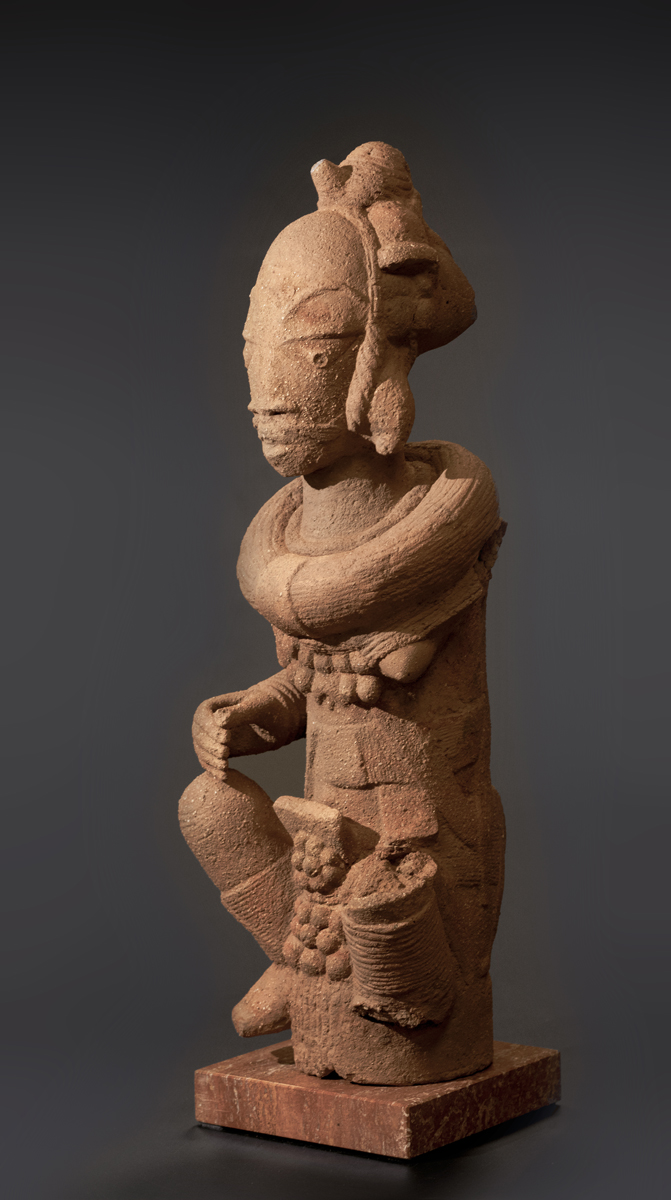 photo: wolfgang-jaenicke.com, for more information, please write us an e-mail with the identification number of the photo identification no. GSC04382.jpg |
 According to the UNESCO Convention of 1970, a claim for repatriation expires one year after the authorities of a country of origin have learned where and with whom a cultural object is located. Wolfgang Jaenicke Gallery therefore always informs about every newly imported object. Especially about the bronzes from Nigeria shown on this page, which are published in the internet and are accessible to everyone. Organizations dealing with restitution issues, but also freelance art historians employed by the state, such as restitution experts like Benedicte Savoy, are regularly informed about objects in the Galerie Wolfgang Jaenicke. Every buyer of an art object, regardless whether it is made of wood, terra-cotta or bronze, must be aware that from a European legal perspective, traditional African art usually came from the respective African country of origin with insufficient export documents. Galerie Wolfgang Jaenicke, Berlin, tries to do justice to this dilemma by acting with the greatest possible transparency. The export policy of African states is problematic for art historical research, since African and European dealers usually work covertly due to diffuse legal situations and important information that was passed on from trade to science before 1970 tends to be lost. In case of uncertainties, please contact the managing director of Jaenicke-Njoya GmbH, Wolfgang Jaenicke. It is in the interest of the gallery to clarify any questionable situation with all available means. |