 |
A Senoufo Kpelié mask, the oval face with scarifications around the mouth and the cheeks, a domed forehead beneath two bent horns and a mask-like figure in the middle, pierced through at the rim for attachments; a fine dark patina, significant traces of use and age, collected in the vicinity of Korhogo, Ivory Coast.
Kpelie-masks were worn during funeral sessions by the Poro society. These funeral festivities are marked by masquerades, which symbolically expresses the fundamental dualities in Senufo thought: male/female, body/spirit, life/death. In general this type of mask is symbolizing an ideal woman. The unique features which characterize the Kpelié mask include elongated flanges radiating from the bottom part of the mask, which are a reference to the hornbill bird. The horns on the mask refer to the ram, an important sacrificial animal. The nodules on the forehead represent palm nuts as well as vulvas; they are flanked by cicatrization marks that symbolize the twins born to the primordial couple. The significance of a double face is not known, but double- and single-faced Kpelié masks are used interchangeably.
Lit.: Holas, B., L´Art Sacré Sénoufo, Limoges, 1978, Facing the Mask, Herreman, Frank, Museum for African Art. s. publ.
1.200 - 1.600,- Euro
Height: 39 cm
Weight: 739 g |
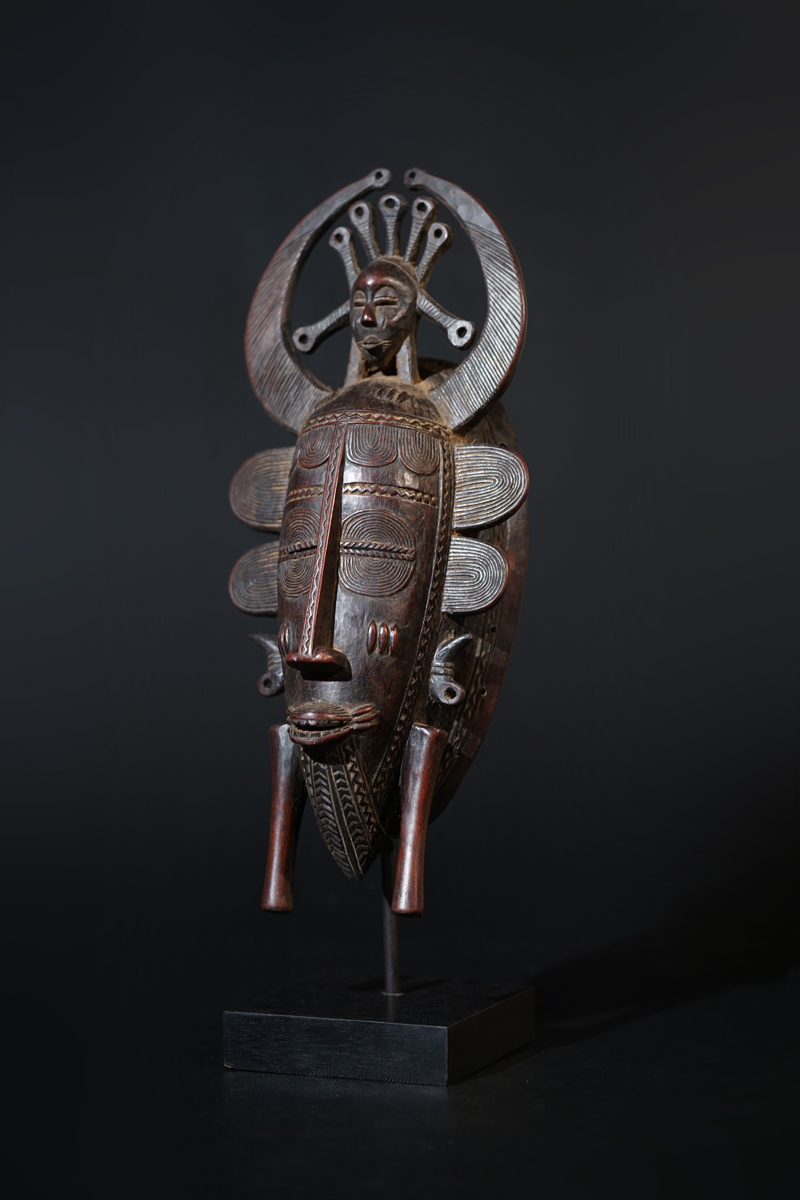 photo: wolfgang-jaenicke.com, for more information, please write us an e-mail with the identification number of the photo identification no. FXP04853.jpg
 |
|

