 |
 A fragmentary Bamana Gwandusu sculpture, seated on a four leg stool, one arm is broken, the other is framentary, from the two children of this maternity one is lost, the long, curved pigtails are fragmentary as well; the sculpture, which is carved from heavy, hard lenke-wood, shows remnants of oxidised karité, but is in a weathered condition, which could be a sign for a longlasting outside position on the fields, where many Gwandusu sculptureswere posted before the Goldwater Bamana publication at the beginning of the 1960th was edited. In traditional African societies, a childless marriage is a grave problem that has serious repercussions on the relationships between wife, husband, and in-laws and on the village as a whole. Further, childlessness seems to be the wife's problem to resolve. According to Kate Ezra (1986), women with fertility and child-bearing problems in Bamana society affiliate with Gwan, an association that is especially concerned with such problems. Women who avail themselves of its ministrations and who succeed in bearing children make extra sacrifices to Gwan, dedicate their children to it, and name them after the sculptures associated with the association. When Bamana sculptures of dignified men and women first appeared in Western collections in the 1950sthe female figures were to as "Queens". They all came from the villages near Dioila and Bougouni in the region of the Baoule river before it joins the Bagoe to form the Bami, a tributary of the Niger river, but none arrived with any documentation (Kate Ezra, A Human Ideal in African Art. Bamana Figurative Sculpture (New York, 1986) Youssouf Tata Cissé ( Arts d´ Afrique, Paris 2000, p.15) told us, that the female figures represent the goddess of water and the primordial mother and that the groups were displayed every seven years in relevant ceremonies. In the years after 1950 till the beginning of the 1960s most of the Bamana Jo sculptures were stolen from the fields. It is more or less unknown how the cult of the Jo/Gwan society is practicing their knowledge nowdays. The last important fieldworks in the Bamana Region are done by Kate Ezra and Sarah Brett-Smith more than twenty years ago. A wellknown Parisian Tribal Art dealer told me, that the Jo statuettes, which were placed on the fields, and which have a special weathered patina, doesn´t exist anymore in the Bamana region. Only the statues, which were protected in the huts of the villages have "survived". They have a different patina, they are extremly rare but sometimes it is possible to find one of this authentic big Bamana-statues.WJ So don´t forget where this stuff is coming from (deutsch),www. wolfgan-jaenicke.blogspot.com The Bamana hairdress as an expression of social ranking sold Height: 131 cm |
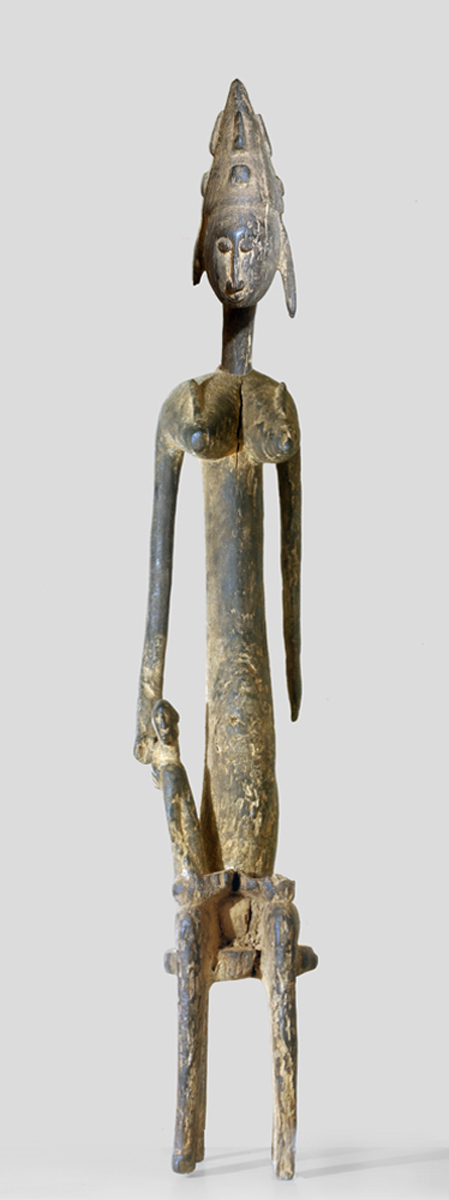 photo: wolfgang-jaenicke.com, for more information, please write us an e-mail with the identification number of the photo identification no. PB151542.jpg |
 |