Previous
Home

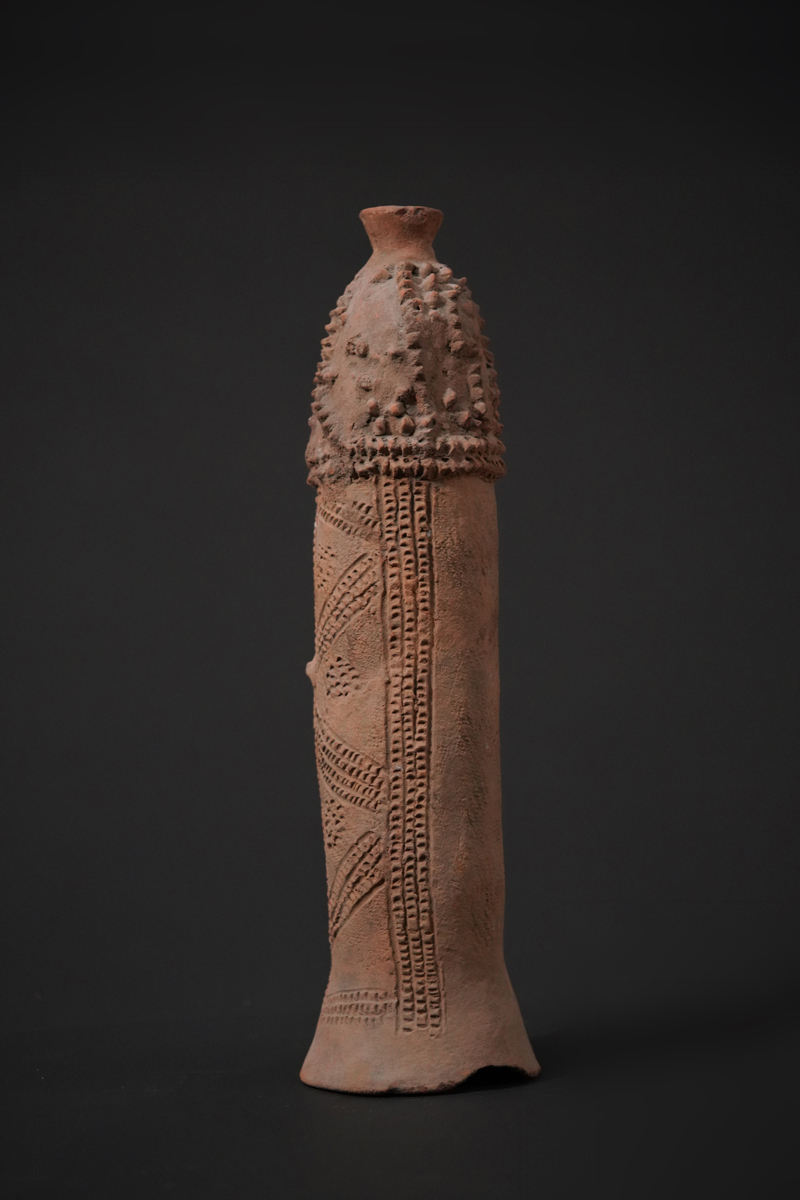
A Bura phallomorphic terracotta urn, Niger, the lower part decorated with geometric incisions, the upper part has irregular knobs; a chipped spot at the bottom rim.

The Bura are a mysterious Nigerian/Malian people about whom almost nothing is known. They seem to have emerged in the first half of the first millennium, but the only archaeologically researched site (Nyamey) dates from the 14th to 16th centuries. They exist at about the same time as the Djenne Kingdom, the Koma, the Teneku and a satellite culture known as the Inland Niger Delta, which is probably related to them. In stylistic comparison, the Bura share certain characteristics with these groups; visible in the ceramic and stone sculptures.

The Bura appear to have been sedentary farmers who buried their dead in tall, conical urns, sometimes topped by small figures. The best-known art objects are extremely reduced anthropomorphic stone statues and phallic objects, whose meaning is still unclear. One may - as with numerous other peoples within and outside Africa - most likely associate the figures with strongly pronounced sexual features with fertility, as well as all objects modelled in the shape of a phallus or with pronounced labia. The arrangement of the decorations on some ceramic pieces (especially the phallic ones) might suggest that they were meant to be viewed from one angle only.

Lit.: Karl-Ferdinand Schaedler, Erde und Erz. 2500 Jahre Afrikanische Kunst aus Terrakotta und Metall, 1979. Michelle Gilbert, Bura Funerary Urns: Niger Terracottas: An Interpretive Limbo? African Arts (2020) 53 (1): 66–75.

400 - 500,- Euro

Height: 54 cm
Weight: 4,1 kg


BBC16706
photo: wolfgang-jaenicke.com, for more information, please write us an e-mail with the identification number of the photo identification no. BBC16706.jpg
Next