|
 A fragmentary Adamawa horseman, Nigeria, the hands touching the reins of the horse, occre to reddish surface. The objects take on a variety of zoomorphic and anthropomorphic themes and forms, and show considerable technical mastery in their execution. The sculptures are not archeological but were used since the 18th to 19th century for ritual/healing purpose. Several cracks and small missing pieces, but in general of good condition for terracotta sculptures of this region. " Equestrian figures have a double function in the performing arts of West Africa. On one hand, they are symbols for a good journey, because the horse had traveled withe the Europeans a long way to Africa , and on the other hand, they were made as protective figures against the former colonial masters, who came to the villages on horseback to collect taxes, which caused fear and terror among the villagers." WJ The Adamawa live in the north-east of Nigeria close to the border to Cameroon and have a striking expression of their facial features, which (with their open mouths) resemble those of Cham or Mwana. They are usually vessels for ritual medicine. Nevertheless, the figures differ significantly from those of the Cham or Mwa, which, unlike the Adamawa, have elongated lower lips. The Adamawa are hardly described in the literature, although they have great artistic skill in the design of their figurative healing vessels. This is presumably the only known rider figure, with whom you can not say what kind of animal it is. It could be a horse or a ram on which the rider is sitting. The representation of mounts is mostly about figures that were made before a long, arduous journey in order to successfully reach their destination. The model was taken from the horses of the Western colonialists, who also came from far away and had traveled a long way. Thus, animals on which one could ride became a symbol for a successful journey, to which magical powers were assigned and which were also sacrificed in some cases.
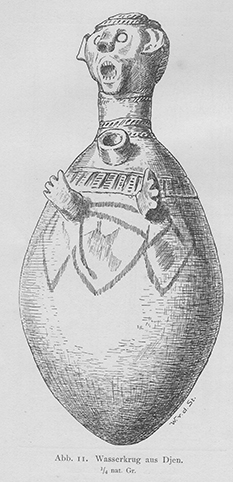
Dr. Sigfried Passarge, Adamaua, Bericht über die Expedition des Deutschen Kamerun-Komitees, 1893/94, Belin 1895, s. 20 Adamawa terracotta sculpture The Adamawa province is located in northeastern Nigeria; the "Adamawa" terracottas are similar to those of the Bata and it can be assumed that they have the same cultural value: the anthropomorphic terracottas were the main support of the cult reserved by the Bata for the ancestors of their village chief; only the village chief and chief-maker (njubare) could own and commission them to women specialized in this art. Kept in a public building, they were used to propitiate crops and fishing; due to Islamization these cults were no longer practiced in the late fifties, cm. 38 h., Nigeria, early 20th century. Lit.: Schaedler, Erde und Erz, 1979, Longuda, Cham, Mwana 800 - 1.000,- Euro Height: 46 cm |
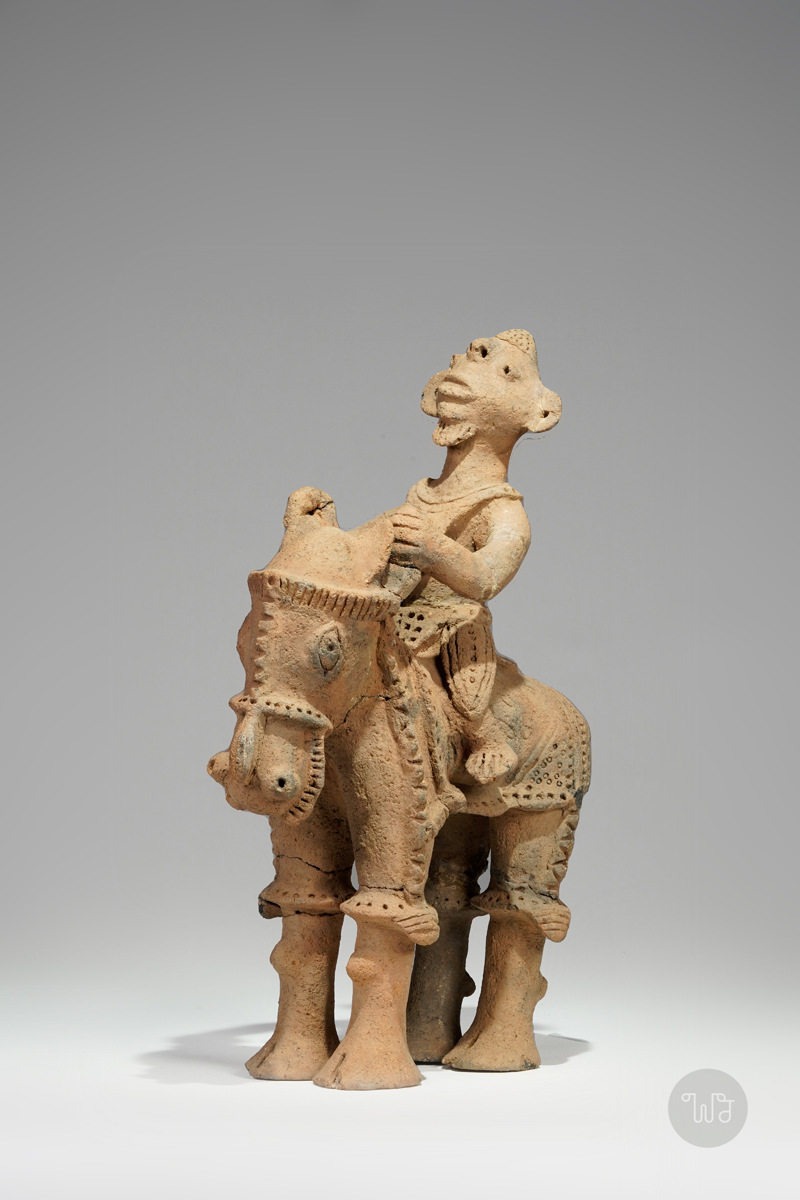 photo: wolfgang-jaenicke.com, for more information, please write us an e-mail with the identification number of the photo identification no. _BBD041671.jpg |
 |