 A fragmentary seated bronze in the style of Tada, remarkably complex casting, depicts a seating figure, carrying a snake in the right hand and an object in the left, in an upright position, large rounded head with expressive features, an awake look in the eyes; oxidation holes in the neck and waist, a large hole in the center of the head where The fragmentary state of this figure is not explained. However, reference is made to a tradition that continues to this day." Every Friday it was taken to the Niger River to be ritually bathed with sand and water, accompanied by chants in Yoruba, a language associated with the city of Ife". The age of this figure is given with "late 13th/14th century". As is so often the case, the source and way of analysis is not mentioned.What is certain, however, is that this figure is no longer in its original condition. Like most museum exemplares, this figure was probably "cleaned" in the 1960s and 1970s. The original state of this figure, which could provide important information for further researches, was probably destroyed by inexperienced scientists at that time. "A group of nine bronze sculptures had for a long time been known to exist in two villages on the River Niger, at Tada and on Jebba Island. The bronzes are referred to as the Tsoede bronzes because oral tradition says that the founder of the Nupe Kingdom, King Tsoede, who escaped from Idah in a bronze canoe, distributed these bronzes on his way to founding the present Nupe Kingdom which is believed to date from the sixteenth century. It contentends a seated figure shown here, perhaps the most important naturalistic sculpture in Black Africa. The Tada seated figure seems, in its naturalism and rigidity, to belong to the Ife school. The two more recent looking figures from Tada have a combination of Yoruba and Benin traits while the ostriches and the elephant belong to a yet unidentified school. All the figures were still being used in rituals, in secondary contexts, in the places where they were located until they were temporarily taken into safety in the National Museum in Lagos." As is so often the case, the source/analysis of which is not mentioned. sold Height: 35 cm |
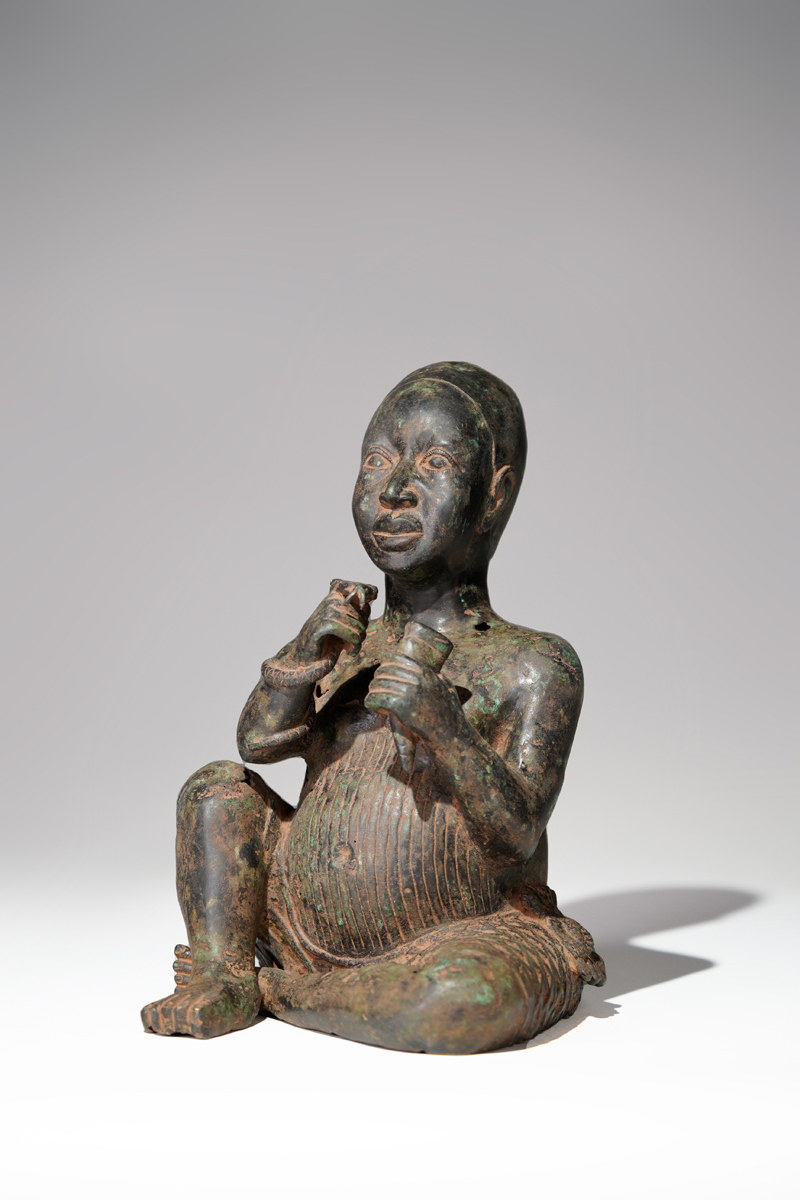 photo: wolfgang-jaenicke.com, for more information, please write us an e-mail with the identification number of the photo identification no. _XBD010068.jpg |
 |