 |
A very rare and beautiful Ibeji couple from Benin, unusually childlike proportions, finely elaborated hairstyles, the hair dyed black; heavy and very light-coloured wood, the faces somewhat worn due to frequent touching.
The twins, called Hoho in Benin, Ibeji in Nigeria and Venanvi in Togo and the Volta region in Ghana, are considered sacred. The names given to the twins vary according to language, tradition, region and culture.
Among the Yoruba, a large ethnic group in Africa represented in Nigeria and Benin, the firstborn is called Taiyé, which literally means "the first to taste the world". The second-born, called Kehindé, comes after the first-born. Kehindé sends Tayie out as a scout to find out if life is worth living according to African tradition. Among the Baatonou people of Benin, twins are given the baptismal name Séni if they are boys, and Assana if they are girls.
The birth of twins is considered a happy event. At the birth, family members go to the bokônon or fortune teller and perform some rituals. When twins die in Benin, they are carved into sacred wooden dolls to replace them in the lives of those left behind.
The rituals for those Ibeji include washing, dressing, feeding and protecting the dolls. A festival is celebrated in their honour every year in Benin from mid-September to mid-October.
Lit.: Stoll, Ibeji, 1980. Jantzen, Bartsch, Doppel-Leben. Ibeji, 1993. Polo, David, Catalogue of the Ibeji, 2001. Polo, Enzyklopädie, 2008.
sold
Height: 21 cm / 22 cm
Weight: 200 g / 160 g |
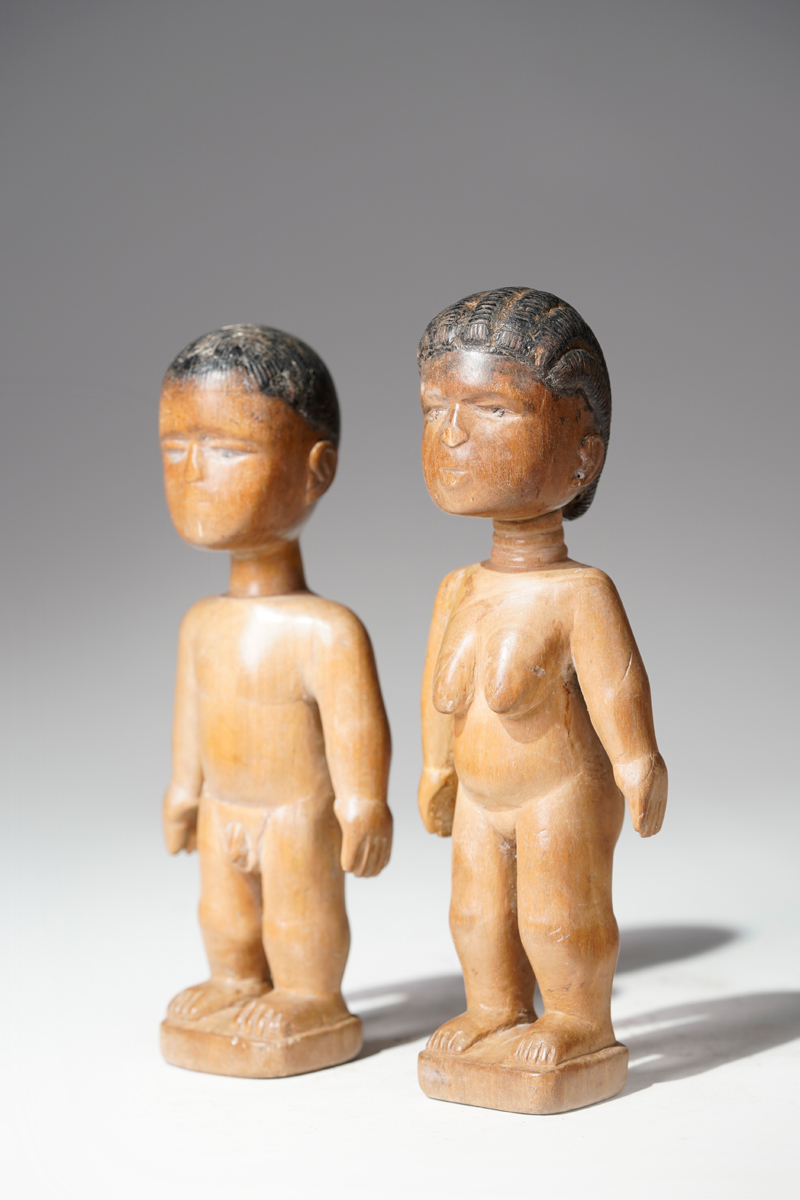 photo: wolfgang-jaenicke.com, for more information, please write us an e-mail with the identification number of the photo identification no. _XBD100860.jpg
 |
|

