|
A Bakongo/Vili fetish sculpture, Zaire, in shape of a Janus-head crocodile, the eyes with painted glass-inlays, the snout with animal teeth, numerous metal pieces and handforged nails all over the torso of the animal, which were used in the time of colonisation in the former Kongo, on the back a small container for fetish material under a glass-inlay.
Magic is practiced throughout Black Africa, but there are distinctions to be made among those who participate in it. The witch doctor is seen as someone who undertakes on his own account a personal communication with evil powers -suspected of casting spells, he is feared and rejected as the most dangerous individual in the tribe. The accusation of sorcery is a serious one.
The diviner, or fetishist, operates in principle for the good of all. His help is sought in times of need, for he is seen as the mediator between members of the tribe and all the powers of darkness. For this reason he also acts as healer.
The various attempts to influence the fearsome powers of the supernatural through the mediation of statues or fetishes have acquired particular intensity in the regions round the mouth of the River Congo, home of the Kongo, Yombe and Vili tribes, and this is also the case in the east of Zaire,
among the Songye.
Magical objects were for many years little known in Europe, as Christian missionaries working in Africa tracked them down and had them burnt. Certain statues which were brought back to Europe by religious men, allegedly for documentation, were kept in secret and could not be studied. They were much feared for they seemed, even to European eyes, to have real power, a belief almost universally accepted in 17th-century Europe. Olfert Dapper was the first to look dispassionately at these "fetish" objects and to dare to describe them.
Recent work has led to a better understanding. They are wooden carvings, either anthropomorphic or zoomorphic, which are covered with a variety of objects such as nails or metal blades. The cavities in their back or stomach contain "medicines" - grains, hairs, teeth or fingernails - which are held together with various binding materials. Pieces of fabric, feathers or lumps of clay are sometimes present. Finally, bits of mirror, shiny metal or shells are used to close the cavities or to mark the eyes.
Generally grouped as Nkisi, they were the result of the combined work of two men, the carver and the fetishist. The former created the shape, but without the latter (the Nganga) the figure had no meaning. It was the Nganga who filled it with magic substances and completed the rituals which gave it supernatural powers. Source: Rand African Art.
sold
Height: 26 cm
Length: 65 cm
Weight: 5,4 kg |
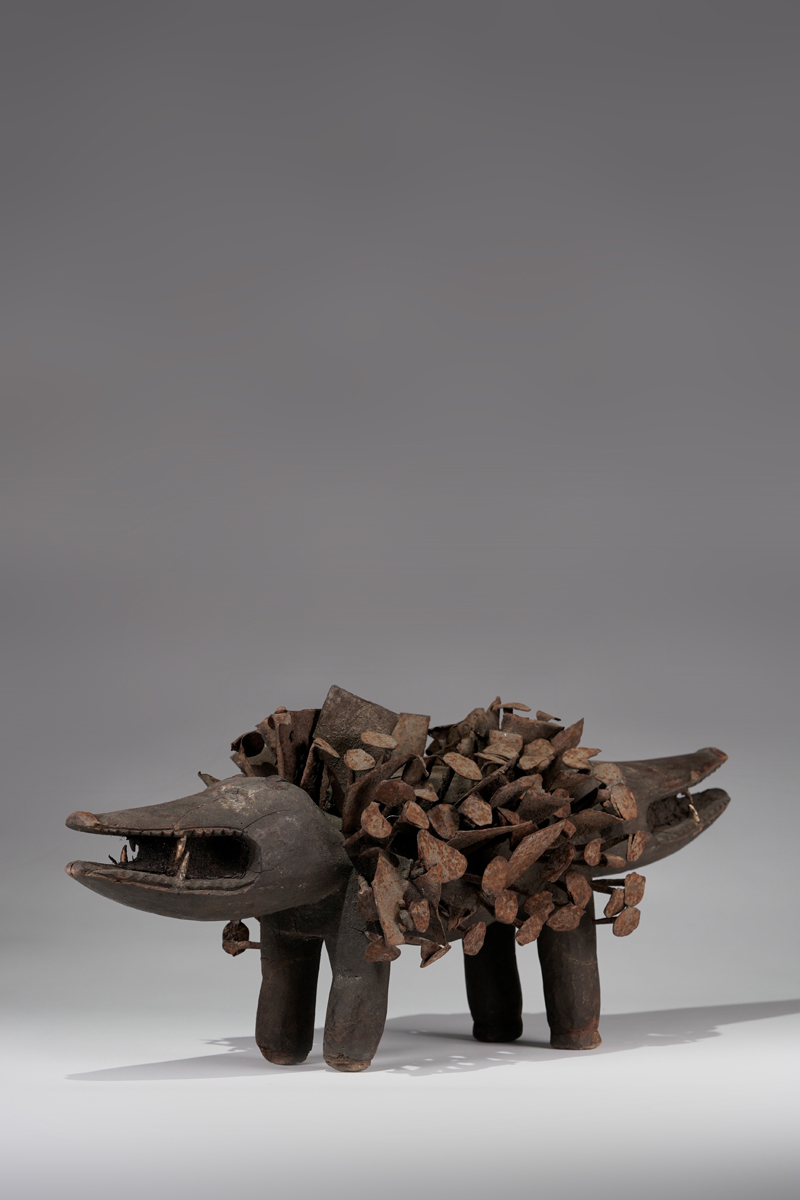 photo: wolfgang-jaenicke.com, for more information, please write us an e-mail with the identification number of the photo identification no. _XBD100934.jpg
 |
|

