 |
 A fragment of a Dogon door-lock with a male and a female figure seated on it, their square shaped bodies compose this look with a geometrical style; fine, aged touch patina, incl. stand. "Paradoxically, the art of [the Dogon people...] is closer in spirit to modern sculpture than almost anything else in Africa. The plasticity of the greatest Dogon carvings must be compared – in quality as well as nature – with that of Brancusi or (the Cubist) Lipchitz. I say 'paradoxically' because (except for possible rare stray pieces) Dogon sculpture was unknown to that pioneer generation of twentieth century modernists (except in some cases at the end of their careers). One cannot but imagine how the Brancusi or Lipchitz (or, for that matter, the Picasso or Matisse) of 1915 would have savored the great Dogon pieces we know today. How much more than most of the African material then at hand these sculptures would have confirmed those modernists in the daring solutions they were undertaking. sold Height: 33,5 cm incl. stand |
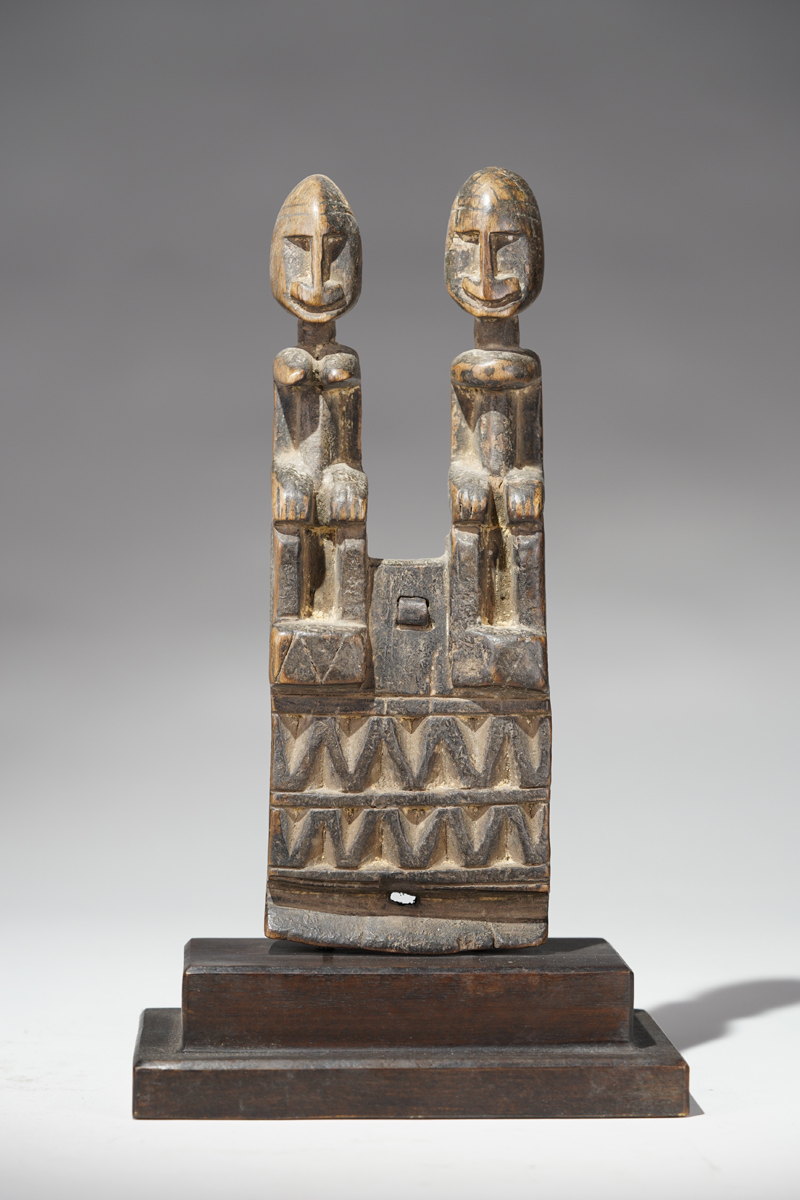 photo: wolfgang-jaenicke.com, for more information, please write us an e-mail with the identification number of the photo identification no. _XBD101493.jpg |
 |