 |
 A Senufo spoon, the handle is the male figure, his feet rest on the bowl part, hands on the hips, thick neck carrying a large head with a plunging jaw, scarifications on his abdomen and chest, cheeks; signs of use, glossy by touch.
"The Senufo people, who together number nearly one million, live in an area that is today divided among the republics of the Ivory Coast, Mali and Upper Volta. Their neighbors to the south are the Baule and the Guro, to the southwest the Dan and the N'gere, to the northeast the Bobo, and along an extensive border to the north the Bambara, whose villages in the Sikasso area are interspersed with theirs. The arts of these peoples surrounding the Senufo (and of the more northerly Dogon) were already well known to the outside world at a time when little sculpture had come out of Senufo country. Partly for this reason, partly because their land (except for the Sudanese aspect of the region north of Sikasso), was neither clearly "coastal" nor clearly "steppe," Senufo art has often been described as "transitional," and placed somewhere between "round" and "pole" styles, or between naturalism and abstraction. But however helpful these broad categories may be for African art as a whole, such an easy summary of Senufo sculpture, emphasizing surrounding influences at the expense of inherent character, hardly does justice to the particular indigenous qualities of its style."
"Among the Senufo, as generally among the peoples of West Africa, the artisan occupies a special place. He is usually referred to in the literature as a blacksmith—but this term must be understood in its oldest and widest sense—and he belongs to a special group, or caste, largely endogamie, which is separate from the main body of Senufo farmers. Nevertheless he must cultivate his own fields, deriving his living only partly from his technical specialty, as is the case also among the neighbors of the Senufo. That specialty includes the fashioning of all objects made from metal: agricultural tools, weapons, knives used in the sacrificial killing of animals, amulets, divination figures, and masks. But it is not merely a craft knowledge of metal-working skills that gives the artisan his place apart; this is established rather by his inseparable and magic connection with fire and the forces of earth inherent in the extracted metal. Thus, as Father Knops points out, to be a blacksmith is not simply to have learned a métier; rather, one is a blacksmith "in essence," born as such, and remaining so whether or not he practices the profession."
Source: Senufo sculpture from West Africa / by Robert Goldwater, New York : Museum of Primitive Art ; Greenwich, Conn. : Distributed by New York Graphic Society, 1964.
sold
Height: 37 cm without stand
Weight: 610 incl. stand |
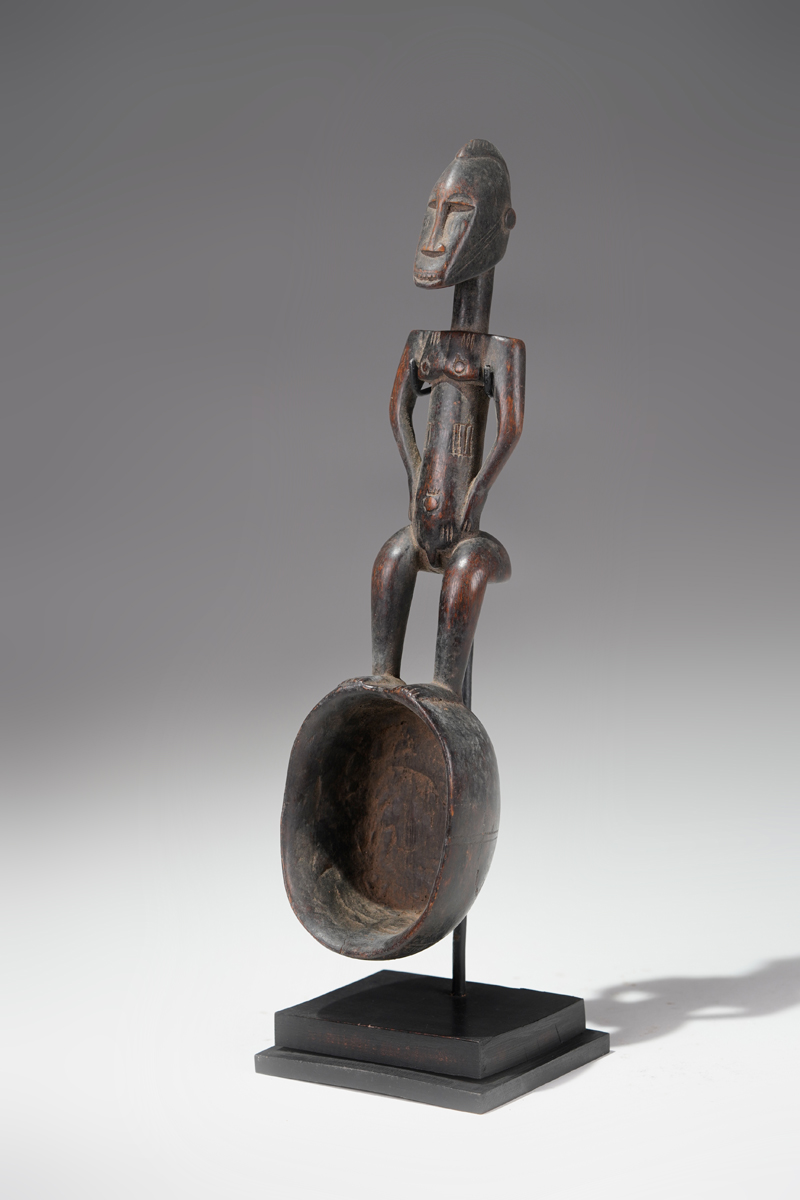 photo: wolfgang-jaenicke.com, for more information, please write us an e-mail with the identification number of the photo identification no. _XBD101632.jpg
 |
|
