 |
 A female Ibeji sculpture, Ewe, Togo / Ghana, standing on a wooden base, stout legs, an elongated thick bust, protruding breasts, large shoulders, arms slightly bent descending down towards the hips, the hands are in a position that would suggest they were holding a tool of sorts, the wrists have blue beaded bracelets, same as the hips, a thick cylindric neck carrying a smaller conical shaped head, with simple features of a mouth, nose, large globular eyes and scarifications on the cheeks, the hair is short and pulled back, painted in back; in good condition, glossy bu use. “Twin figures are carved out of wood and can depict one twin, a set of twins, or a set of triplets. They are usually commissioned from a sculptor by the twins’ mother so that if a twin dies, the parents will have a small figure to take his or her place in their memory. The figures are treated as though they are living people as well: they are clothed, bathed, fed, and carried from place to place. It is the mother who primarily cares for the twin images, then other relatives if she passes away. The figures do not actually look like children, however, as they possess features of adults such as appropriate genitalia and intricate hairstyles. In a set of twin figures, each one must be treated the same regardless of gender. They are fed the same, bathed at the same time, and clothed the same way, until they reach puberty.” Source: Elisabeth Cameron, “Ewe Peoples,” in Isn’t S/he a Doll? Play and Ritual in African Sculpture (LA: University of California, 1996), 67. sold Height: 28 cm |
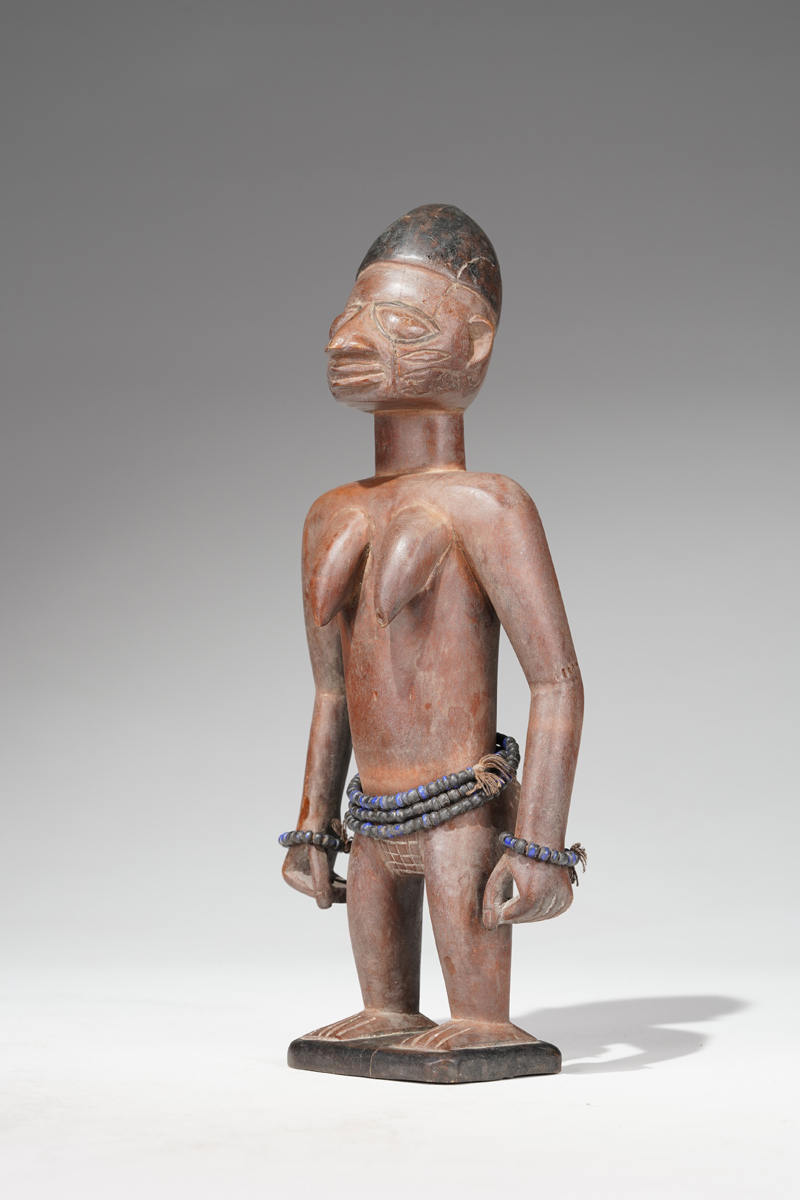 photo: wolfgang-jaenicke.com, for more information, please write us an e-mail with the identification number of the photo identification no. _XBD119006.jpg |
 |