|
A Baule Monkey sculpture, Ivory Coast, of unusual shape, standing on a intricate stool composed of five smaller Baule heads and their legs, which are also standing on a conical rounded base, the monkey is only carved from the waist up, his bust is concave, two big arms are coming out of the body and the left one folds upwards to the center of the body, holding a small bowl, the head comes straight out of the fallen shoulders and is placed in an upright position, with a delicately carved mouth and nose, two small eyes placed inwards; damage at the base, cracks through out, the bowl is chipped off, ritual patina incrusted. Certificate of providence.
"Such works are historically related to the traditional belief system of Baule peoples of Côte d’Ivoire according to which human experience evolves out of and remains inextricably linked to the ancestral spirit world, blolo, which controls and determines the fate of the living. This example belongs to a group of powerful objects known as amuin, a Baule term that encompasses masks and figures conceived to host particularly potent spiritual powers. Taking on zoomorphic features associated with the wilderness of the bush, such figures are physical representations of supernatural spirits and can act in a variety of functions or cults. Activated through the mediation of a diviner, or amuinfwe, they are instruments of social control used to punish anti-social behavior, while protecting against malevolent forces in the spiritual realm.
A context in which bowl-bearing figures are used is mbra, an amuin at the center of a possession and divination cult that was called upon for solving individual as well as collective ailments. Such objects were so central to the divination practice that aspiring trance diviners would have to either commission or inherit the objects required by their particular spirit before they could begin to practice. Like all amuin, their creation and usage were shrouded in secrecy. In the case of these figures, the spiritual force is intimately tied with the sculpture that holds it. As such, only the most experienced carvers were in a position to create such objects, and would do so outside of the village, in secrecy. This practice allowed not only for the figure to remain away from sight, but also served to disassociate the sculpture from its maker: an essential process intended to distance the spiritual realm from the prosaic context of its manufacture. Once carved, they were seldom displayed openly and could not be seen by women.
A diviner, who was also the figure’s caretaker, was then responsible for empowering and invigorating the work through sacrifices of blood and offerings of food, in particular eggs. The offered food was placed in the cupped hands, while the blood poured at the top of the figure’s head made its way down the animal’s muzzle and into the cup, a receptacle central to the power held by the figure. While the zoomorphic nature of these figures vary greatly and are not standardized, they all do hold a cup, or, as it is the case here, use their hands as a receptacle. As such, this central part of the sculpture and visual focus epitomizes the narrow connection between form and function. Altogether, it is the libations and food, as well as the aggressive zoomorphic shape they inhabit that are the sources of the bowl-bearer figures’ power.
The figures’ attributes and usage are opposed in every way to the notions of civilized space and beauty otherwise central to Baule society and visual expression. Their simian-shaped features associate them with the untamed spirits and the wilderness of the bush and this association stands in strong opposition to the civilized, controlled space of the village. Similarly, their features contrast sharply with the Baule’s ideal of human beauty, which echo that of a socialized humanism. This example is formally admired for its vigorous lines, attention to anatomy, and refined carving. In Baule society, however, the bulging eyes, jutting mouth, sharp showing teeth are regarded by the Baule as “horrible” (té) and “dangerous” (iléké, yolé yéla). The epitome of anti-aesthetics within the Baule sculptural world, the visual attributes of this bowl-bearer and its ferocious features of a bush animal that takes a human stand are aligned with the work’s function – that of hosting a powerful spirit whose forces can only be channeled through the skills of a trained carver and the experience of a Baule priest."
Yaëlle Biro, 2015.
Further reading:
Bouloré, Vincent. 2000. “Cynocéphale portant une coupe (mbotumbo ?)”, in Sculptures Afrique, Asie, Océanie, Amériques. Paris : Musée du quai Branly, Réunion des Musées Nationaux.
Boyer, Alain-Michel. 2008. Visions of Africa : Baule. Milan : 5 Continents Editions
Claessens, Bruno, and Jean-Louis Danis. 2016. Baule Monkeys. Brussels: Fonds Mercator
Vogel, Susan M. 1997. African Art Western Eyes. New Haven: Yale University Press.
sold
Height: 58 cm
Weight: 1,06 kg |
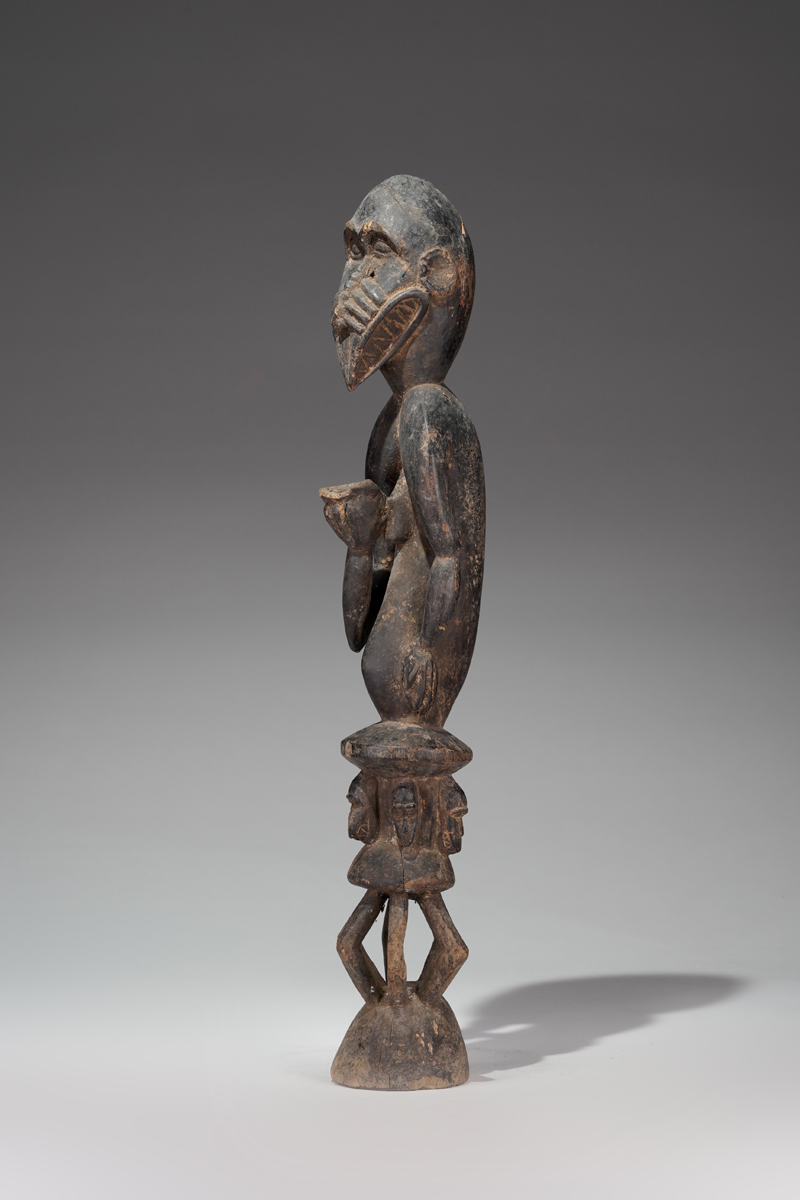 photo: wolfgang-jaenicke.com, for more information, please write us an e-mail with the identification number of the photo identification no. _XBD118843.jpg
 |
|

