 |
A Dan Mahoun mask, Ivory Coast, composed of an elongated and curved beak below the nose, small narrow slit eyes, round ears and animal horns, on the beak and forehead are sheet metal plates nailed on; blackened wood, partly glossy, the tip of the beak is damaged, an age crack on the top of the head, signs of age and use. Certificate of origin and provenance.
“All Dan masks are worn frontally, tied to the head in a vertical position over the face. Horizontally oriented masks worn atop, the head and helmet masks are unknown to the Dan, although both types are found among their neighbors. Dan face masks are nearly always made of wood […] Dan masks have either human or animal features, or sometimes a combination of both […] It is essential to realize that it is not only the face mask but also the headdress which indicates to the Dan observer the nature of the masquerade before him.” Source: Eberhard Fischer and Hans Himmelheber
"The border between Cote d'Ivoire and Liberia cuts across several ethnic groups, including the Dan, Wee, Kran, and Grebo. In Dan society, dangerous immaterial forest spirits are translated into the forms of human face masks. Whether or not they are worn, such sculptures are spiritually charged. Male performers, gle-zo, experience a dream sent by the mask spirit that allows them to dance it. In performance, the masks are integrated into the hierarchical system that governs political and religious life.
Dan masks have been documented as the embodiment of at least a dozen artistic personalities. Among these are Deangle, who ventures into the village from the initiation camps to ask women for food; Tankagle and Bagle, who entertain through a range of aesthetically pleasing dances, skits, and mimes; Gunyege, whose mask is worn by a community's champion foot racers in competitions; and Bugle, who historically leads men into battle. This example's distinctive projecting triangular cheekbones and recessed triangular eye apertures indicate that this is probably a kagle mask. Kagle masks are "troublemakers", meant to disturb village festivities with their erratic movements and agressive behavior. Intended to symbolize the brutal force of the bush and of savage, nonhuman creatures, the "troublemaker" is in fact a test of the solidity of social institutions. Its disruptive performance serves a social function by teaching the value of order and discipline through its negative example.
Once they are divorced from their performance contexts, mask forms are difficult to identify. Performances of Bete and Wee masks may span the careers of many generations of wearers, contributing to the increasingly sacred status of these objects. A masquerade's vitality may also be transferred from one mask form to another. Over time, any respected Dan mask may eventually be elevated to the category gunagle, the mask that represents a village quarter, or gle wa, a judicial mask."Source: The MET.
Lit.: Eberhard Fischer and Hans Himmelheber, The Arts of the Dan in West Africa, Museum Rietberg Zurich, 1984
sold.
Height: 53 cm
Weight: 2,1 kg (with stand) |
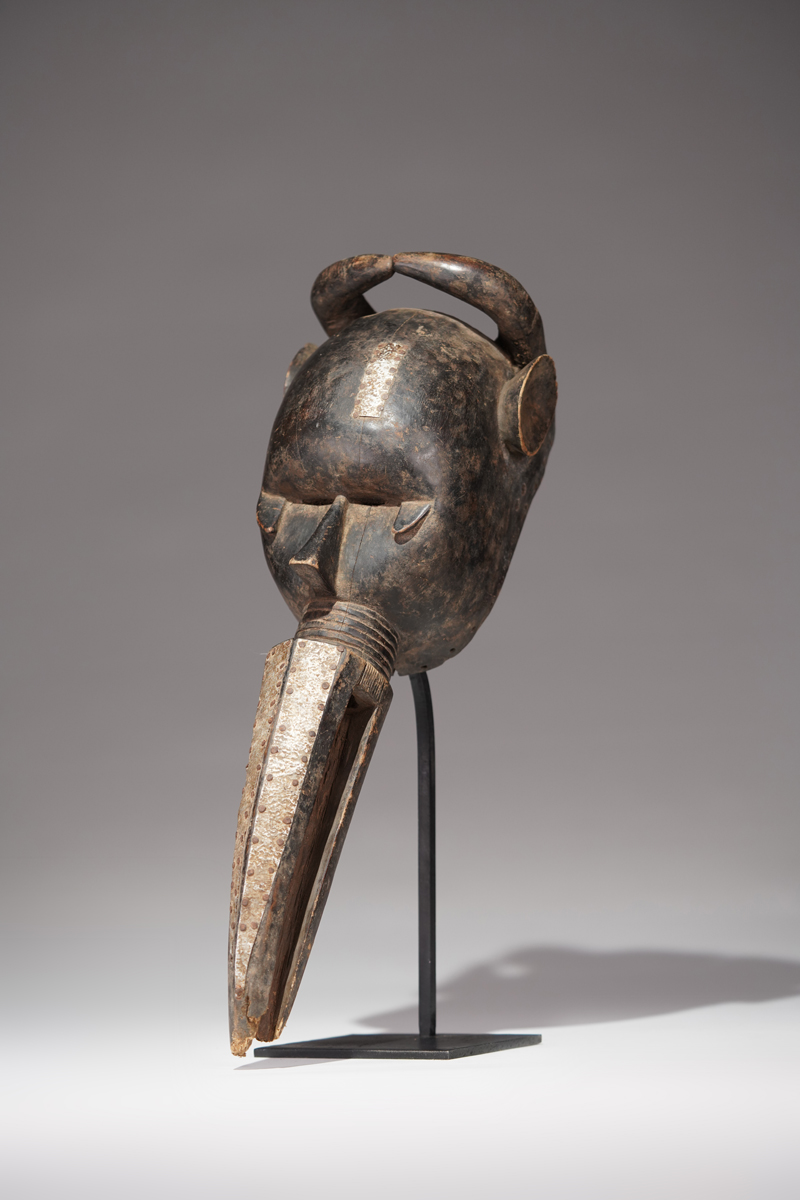 photo: wolfgang-jaenicke.com, for more information, please write us an e-mail with the identification number of the photo identification no. XBD122102.jpg
 |
|

