 |
 A Baga serpent, Guinea, of beautiful and abstract shape, carved from one piece of heavy wood, details of triangular shapes and rounds, red, whites, oranges and browns, this piece is of excellent craftsmanship; a large crack at the bottom, glossy by use, signs of use. Certificate of origin and provenance.
"Within the corpus of African art, the great Baga serpents hold an iconic place. A force of axial plasticity, carved from a single piece of wood and standing six feet tall they are rare in the purity of their aesthetic power and monumentality within African art. The Bartos serpent of tall, elongated proportions, highly balanced curves and lyrical patterning places it among the most important of this already iconic set. The body dramatically flares at the extremities and frames a corpulent bulge at the center which then narrows severely at the neck to delineate the animal's head. The medial ridge which runs the entire length of the body's surface follows the shape of the carving by shrinking at throat level. The profile shows a powerful movement upward with spring-like tension expressed through the curves and counter-curves. The superb painterly surface is enhanced with black, red and white pigments forming triangular geometric patterns and further reinforces the form's rhythm.
The majority of exceptional examples among these sculptures, the Bartos serpent among them, were collected by Hélène and Henri Kamer in the 1950s, and are now held in the greatest museums in the world. Among the eight snakes collected by the Kamers are: one belonging to the Musée du Quai Branly, now exhibited in the Pavillon des Sessions (Louvre, Paris, 71.1989.49.1), it was given to the museum by Jacques Lazard under Hélène (Kamer) Leloup's instigation; another one from the Menil Collection in Houston (V9009), two other examples from the Metropolitan Museum of New York (1978.206.101 and 1978.412.339) formerly in the Rockefeller collection, another snake sold by Leloup to the American director, John Huston, and finally, the one formerly part of the Pierre Matisse collection, now in a private collection (see Sotheby's, 16 May 2008, lot 58). For other similar snakes, see: the Geneva Barbier-Mueller Museum figure; the Cleveland Museum of Art example (1960.37) published in Robbins and Nooter (1989 fig.247); and the Rietberg Museum figure in Zurich, acquired from Emil Storrer.
Hélène Leloup recently recalled the specific circumstances under which she collected the Bartos serpent: When she arrived in Guinea in 1957, she and Henri Kamer settled in Boke. Over the course of 10 days she visited the Baga and Nalu territories. Searching for snakes. The Bartos snake was found toward the end of 1957 in a Guinea village then referred to as Victoria, today Kanfarandé. At the time, because it is situated at the mouth of the Rio Nuez River, this village had different names depending of the ethnical origin of the speakers. At low tide, she went via canoe up the river, which was bordered by mangroves, and she could see frightened crocodiles were escaping and dashing into the water. The return was very dangerous as the tide was high, and the waves became stronger causing the canoe to heave to and fro as it was very heavy with passengers - both objects and people (Leloup, personal communication, Paris, March 27, 2013)."
Source: Christie's
"The Baga, Landuman and Nalu peoples, with similar ethnic and artistic characteristics, live along the coastal lagoons of southern Guinea. Six months each year, the surrounding marshes are flooded, making it difficult to reach a large part of Baga territory. This relative isolation explains the lack of early field studies. The anthropologist Denise Paulme (1909-1998) lived among the Baga during the 1950's, but was never able to attend the initiation closing ceremonies (Stoullig-Martin, 1988). It was not until the publication of Frederick Lamp's research (Art of the Baga, New York, 1996) that deeper discussions could held around the subject.
The spirit Ninkinanka, of the snake called bansonyi or Mantsho-or-no-Pön, reigned among the Baga people, who feared him. He was the spirit who could bring rain, provide wealth, and children to infertile women. Each section within a village was represented by the wooden image of a serpent, like a totemic animal. The bansonyi headcrest appeared during competitions between different clans. Young people dressed in a complex suit topped by the representation of the snake faced each other during dances that were judged by women. The snake also manifested itself during the final phase of the girls and boys initiation and at the beginning initiation ceremonies for young adults. Associated with the rainbow, considered the source of the rivers and a marker of the end of the rains, the snake evokes the idea of life and death, the beginning and the end (Lamp, 1996)."
Source: Christie's.
sold
Height: 72 cm
Weight: 2,5 kg |
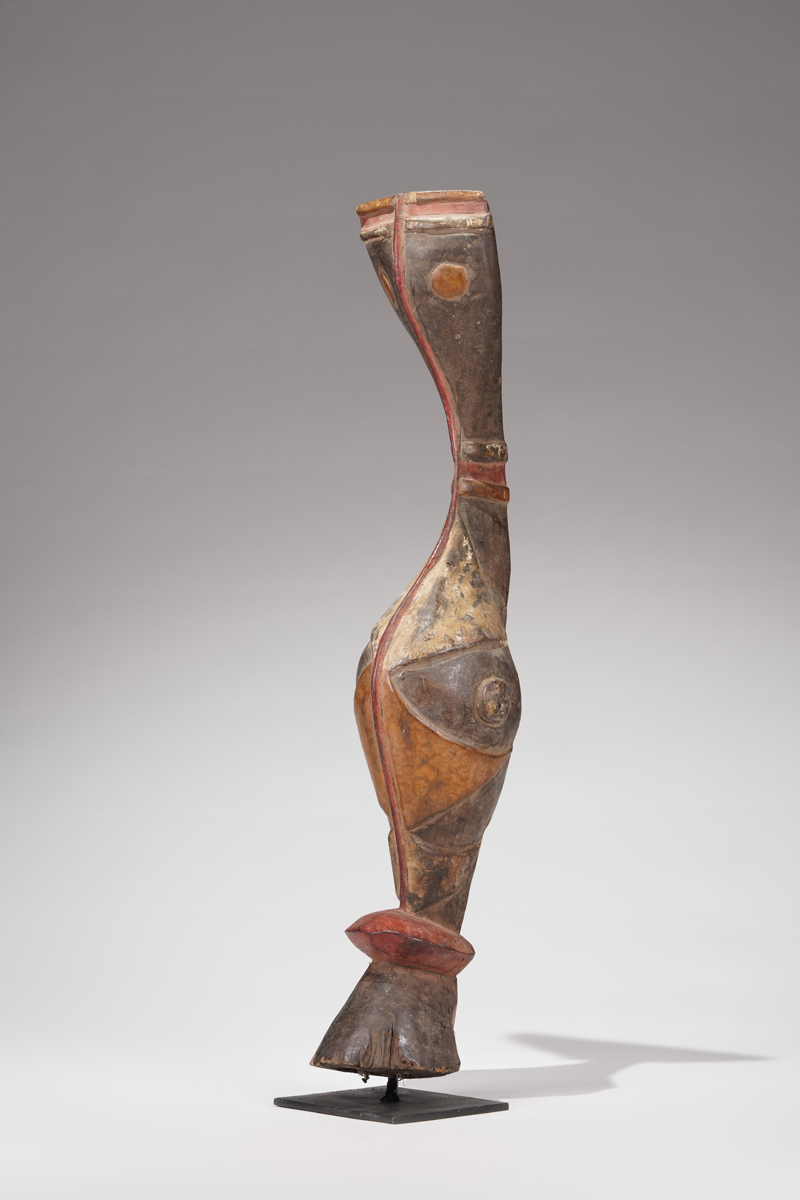 photo: wolfgang-jaenicke.com, for more information, please write us an e-mail with the identification number of the photo identification no. XBD122437.jpg |
|
