 |
 A Grebo mask, of half croissant shaped, a long thin jawline, protruding lips, pointed nose, the tubular eyes are covered over with remnants of passion fruit kernels, small ears, a protruding forehead, holes in the rimes of the mask to attach a costume, the neck of the mask comes out and there are thin strings attached to it; glossy by use. Certificate of origin and provenance. These masks, most of which disappeared in Liberia due to the ‘Grebo Wars’, represented spirits of nature or the forest as found among the We, Guere and Bete peoples, northern neighbours of the Grebo. Although used for mainly secular purposes today and for collective entertainment as among the Godie and Neyo people of Côte d’Ivoire, they were previously used, according to Alain-Michel Boyer, to “expurgate those who ate "doubles" (or souls for Christians), but that it also played a part in settling ritual conflicts between clans, in the case of a land contest, a hunting problem or the rape of a woman. With its numerous eyes, it could "watch" the fighters, but also "strengthen" them, in order to raise them above their status as men, and turn them into valiant warriors.” This type of mask was also used in funeral dances accompanied by various other animal or more figurative masks. However, for Pierre Boutin, “the information we have [on these masks] is inversely proportional to their artistic fame. Contrary to other ethnic groups in south-western Côte d’Ivoire (We, Bete, Niabwa, etc.), […] we known […] nothing of their function, - entertainment, funerary, initiatory, judicial -, of the frequency of their appearances, - regular or exceptional -, nor the audience permitted to see them - open audience, extended or limited audience, with or without restriction regarding age or gender”. Source: Boyer, Alain-Michel, Idem, pp. 141-142. Boyer, Alain-Michel, Between the seen and the unseen, Paris, Sotheby’s, 12 December 2017, lot 50. Boyer, Alain-Michel, Grebo Mask, Paris, Sotheby’s, 13 June 2018, lot 26. Boutin, Pierre, ‘Les masques « krou » de Côte d’Ivoire’ in Afrique, Archéologie, Arts, no. 5, 2007-2009 sold Height: 38 cm / 51 cm incl. stand |
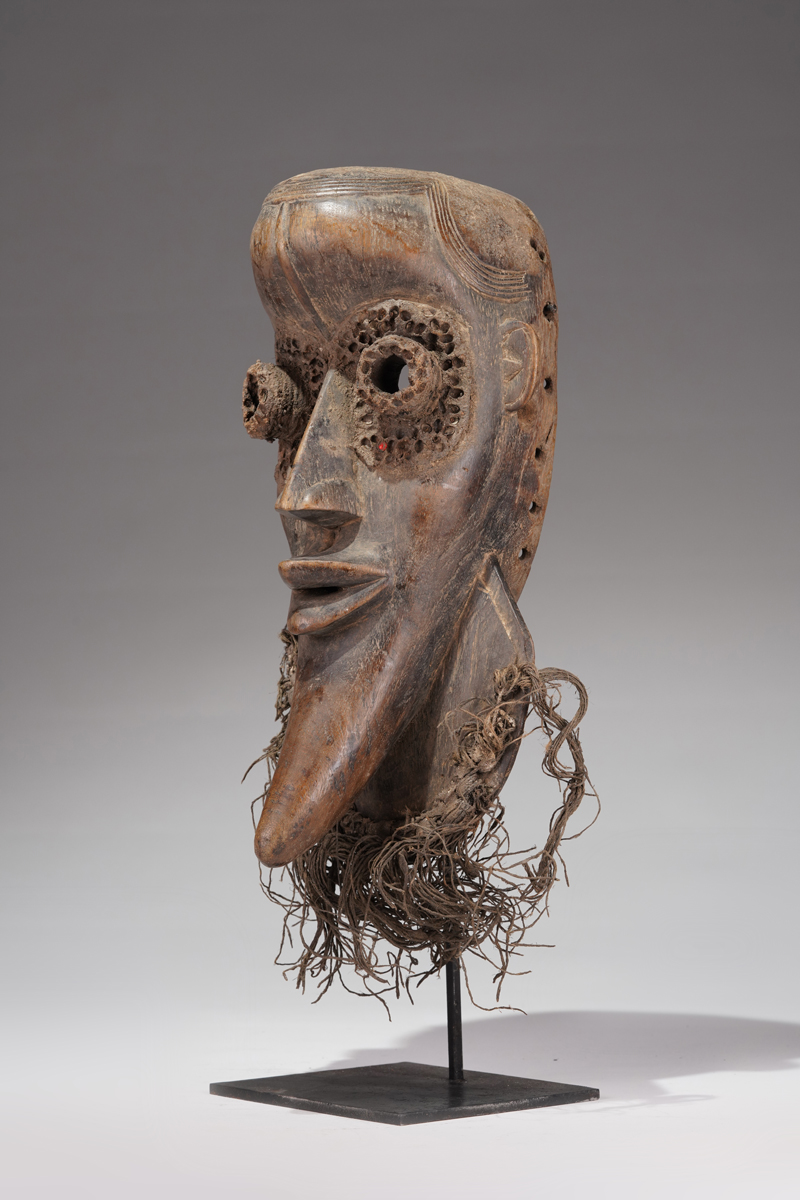 photo: wolfgang-jaenicke.com, for more information, please write us an e-mail with the identification number of the photo identification no. XBD122472.jpg |
 |