 |
 A male Hemba statue from Eastern Zaire, missing its waist downwards, the hands are touching the protruding stomach, his arms are slightly pulled back and curled upwards, around the waist is a red rope, while the large head rests on a short cylindric neck. The attention to carefully detailed carvings is notable, especially around this head: it is very finely carved but also the headdress which is pulled back is beautifully chiseled. The features of this face are elegant and thin, giving a rested and wise expression to the whole figure. Indeed, the arched eyebrows englobe the slit eyes, falling down the centre together to form the nose, the hair is pulled back in quadrilobed shaped petals and connected with a crucifix style braids, opened up behind create an empty space, which is traditional to the region. The top of the head is mounted with a piece of cloth captured in sacrificial residues. Relics and effigy of ancestors, in CONGO River, Francois Neyt, Quais Branly Museum, p. 254-255 "Die Skulpturen der Hemba zählen zu den bedeutensten Kunstwerken Schwarzafrikas; es sind vor allem Ahnenfiguren, singiti, die Kriegsfürsten, Gründer von Königsfamilien, oder lokale Häuptlinge darstellen und die in kleine Hüttengestellt werden." Schaedler, 180. Lit.: K.-F. Schaedler, Lexikon afrikanische Kunst und Kultur, 180f. Evan Maurer, The Intelligence of Forms, 1991. Luigi Spina, Hemba, 2018. Francois Neyt, La grande statuaire hemba du zaire, 1977. Francois Neyt / Louis de Strycker, approche des arts hemba, 1975. Francois Neyt, South East Zaire, 1993, 163-181. sold |
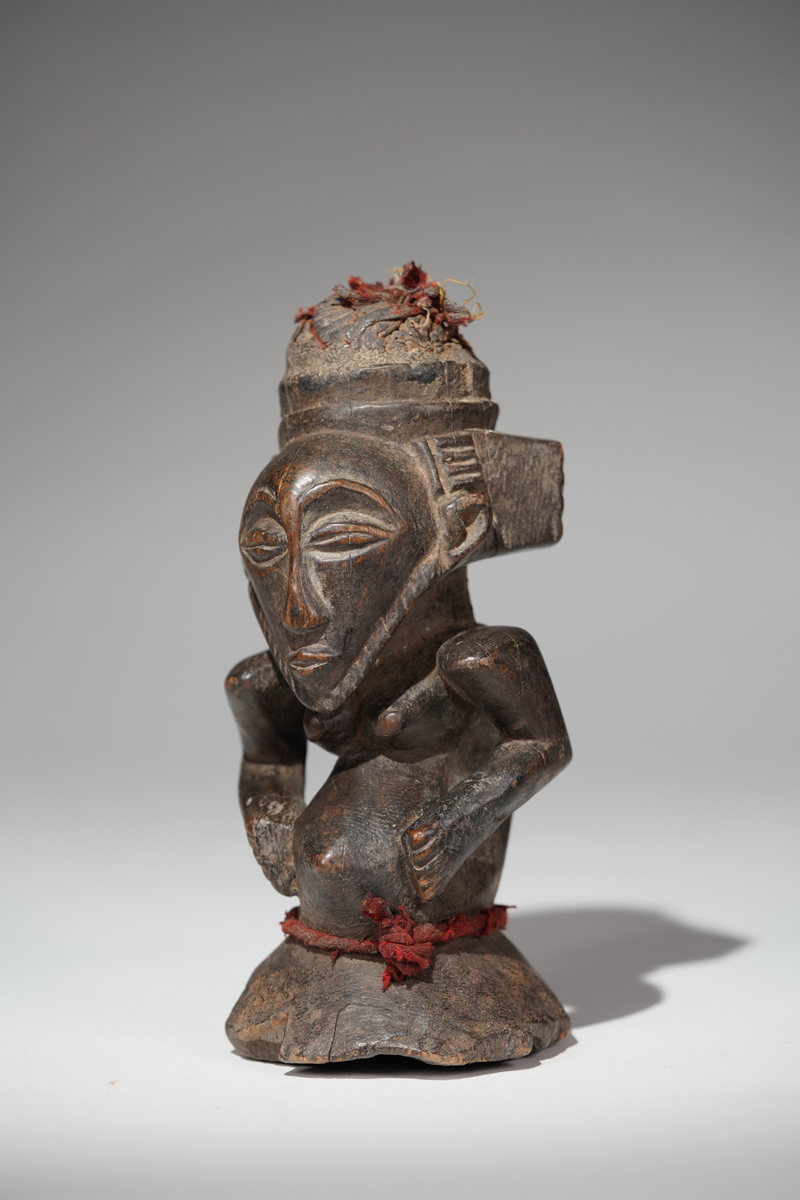 photo: wolfgang-jaenicke.com, for more information, please write us an e-mail with the identification number of the photo identification no. XBD124931.jpg |
 |