 |
A We/Guerre mask, Ivory Coast, A Guerre/We mask, of oval shape, T shaped nose splitting the face in two sections, two tubular hollow eyes, with sets of horns curing inwards and across the sides of the face that join in the middle, these horses and the nose and punctuated with metallic rounded parts, the rear of the mask is punctured with holes where the costume would have bene attached; thick incrusted ritual patina, signs of use. Certificate of origin and provenance.
"The border between Cote d'Ivoire and Liberia cuts across several ethnic groups, including the Dan, Wee, Kran, and Grebo. In Dan society, dangerous immaterial forest spirits are translated into the forms of human face masks. Whether or not they are worn, such sculptures are spiritually charged. Male performers, gle-zo, experience a dream sent by the mask spirit that allows them to dance it. In performance, the masks are integrated into the hierarchical system that governs political and religious life.
Dan masks have been documented as the embodiment of at least a dozen artistic personalities. Among these are Deangle, who ventures into the village from the initiation camps to ask women for food; Tankagle and Bagle, who entertain through a range of aesthetically pleasing dances, skits, and mimes; Gunyege, whose mask is worn by a community's champion foot racers in competitions; and Bugle, who historically leads men into battle. Once they are divorced from their performance contexts, however, mask forms are difficult to identify Performances of Bete and Wee masks may span the careers of many generations of wearers, contributing to the increasingly sacred status of these objects. A masquerade's vitality may also be transferred from one mask form to another. Over time, any respected Dan mask may eventually be elevated to the category gunagle, the mask that represents a village quarter, or gle wa, a judicial mask.” Source: The Met.
"Östlich und westlich des oberen Cavally dehnt sich ein Kunstgebiet, das Völker zweier ganz verschiedener Sprachgruppen umfaßt und doch sowohl im Stil als auch in der besonderen Bedeutung der Schnitzereien eine Einheit bildet. Es handelt sich um die "mande -fu" sprechenden Ethnien der Konor und Guerze nördlich des Mount Nimba in der Republik Guinea und der Dan in Liberia und an der Elfenbeinküste, und um die "kru"-sprechenden Völker der Wè (Kran, Guere, Wobe) Bete, Niaboua, Oubi an der Elfenbeinküste. Der kundige Leser wird überrasscht sein, dass ich die zarte Kunst der Dan und die ungschlachte der Wè als Einheit auffasse, aber wir werden sehen...". Source: Masken der Wè und Dan Elfenbeinküste, die Sammlung des Schweizer Malers Charles Hug.
Lit.: Masken der Wè und Dan Elfenbeinküste, die Sammlung des Schweizer Malers Charles Hug, Paris 1928-31 mit einem Beitrag zum Maskenwesen der Wè von Hans Himmelheber.
sold
Height: 41 cm (including stand)
Weight: 2230 g (including stand) |
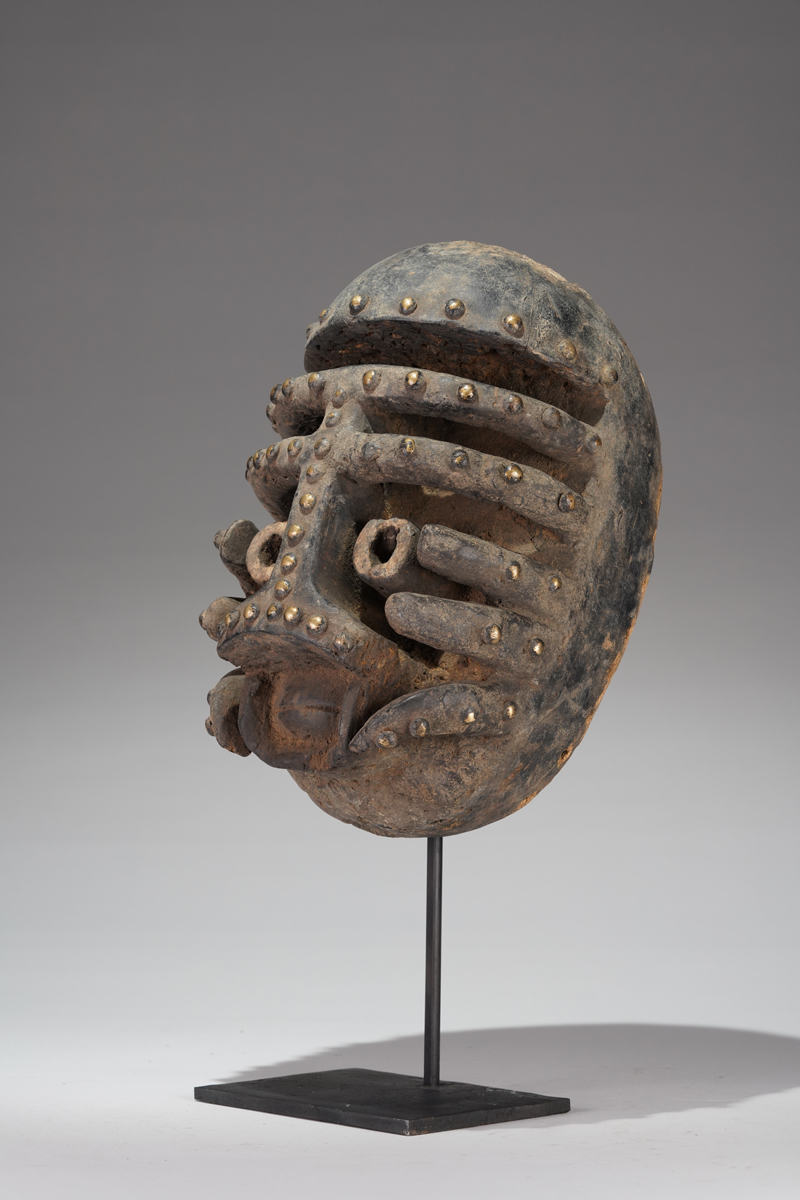 photo: wolfgang-jaenicke.com, for more information, please write us an e-mail with the identification number of the photo identification no. XBD125617.jpg |
|

