 |
 A We/Guerre mask, Ivory Coast, the nose splitts the face in two sections, two tubular hollow eyes, with sets of horns curing inwards and outwards through the face and on its sides, these horns and the nose and punctuated with metallic rounded parts, the rear of the mask is punctured with holes where the costume would have bene attached; traces of ritual patina, damage on the back of the mask, signs of use. Certificate of origin and provenance.
"Dan masks have been documented as the embodiment of at least a dozen artistic personalities. Among these are Deangle, who ventures into the village from the initiation camps to ask women for food; Tankagle and Bagle, who entertain through a range of aesthetically pleasing dances, skits, and mimes; Gunyege, whose mask is worn by a community's champion foot racers in competitions; and Bugle, who historically leads men into battle. Once they are divorced from their performance contexts, however, mask forms are difficult to identify Performances of Bete and Wee masks may span the careers of many generations of wearers, contributing to the increasingly sacred status of these objects. A masquerade's vitality may also be transferred from one mask form to another. Over time, any respected Dan mask may eventually be elevated to the category gunagle, the mask that represents a village quarter, or gle wa, a judicial mask.” Source: The Met.
Lit.: Masken der Wè und Dan Elfenbeinküste, die Sammlung des Schweizer Malers Charles Hug, Paris 1928-31 mit einem Beitrag zum Maskenwesen der Wè von Hans Himmelheber. Lit: The Arts of the Dan in the West Africa, Eberhard Fischer and Hans Himmelheber, 1984. sold Height: 30 cm |
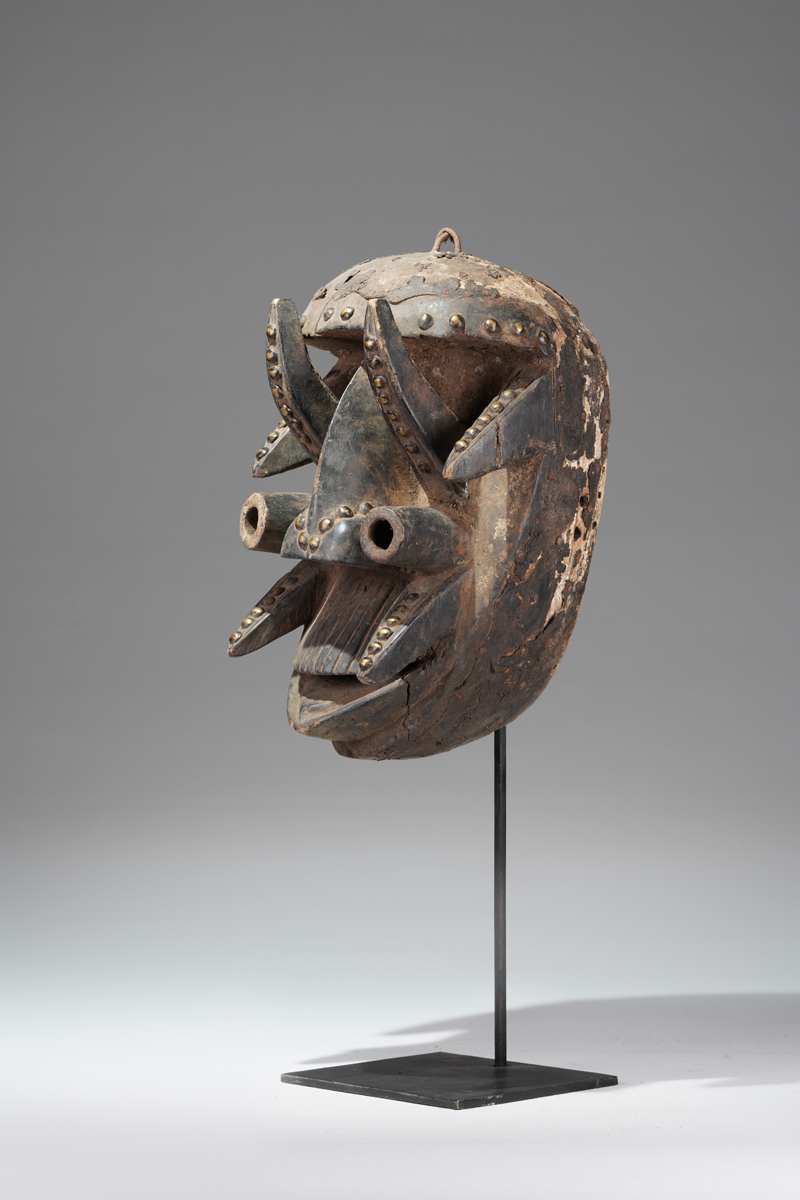 photo: wolfgang-jaenicke.com, for more information, please write us an e-mail with the identification number of the photo identification no. XBD126543.jpg |
 |