 |
 A female Baule sculpture, Ivory Coast, standing on a rounded base, her knees slightly bent, the two hands are resting on her stomach, her oval shaped head welcomes strong and determined features, while her mouth slightly opened and eyes staring straight ahead. The hairdo is pulled back in an arched manner, the front and back of the body are covered with scarifications, sign of beauty and status in Baule culture; some wear throughout the sculpture, signs of use, thick ritual patina. Certificate of origin and provenance.
“To articulate historians, the most consistent features of Baule art is a kind of peaceful containment. Faces tend to have downcast eyes and figures most often hold their ams against the body. […] Among their abundant art forms, the Baule people continue to place the greatest value on masks and figure sculptures, which remain the only sculptural art still widely used in Baule villages. While there is a difference between the Baule view of their objects and that of Western connoisseurs, there are points of agreement. Aesthetic appreciation is one: Baule artist, and individual owners of objects, certainly sometimes enjoy the beauty of these objects and the skill it took coproduce them. […]
Lit: Baule: African Art, Western Eyes. Susan M.Vogel 1997.
“A carving of the Baule people of the Ivory Coast is of a type sometimes referred to as an 'ancestor figure'. In fact, it represents a male spirit lover, blolo bian who would be partnered by a female spirit lover, blolo bla. They are frustrated partners left behind in the world of the spirits when people are born into this world. Each man and woman is believed to have a spirit double or spouse that resides in the other world. If the spirit becomes angry, the human spouse commissions a carving to receive offerings. Cloths and jewellery are used to decorate the figure which is oiled regularly. The Baule believe that beauty helps promote fertility and avoid marital problems so the blolo bian has an elaborate hairstyle with intricate textured designs.”
Lit.: J. Perani and F.T. Smith, The visual arts of Africa: gen (Prentic Hall, New Jersey, 1998).
sold
Height: 61 cm
Weight: 1,2 kg |
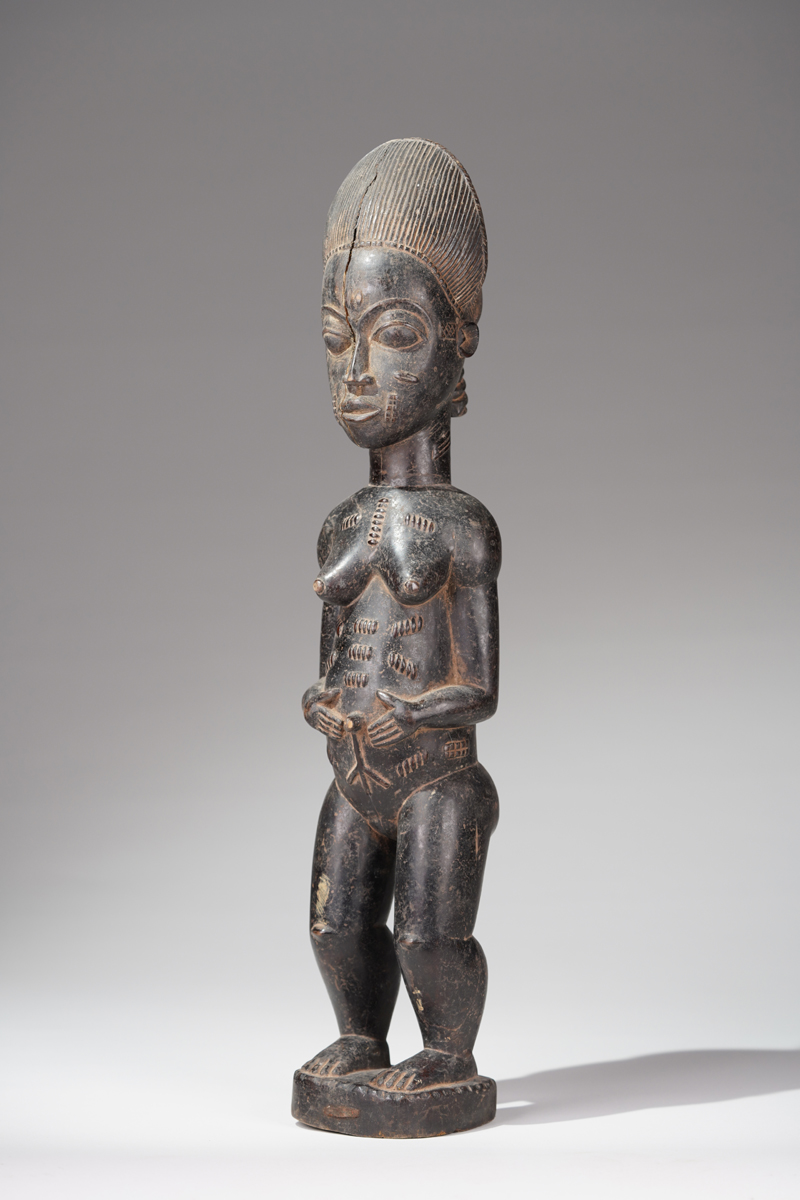 photo: wolfgang-jaenicke.com, for more information, please write us an e-mail with the identification number of the photo identification no. XBD127371.jpg |
|
