 |
 A Bete mask, Ivory Coast, of oval shape composed of a flat surface for the face and a bulging forehead, with a half opened mouth beneath a prominent pointed nose, standing between two hollow rounded eye holes, the boarders of the face, lips and chin are punctuated with circular metallic, in addition to a thick braided piece of textile rope bordering the jaw line and chin, the rear of the mask is punctured with holes where the costume would have bene attached, a small metallic hook at the top of the head; a large crack on the left of the face, glossy by use, signs of use. Certificate of origin and provenance. “Amongst the people known by the ethnonym of Bete – a term which encompasses several very different groups – it is only the western Bete, who live in western Côte d’Ivoire near the We and Nyabwa, who use masks of this type. Nyabwa is the ceremonial language of the Bete for this mask…Among the Bete, officiants use only Nyabwa so as to preserve the ‘authenticity’ of the ceremony”. “All distinction between the masks of the Eastern We, the Nyabwa and the Bete is artificial, since the brotherhoods that manage them are not curtailed by ethnic or dialectal barriers and readily perform in each other’s villages. Amongst the Eastern We as well as the Western Bete, [masks] are commonly characterized by their majesty, their opulence […and] density of composition, multiplication of overlapping, stylized horns and tusks reaching out to the light in a constructed architecture, nostrils so hypertrophied that they sometimes resemble fins, sometimes the snout of a warthog curving up to the temples […]” Source: citing Marie-Noël Verger-Fèvre in Jean-Paul Barbier, ed., Arts de la Côte d’Ivoire, Geneva, 1993, Vol. II, p. 90. sold Height: 27 cm |
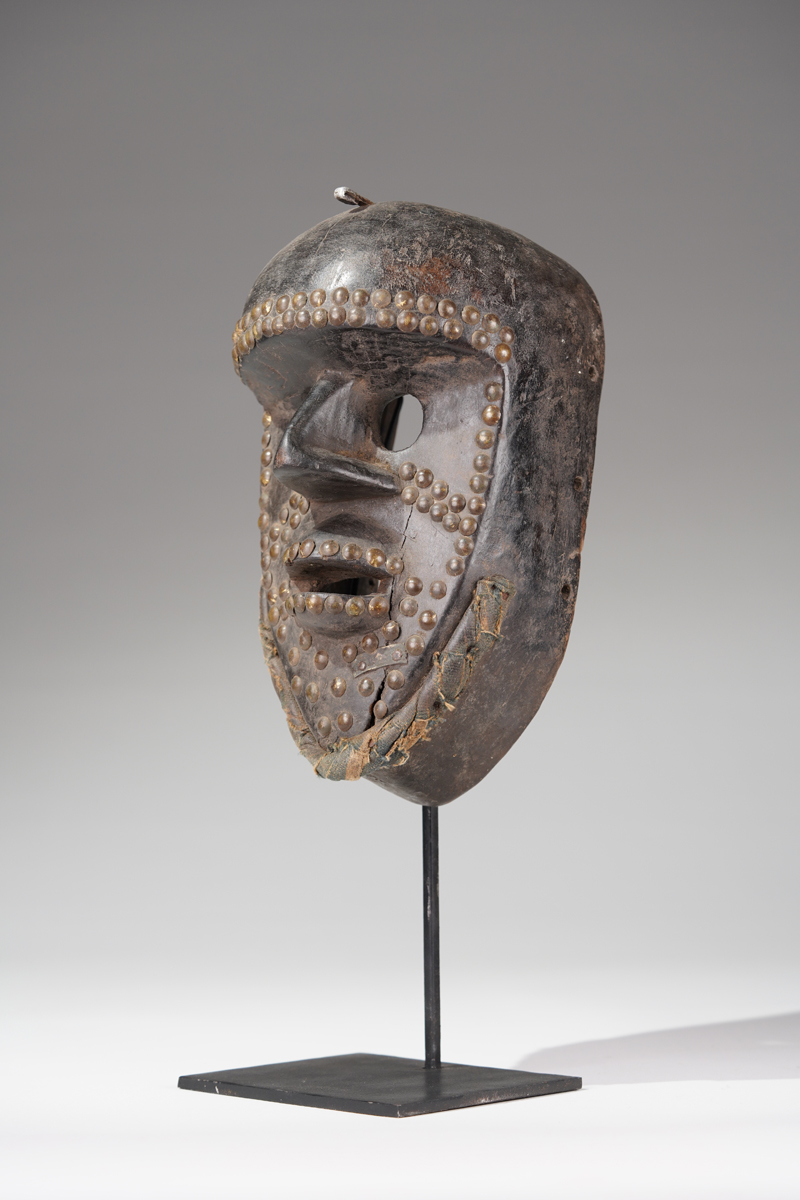 photo: wolfgang-jaenicke.com, for more information, please write us an e-mail with the identification number of the photo identification no. XBD130049.jpg |
 |