 |
 A Yaure mask, Ivory Coast. Incl. stand. "Yaure masks are linked to men's associations organizing funerals to honor the spiritual power of the deceased. The masks come out for a single occasion, death, this disturbance of order that needs to be restored. Alain-Michel Boyer compares them to "dynamic forms located at the point of articulation of life and death" («formes dynamiques situées au point d’articulation de la vie et de la mort»). The Lomana mask, accompanied by incantations, dances by grazing the body of the deceased, ritualistically transforming him or her into an ancestor who is supposed to help and protect his or her descendants. Masks are considered among the Yaure people to be very powerful and dangerous objects. Women are not allowed to see the masks and it is impossible for men to approach them outside the ritual context; moreover, they are subject to numerous prohibitions, sexual, choreographic and aesthetic." Lit.: Les Yohouré de Côte d’Ivoire. Faire danser les dieux, Lausanne, Ides et Calendes, 2016. Traduction américaine de Jane Todd, The Yaure of Côte d’Ivoire, Make the Gods Danse, Geneva-Cape Town, Cultural Foundation Musée Barbier-Mueller, 2016). Arts de la Côte d’Ivoire. Autour des Yohouré, Genève, Musée Barbier-Mueller, 2016., with two different long horns Lit.: Susan M. Vogel: Baule: African Art Western Eye, 1997, p. 169 (169-187); Bernard de Grunne: Über den Baule-Stil und seine Meister. In: Eberhard Fischer/Lorenz Homberger: Afrikanische Meister. Kunst der Elfenbeinküste, Zurüch 2014, p. 81-106; Alain-Michel Boyer: Baule. Visions of Africa, Milan 2008. sold Height: 36 cm |
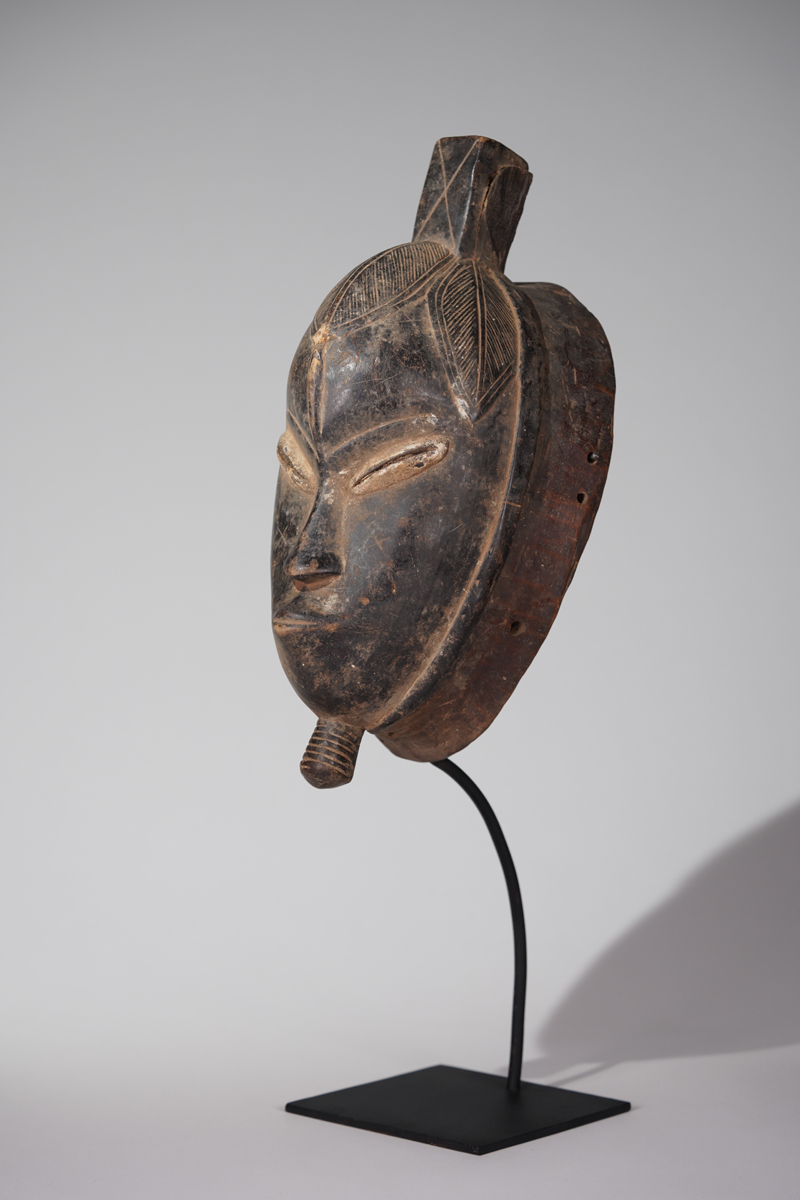 photo: wolfgang-jaenicke.com, for more information, please write us an e-mail with the identification number of the photo identification no. XBD140337.jpg |
 |