 |
 A Mbole sculpture, Zaire, a stocky figure, with sloping shoulders, a flattened heart-shaped face and surface bearing ochre, white and brown pigment, takes the appearance of a hanged man. Conventionalized polychrome figures carved in this manner represent individuals who were hanged for violating the public order and transgressing the laws of a powerful association among the Mbole, known as Lilwa. This graded association performed ritual, educational, jural, social, political, and economic functions (Biebuyck 1995). The Lilwa association is related to the better-known Bwami association of the Lega peoples, the Mbole’s southeastern neighbors. While the Lega use a multitude of small-scale objects as part of the initiation into Bwami, Lilwa’s artifacts are few and are striking for their comparatively large scale.
Mbole statues are carved from wood and are generally small in size. They are characterized by stylized features that emphasize certain parts of the body, such as the head, shoulders and arms. The faces of Mbole statues are often decorated with scarifications, hairstyles and decorative elements
These statues have deep cultural and ritual significance. They are associated with religious practices and healing rituals within Mbole society. Mbole statues can be used to represent ancestors, spirits or divine figures, and they play a role in communicating with the spiritual world. They are often used in ritual ceremonies, dances and other cultural events.
Mbole statues bear witness to the artistic creativity of the Mbole people and their link with spirituality and collective memory. They are also sought-after art objects for their unique aesthetic and are exhibited in museums and art galleries around the world to highlight the richness of Mbole culture and traditional African art.
The anthropologist Daniel Biebuyck has highlighted Lilwa’s sophisticated moral philosophy (Biebuyck 1976, 1979, 1995). This philosophy and way of life were instilled into most members of Mbole society, during a period of initiation during which they learned basic social and ethical precepts. All young men and some women (daughters of the highest-ranking initiates) were initiated into the basic introductory level of Lilwa. At that time, they were isolated in a forest lodge and, guided by a ritual expert (onanga), passed through a series of trials. Congolese psychologist Kalala Nkudi's study of the Mbole’s social structure and the steps of Lilwa initiation reveals that Ofika (hanging) figures were central to the final moments of the initiation when initiates were allowed to see and touch the symbolic objects of Lilwa. According to Nkudi the sculptures allowed the elders to explain the consequences of immoral conduct, to impart respect for elders, to transmit concepts about etiquette, and to warn against adultery, thieving and lying (Nkudi 1979, pp. 20-21).
The practice of hanging was central to law enforcement in Mbole society and was done publicly in the village, with great pomp. The spectacle must have been striking: a special status-holder of Lilwa placed a liana around the victim’s neck and attached it to a flexible, bent tree, which pulled the body into the air when released. The sculptures, carved at the request of a Lilwa elder following an execution, represented particular individuals who were condemned to death by Lilwa. While the figures should not be considered as portraits of offenders, the carvings were given their names and perpetuated their memories. This element of personification was expressed during the initiation rituals that showcased the figures. Indeed, as the ritual leaders showed the Ofika figures to the neophytes, they warned the young initiates with these words: “Watch out, if you scorn the customs of the ancestors, we will kill you and fix you in a statue, as we did for the son of X and Y” (Nkudi 1979).
|
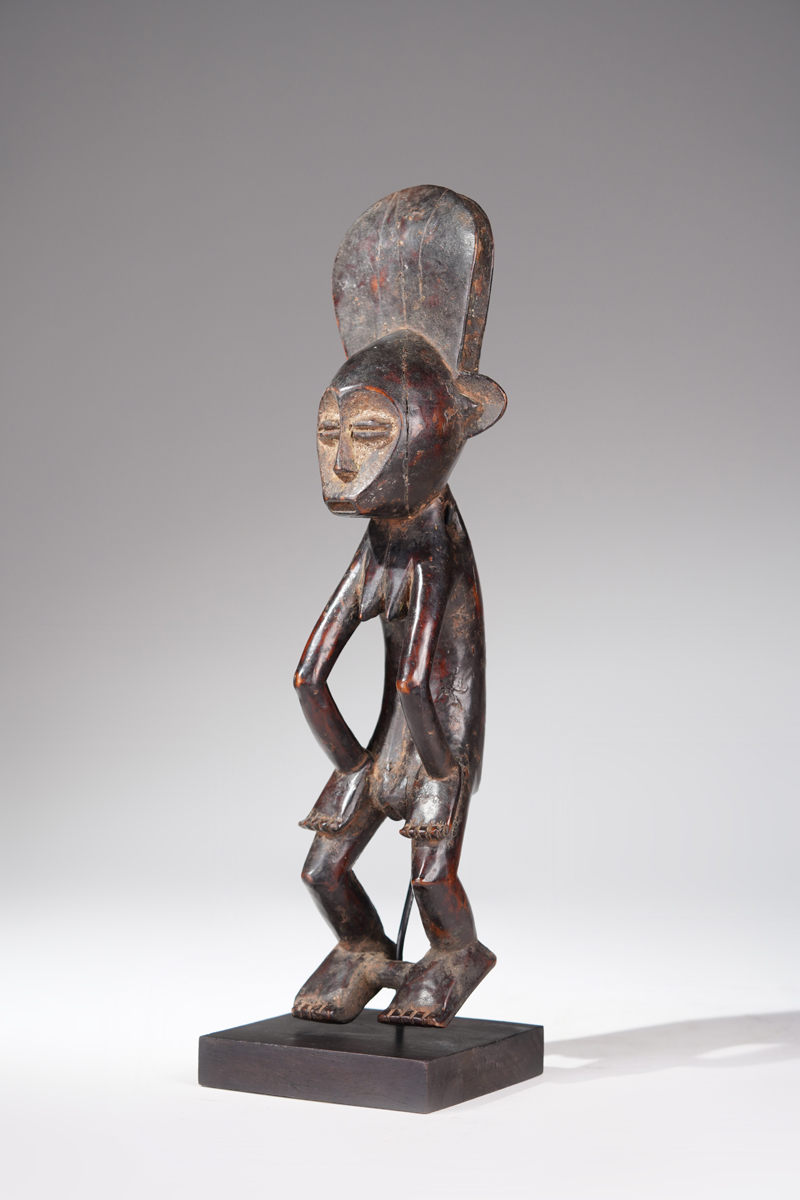 photo: wolfgang-jaenicke.com, for more information, please write us an e-mail with the identification number of the photo identification no. XBD140575.jpg
 |

Bringing nuance to the interpretation of the hanged man imagery, Biebuyck suggested that the Ofika figures might allude to another important moment in Mbole society, the pre-burial rites performed for high-ranking Lilwa members. Following their death, their body was suspended from a pole in their house to collect fluids. These fluids were then sprayed to transmit vital force to their successor (Biebuyck 1986, p. 242).
In addition to initiations, the figures were shown on other rare occasions: to protect society from calamity and in times of persistent bad hunting, when oaths were taken, or when serious conflicts between parties needed to be settled. Colonial administrator V. Rouvroy observed the appearance of such figures in 1928. The arrival of the figures was announced with drumming, to warn off women and children. Generally, however, they were hidden from sight by high-ranking initiates, either in or outside the village, as non-initiates were entirely forbidden to see them. They were prepared for display by being repainted. Once ready, they were brought out by a special status-holder called isoya (the same individual who acted as the supreme judge in criminal cases that require execution by hanging). The figures were carried lying on their backs on litters in a manner reminiscent of Mbole burial customs (Rouvroy 1929).
In his attempt to interpret the deeper significance of the Ofika figures, Biebuyck suggested that they helped neutralize the souls of criminals (Biebuyck 1976, p. 58). This interpretation is connected to a Mbole belief, according to which the souls of the dead are reborn with their previous characteristics. The figures may serve to attract and house the souls of hanged criminals in order to prevent their rebirth.
Yaëlle Biro, 2016
Biebuyck, Daniel. 1976. “Sculpture from the Eastern Zaire Forest regions: Mbole, Yela and Pere.” African Arts, Vol. 10, no. 1 (Oct. 1976), pp. 54-61 + 99-100.
Height: 42 cm
Weight:1,2 kg |