|
 A Bronze sculpture in the style of Tada with an extremly smoozh patina. The related famous exemplare was obviously deliberately destroyed, which is probably due to the influence of militant Islamism, which has now found its continuation in the reign of terror of Boko Haram and dominates this region. However, this reign of terror has now stopped destroying high-quality works of art and instead sold them to the art trade because they can fetch a considerable amount of money. Even though this sculpture was in a well-known collection in Togo for many years, it is likely that it is closely linked to the decline of animism and the aggressive advance of an intolerant Islamism. The condition of the surface suggests that it was in the ritual use - like mentioned above - for many years; provenance Heritage El Hadji Ibrahim Ousmane, Cotonou, who passed away 2022
"This is without doubt the suprem masterpiece of the Ife smiths´art. Its proportions are naturalistic, whereas normally the head quarter or more of the height of the figure. The limbs and usualyly the torso are generally no more than cylinders, but here legs and remaining parts of the arms are very Ifelike. The figure wears a wrapper that is overlain with a net of beads. On the left hip a shash is tied round a folded cloth, perhaps thw concerns of the wrappers. (There is a similar hip ornament in terracotta form a life size figure from the Iwinrin Grove). Originally the right foot may have projected below the level of the base, ehich promted Willim Fagg to suggest that it might have been unrended to sit on a round stone throne (as cat. 5.66)... Until recently this pice was kept in a shrine in the Nupe village of Tada on the river Niger 192 km north of Ife, where the villagers took it downto the riverevery Friday and scrubbed it with river gravel to ebsure the fertility of their wives and of the fish on which they live.. This accounts for its smoothed appearance , Bernard Faggpersuaded the villagers thar they were destroying the sculpture and with it the fertiliy they were trying to promote... It is not clear why this piece and several others were found so far north. it may well be that its location indicetes the ancient northern frontier of the kingdom of Ife. FW, Bibliography: Willet, 1967, pl 8 |
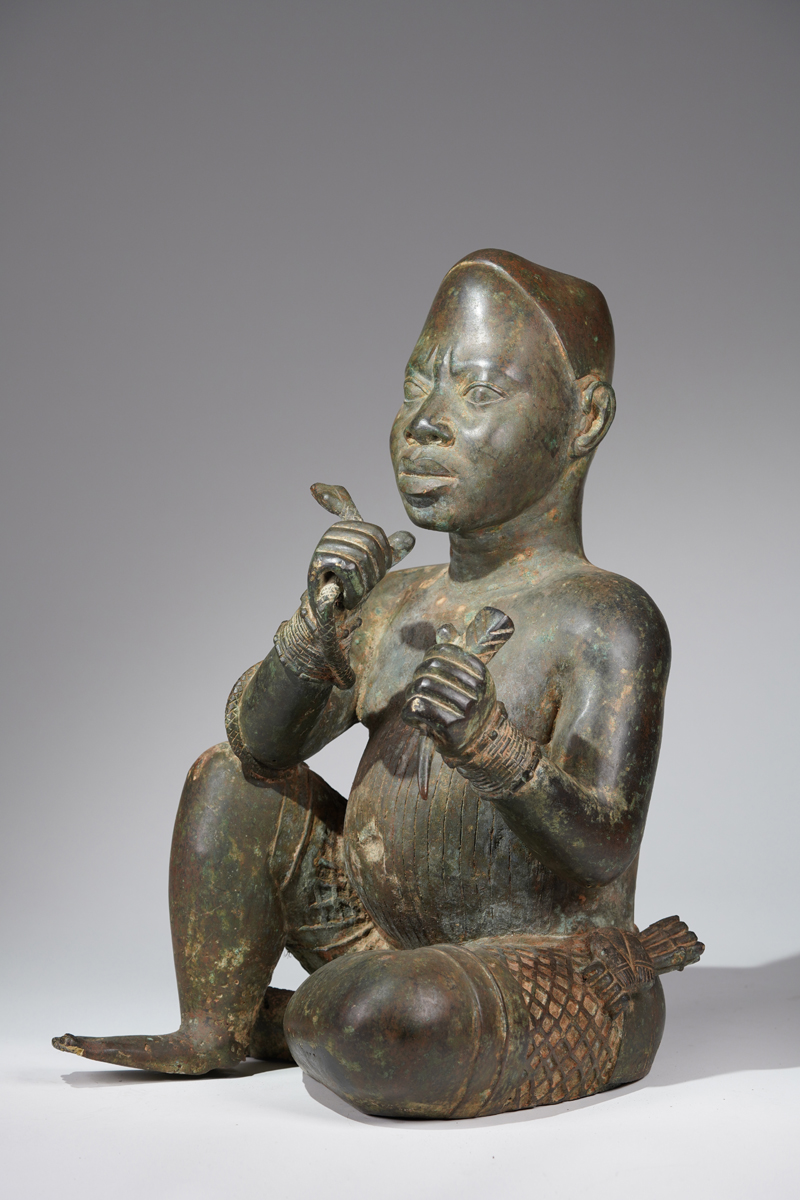 photo: wolfgang-jaenicke.com, for more information, please write us an e-mail with the identification number of the photo identification no. XBD141697.jpg |
 |