 |
 A Terracotta vessel in the style of Djenne, Mali, large spherical body tapering to cylindrical neck that flares out; parallel ringed engravings; varied and mottled red ochre patina. Certificate of origin and provenance. Tra Deserto e Savanna 1994:61-63 for related exemplares. Italian Edition. This terracotta vessel is coming from a tumulus - called locally Koi Gourrey - of the Niger Inland Delta. "These tumuli were large funerary monuments built in honour of an important chief or king. Desplagnes* related them to the pre-Islamic empire of Ghana and dated them 9th - 10th century A.D...In the center of the mound was a funerary chamber with the skeletons of about thirty individuals and their grave goods which consited of silverand copper rings and brcelets , beads and copperbstatuettes of birds, crocodiles and lizards. The Arab autor El Bekri writing in 1050 A.D., described the burial customs of the Kingdom of Ghana: When the king dies, these negroes built a large wooden dome on the burial spot. Then they lay down the body on rugs and cushions inside the dome. They put beside him his arms and his jewelry, the vessels and cups in which he drank and ate, and different kinds og food and drink. Then they buried with the King some of his ccoks. The whole construction is then covered by mats and cotton sheets and the people covered the dome with earth in order to create a large mound. Then they sacrifice victims to their dead and make offering of strong alcohol. ** Bedaux, R.M.A., 1980., The geographic distribution of footed bowls in the upper and middle Niger region´in Schwartz, B.K. and Dumett, R. A., ed., West African Cultural Dynamics, Den Hag, This desciption of the funerary customs of the Kingdom of Ghana fits more or less with the information provided by Desplagnes on the tumuli except for one point. The exception is a large urn filled with ashes which may imply another mode of burial - by incineration. Nevertheless, the dates obtained by thermoluminescence for the pots, which are similar to those of the tumuli region are consistent with the period of the Ghana empire: their last firing was done between 950 and 1385 A.D. sold Height: 28 cm |
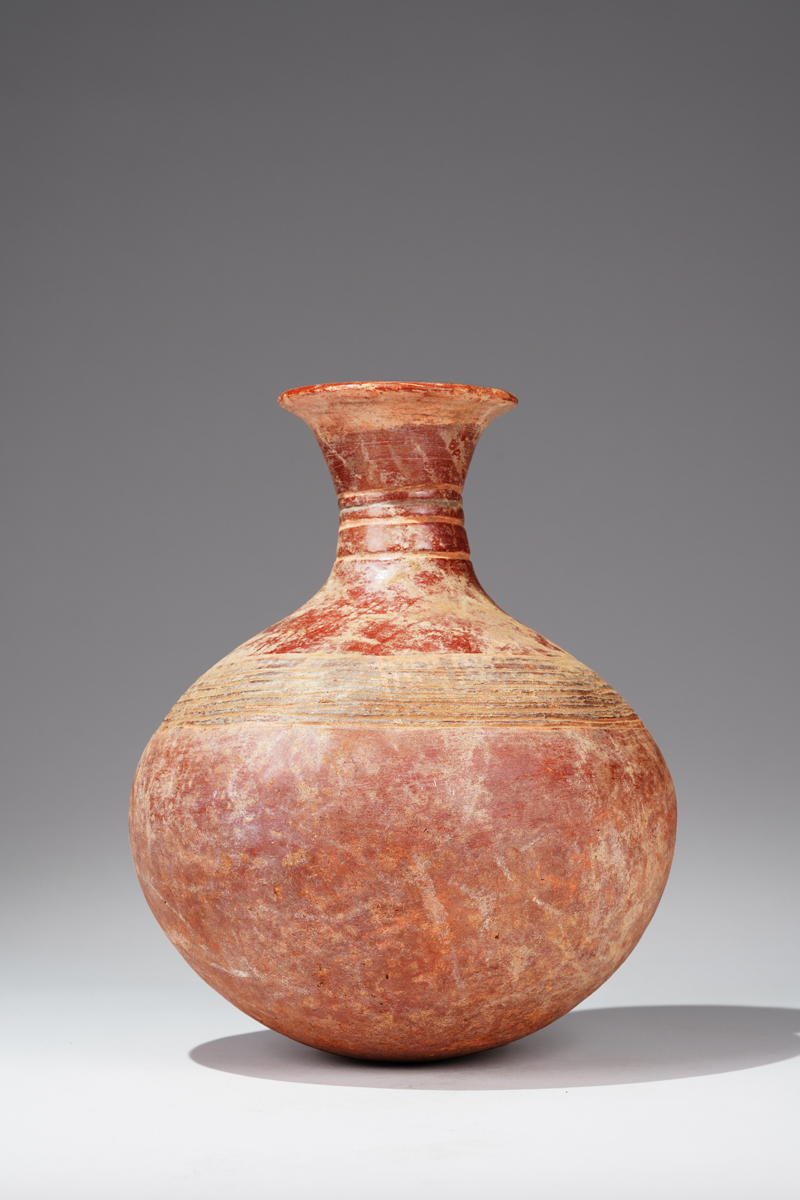 photo: wolfgang-jaenicke.com, for more information, please write us an e-mail with the identification number of the photo identification no. XBD143636.jpg |
 |