 |
 A female Ewe Venavi, Ghana, standing on a platform, straight legs, wide shoulders, thin arms, long hands; large breasts with red blue and black painted on them, so is the rest of the torso; a thick neck, delicately carved oval shaped heads, with a face flat face, the mouth is almost erased, same goes for the nose, and round eyes, right ear is chipped and there is a crack behind the left ear, the hair is short and pulled back, traces of it being painted black remain, in addition to small carving to suggest a texture ; light wood, some age cracks, signs of use. Certificate of originand provenance.
"These beautiful figures were used for the cult of the twins. Coming closer to Yoruba beliefs, the Ewe, on the death of a twin, had a statuette carved in his or her likeness and looked after it like a living child.
"The Ewe, who live in southern Togo and Ghana are the eastern neighbors of Asante. They are probably best known for their textiles and also for small wooden dolls called "venovi" or "venavi" which are used like the Yoruba people in Nigeria used Ibeji twin figurines, for protection of survivor after death of a twin. Some scholars state that they are also used as children's dolls as well as sometimes used as fertility dolls by women who keep these dolls under their mattresses or were worn under the skirts of young women to ensure fertility. Scarifications and added clothing and strings of beads reveal family and clan religious and social affiliations."
Source: ISN'T S/HE A DOLL.
Lit.: ISN'T S/HE A DOLL.
sold
Height: 22 cm
Weight: 0,13 kg |
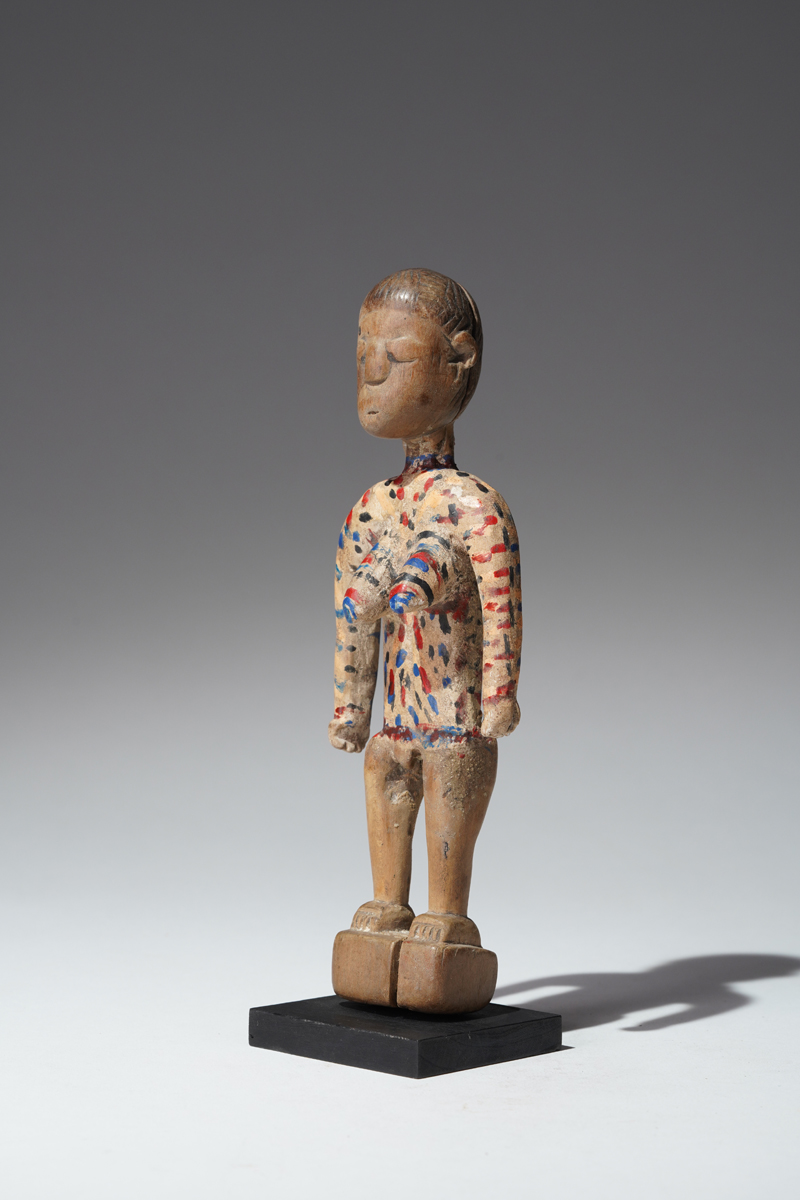 photo: wolfgang-jaenicke.com, for more information, please write us an e-mail with the identification number of the photo identification no. XBD143672.jpg
 |
|
