 |
 A Luba female caryatide stool, Democratic Republic of Congo, supporting a circular disk seated in W-sitting position on a large circular platform; large v-shaped scarification with geometric motif extends from her navel; conical breasts, arms holding up the disc; a thick short neck supports a round head with an expressionless face, almond shaped eyes, wide nose, thin lips and small ears. Signs of use. Certificate of origin and provenance. "The Luba peoples occupy a land of rivers and savanna in the southeast of what is today Democratic Republic of Congo. As early as the seventeenth century, Luba society consisted of an extensive, centrally organized state structured on the principles of divine kingship and rule by council. Luba leaders trace their ancestry to a dynasty of sacred kings, and Luba royal seats are intended to replicate an original seat of office owned by the progenitor of this divine lineage. Such works associate their owner with the source of his legitimacy. Despite their functional form, royal stools are never used for sitting but, rather, are sacred insignia preserved within a king's palace. They serve as metaphorical, not literal, seats of kingship. The design of Luba seats of leadership may either be abstract or figurative. Those incorporating female caryatids give expression to the Luba conception of the female body as a spiritual receptacle that supports divine kingship. The aesthetic refinement of the female body through elaborate skin ornamentation and coiffure serves as a metaphor for the civilization and refinement that Luba rulers disseminate within society." sold Height: 35 cm |
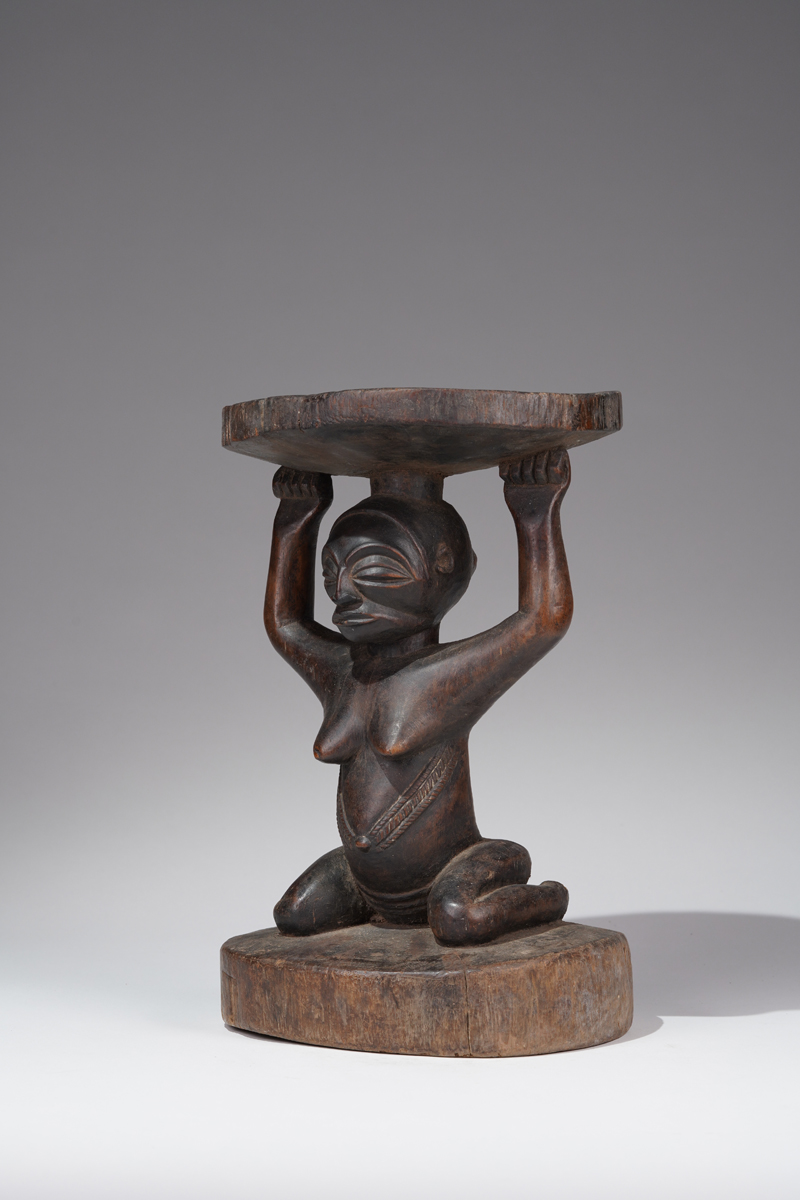 photo: wolfgang-jaenicke.com, for more information, please write us an e-mail with the identification number of the photo identification no. XBD145143.jpg |
 |