 |
 A female Senufo Rhythm pounder, (Deble), Ivory Coast, carved out of one piece of wood, she is standing on a cylindrical base, her knees slightly bent, a thin abdomen with protruding navel, she is characterized by a bent, supernaturally long arm, which would probably reach down to the knee if it were hanging down, while the right arm - in accordance with reality - ends at hip height and indicates a sacrificial ritual with a stylized rooster in its hand. The hand of this extended arm rests on the left breast at the level of the heart. What the figure is wearing on the left side of the hip cannot be seen exactly. Perhaps it is a knife that could correspond to the impending sacrifice of the rooster, which "comes from the heart". The importance of the arm with its hand "on the heart" is emphasized not only by its supernatural length but also by a series of bracelets that adorn the forearm, the face is finely carved, a small mouth at the end of a large jaw, elongated nose, half closed eyes and the hair is pulled back, the top of the head is mounted by a four legged animal, on the forehead and on the sides of the face are carved scarifications, symbol of beauty and statu. Even if the strong conical base indicates a funeral stomper - rhythm pounder/déblé - this figure probably has nothing to do with a funeral ceremony, but rather represents a sacrifice for female fertility. The patina on the handle is impressive, indicating long ritual use. “These large-scale statue are a very rare work of art among the Senufo, institutional style of professional sculpture, yet on some special occasions large works of art were commissioned by the male Poro society and also by their female counter equivalent society, the Tyekpa society. In the case of the Poro society, large statues of pairs were placed on public display near wooden shrines or shelters where the chosen society’s initiators gathered to celebrate and organize special events and funerals. The Poro society would commission statues such as this one to be carried and used in ritual processions or placed on the ground to serve as a focus point for the ceremonial dancers. sold Height: 130 cm |
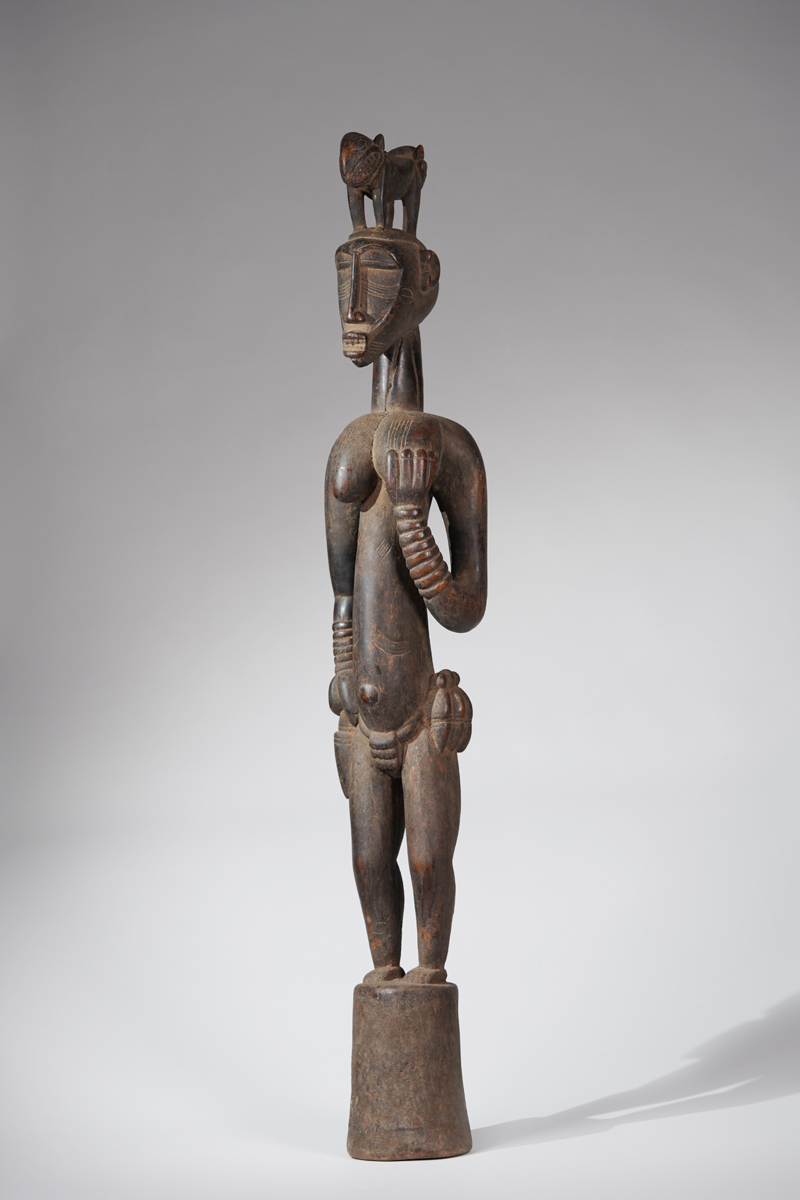 photo: wolfgang-jaenicke.com, for more information, please write us an e-mail with the identification number of the photo identification no. XBD145297.jpg |
 |