 |
 A Senufo guardian sculpture, northern Ivory Coast, rising from a cylindrical base, long thick legs, an abstract loincloth, a slender elongated torso with inwards carved back, the hands are by the waist and are both holding small objects, the neck is long and cylindrical, carrying an oval shaped head composed of expressive facial features, a square opened mouth, Lon thick nose, half opened eyes, two large ears on both sides of the face, the hair falls back in a layered style, the top of the head is crowned with a head dress with an X carved out in the middle. The plaque attachment means that the object plays a double role: First it is a field guard and second it plays a ceremonial role; fine scarifications on the face, encrusted dark brown patina. Certificate origin and provenance.
Burkhard Gottschalk writes that this is not a rhythm pounder (Débéle, do:ogèlè), but a very rare stationary used guardian figure. These sculptures are called propi:ibèlè, „children of the Poro".
"Their membership of the Poro would be an explanation for our little knowledge of their significance, because this organisation, which largely determines the village world of the Senufo, is a secret society. ... Even rarer are the statues [propi:ibèlè] … of which it is only said that they belong to the Poro, because there is no reliable information about their use.“ Burkhard Gottschalk, Kunst aus Schwarzafrika. SENUFO. Unbekannte Schätze aus privaten Sammlungen, 2009, p.174, 179.
Lit.: Burkhard Gottschalk, Senufo. Massa und die Statuen des Poro, 2002; Staatliche Museen der Preußischer Kulturbesitz, Museum für Völkerkunde Berlin, Die Kunst der Senufo, Elfenbeinküste. Mit einem Beitrag von Till Förster, 1990; Museum Rietberg Zürich, Die Kunst der Senufo aus Schweizer Sammlungen, 1988; Susan Elizabeth Gagliardi, Senufo unbound. Dynamics of art and identity in West Africa, Cleveland 2015 page 78, Fig. 41 Private collection McClain Gallery, Houston, Sothebys, 14 November, 2008, Lot 63.
"Auf den Auktionen wird in jüngerer Zeit nur noch gelegentlich ein altes und bedeutendes Exemplar dieser Statuen (deble) angeboten. Wegen der Aura, von denen die Deble auf Grund ihrer Verwendung bei Beerdigungen umgeben zu sein scheinen, und wegen ihrer Seltenheit stehen diese Statuen bei den Sammlern in einem hohen Ansehen. Noch seltener werden die stationär benurtzen Statuen mit flachem Sockel angeboten, von denen es lediglich heißt, daß sie zum Poro gehören, denn über ihre Verwendung liegen keine gesicherten Erkenntnisse vor." Gottschalk, Kunst aus Schwarz Afrika, Vol. 3, page 179.
Lit.: Kat. Ausst. Die Kunst der Senufo, Elfenbeinküste. Mit einem Beitrag von Till Förster, Museum für Völkerkunde Berlin 1990. Burkhard Gottschalk, Senufo. Massa und die Statuen des Poro, Düsseldorf 2002. Susan Elizabeth Gagliardi, Senufo unbound. Dynamics of art and identity in West Africa, 2015. Till Förster, Smoothing the Way of the Dead, A Senufo Rhythm Pounder, Yale University Art Gallery Bulletin (2005).
sold
Height: 130 cm
Weight: 9,2 kg |
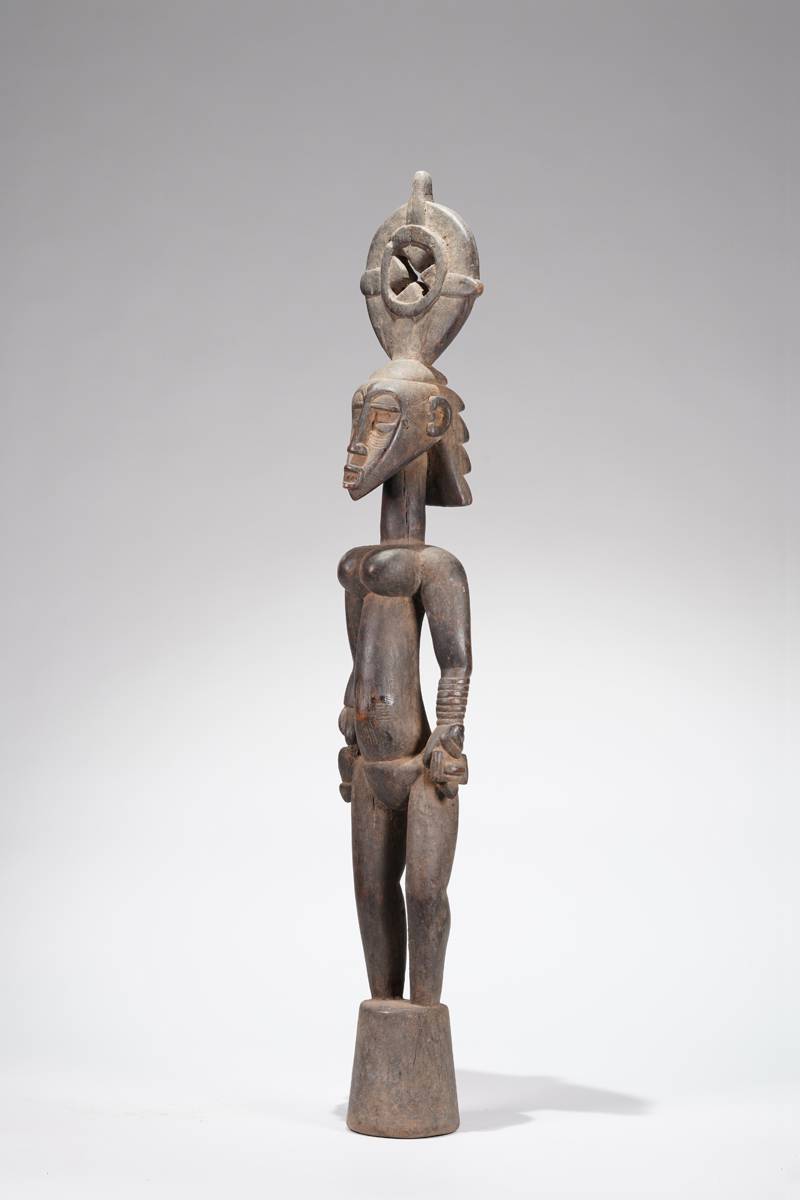 photo: wolfgang-jaenicke.com, for more information, please write us an e-mail with the identification number of the photo identification no. XBD145387.jpg
 |
|
