 An Ibeji twin couple, from the Yoruba people, both stand on a wooden base, long flat feet, small legs, thin chest, conical shaped breasts for the female , arms and hands fall down to the hips, a cylindric neck carries an oval shaped head, the facial features are slightly erased by wear, the eyes are punctured with small holes, so as the ears where earrings would have been, there are scarification marks on their cheeks, the hair is pulled upwards and is colored in washing blue; glossy by use, encrusted camwood powder around the genitals and feet, signs of use.
Sources: Doppel-Leben Ibeji Zwillingsfiguren, Hanni Jantzen und Ludwig Bertsch SJ. Munchen: Hirmer 1993, p.80.
Enzyklopadie Der Ibeji, Fausto Polo, p.496.
“Yoruba peoples have one of the highest incidents of twin births in the world. As a result, twins are regarded as extraordinary beings protected by Sango, the deity of thunder. They are believed to be capable of bestowing immense wealth upon their families or misfortune to those who do not honor them. Powerful spirits in life, twins are honored with carved memorial figures when they die. These figures, known as ere ibeji (literally meaning ere: sacred image; ibi: born; eji: two), remain a point of access to the spirit of the departed individual. The mother provides ritual care to the figures, bathing, dressing, adorning, and feeding them. Such daily handling is responsible for giving their surface its distinctive patina. Ere ibeji invariably represent their subjects with mature adult physiognomies, and are often crowned with elaborate hairdos.”
Lit: The Metropolitan Museum of Art.
sold
Height: 24 cm / 26 cm
Weight: 180 g / 200 g |
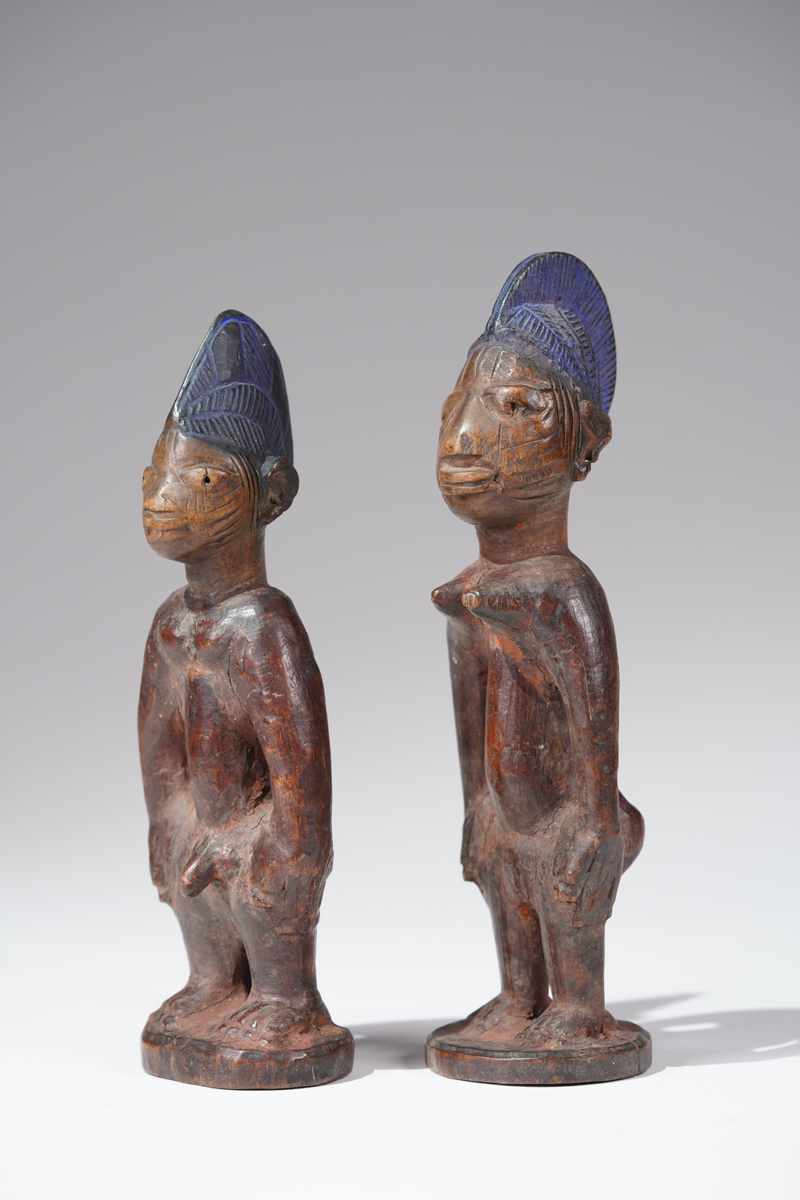 photo: wolfgang-jaenicke.com, for more information, please write us an e-mail with the identification number of the photo identification no. XBD144842.jpg
 |
|
