 |
 A relief Brass Plate in the style of Benin, with the Oba in the center. He wears the attributes of his dignity: a hairstyle and necklaces made of coral pearls, a baldric made of several rows of pearls across his torso, a necklace made of leopard teeth, as well as bracelets and anklets . His draped loincloth is tied at the side. He brandishes a weapon with his right arm, the background is beautifully engraved with leaf patterns, there are also six floral (?) reliefs on each side of the Oba. “The relief brass plaques that used to decorate the Oba's (king's) palace are among the most well-known of all the royal arts of Benin. Although frequently described as 'Benin Bronzes' most plaques are made of leaded brass in various compositions. It is widely accepted that they date to the 16th-17th centuries. In the years prior to the British Expeditionroyal influence in Benin was increasingly under threat from rival powers, both internal and external, with a focus on economic power and control of the important trading monopolies. However, the court and palace remained the political and spiritual centre of the Benin Kingdom. Earlier accounts written by Europeans visiting the city describe its size and scale. The palace complex was set up around atrium courtyards; some had galleries with wooden pillars supporting the roof. Brass plaques, probably made in matching pairs, were fixed to these pillars. The Benin brass plaques represent a distinct and unique corpus of work, unparalleled elsewhere on the continent. They are cast using the cire perdue (lost wax) technique and show significant variation in the depth of the relief. Some of the plaques portray historical events or commemorate successful wars, while others are a vivid depiction of Benin court life and ritual. Several groups of plaques show clear stylistic similarities. William B. Fagg suggested that these plaques represent the work of master brass casters. Fagg, William, 1973, 'Nigerian Images', London: Lund Humphries Gunsch, Kathryn, 2018, 'Benin plaques: a 16th century imperial monument', London: Routledge, Taylor and Francis Group..a stolen plate by the British occupation of Benin City (Edo) in 1897, which was exhibited in the British Museum..” Source: Digital Benin, Registration Number object Af1898,0115.86. sold Height: 49 cm |
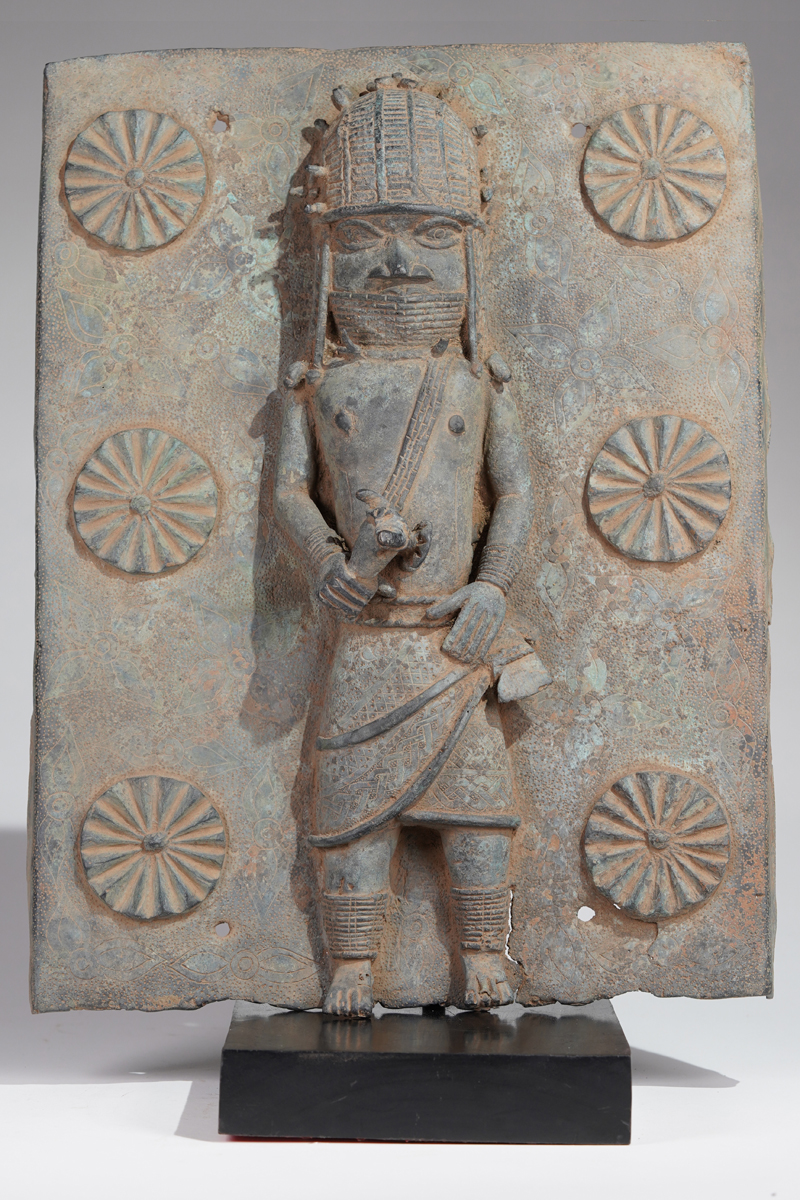 photo: wolfgang-jaenicke.com, for more information, please write us an e-mail with the identification number of the photo identification no. XBD145854.jpg |
 |