 |
 A Baule kple kple Goli mask, Cote d'Ivoire from teh Tebisou region. Dark wood, glossy patina; signs of ritual use and age. Certificate of origin and provenance. Kple-Kple masks are one of the great abstractions in African art. They are used in ceremonies related to the Goli festival of the Baule people. The Goli festival is a day-long spectacle in which the whole village participates. It is performed at funerals as well as at memorial services and agricultural events. Goli masquerades involve three rituals during the day: at dawn, in the afternoon and after sunset. Kple kple masks appear at dawn and again briefly in the evening to announce the arrival of Goli Glin, a zoomorphic figure, or a kpwan, an anthropomorphic figure. During the ritual, the mask wearer mediates with supernatural powers that have a positive influence on the villagers. During the festivities, the young male mask-bearers are often wrapped in a goatskin covering their backs and wear a skirt made of raffia with it. The mask is attached to the costume with vegetable fibres. The Baule people are one of the most important tribes in Côte d'Ivoire. Bauli means "the son is dead" and refers to the origin of the tribe. According to a legend, Queen Aba Pokou led her people on an exodus to the gold mining areas in the 18th century and had to cross a river where she had to sacrifice her son to the river god, which earned her people the name Bauli, "the son is dead". In the 19th century, the kingship disintegrated due to internal conflicts, and when the French colonial rulers took over at the beginning of the 20th century, the kingship was disbanded. With their sense of stylisation and attention to detail, the Baule have created some of the most elegant objects in African art for centuries. Today they still produce numerous sculptures and masks with great skill. sold Height: 43 cm |
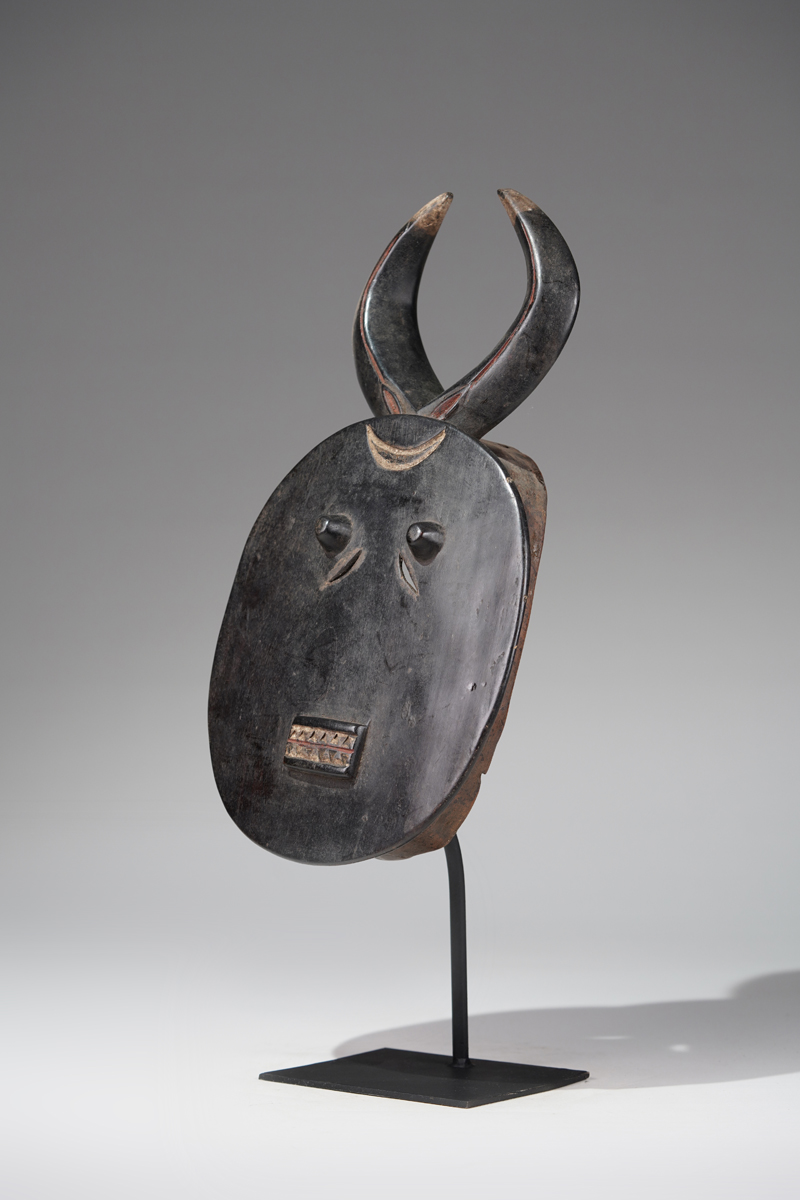 photo: wolfgang-jaenicke.com, for more information, please write us an e-mail with the identification number of the photo identification no. XBD181859.jpg |
 |