 |
An anthropomorphic Kousasse or Konkomba sculpture, Northern Ghana or Northern Togo, close to the Moba population ; extremely heavy hard wood, strongly weathered, posted on a plinth. Incl .stand. certificate of origin and provenance.
The Koussasse sculpture is a significant example of African art that comes from the region shared by Togo and Ghana, specifically from the Ewe people, who inhabit both countries. The Ewe are known for their rich cultural traditions, and their art, including sculpture, is deeply linked to their religious beliefs, social structures, and rituals.
Key Aspects of Koussasse Sculpture:
1. Cultural Context: The Ewe people are known for their vibrant religious practices, and many of their sculptures are used in ceremonies and rituals. The sculptures can represent ancestral spirits, deities, or symbolic figures connected to the Ewe worldview.
2. Materials: Traditional sculptures like those from the Koussasse tradition are often crafted from wood, though they may also include materials like brass, clay, or other natural resources. The wood is usually carved with great precision and detail.
3. Stylistic Features: The sculptures often feature stylized human figures, faces, or abstract forms. These works are often characterized by exaggerated features (such as large eyes or elongated limbs) that represent spiritual or symbolic qualities rather than realistic depictions of people.
4. Spiritual Significance: Many of these sculptures are not simply decorative; they are deeply spiritual and serve to channel or represent the power of ancestors, gods, or spirits. They are used in ceremonies to invoke spiritual forces or honor past generations.
5. Koussasse and its Function: If the term "Koussasse" refers to a particular type of sculpture, it might be associated with a specific function or ritual within the Ewe society. In some cases, sculptures like these could be part of initiation rites, community celebrations, or religious rituals designed to protect or bless the community.
6. Modern Context: Today, such sculptures are also highly valued by collectors and museums around the world. They are important artifacts of African cultural heritage and play a role in preserving the traditions of the Ewe people.
The use of Koussasse sculptures within Ewe traditions highlights the deep connection between art, spirituality, and community in this region of West Africa. If you're referring to a specific sculpture or artist by the name "Koussasse"
The Konkomba people live in the Oti river basin in the northern border region of Ghana and Togo. Neighbors are the Mamprusi and Tchokossi in the north, the Lamba/Losso/Kabye in the east, the Bassari in the south and the Dagomba in the southwest . On the eastern side, the Konkomba area is interspersed with frequent Lamba settlements and some Konkomba groups can also be found in the south of the Bassari region . The Konkomba are composed of five clans, whose cohesion however is marginal , they thus do not form a coherent people. The overarching denomination ‘’Konkomba’’ has probably obtained its significance through the colonial linguistic usage . Alternate denominations are today Kpankpam, Bikpakpaln or Bikpakpaam. Their language is Konkomba (or Likpakpaln), which belongs to theOti-Volta sub-group of the Gur languages.
Reference: Keller, Thomas. Research outcome: Statuary from the Kusasi region, Northern Ghana-Togo. https://statuary-in-context.blogspot.ch, 31.03.2017.
sold
Height: 105 cm incl. stand
Weight: 10 kg |
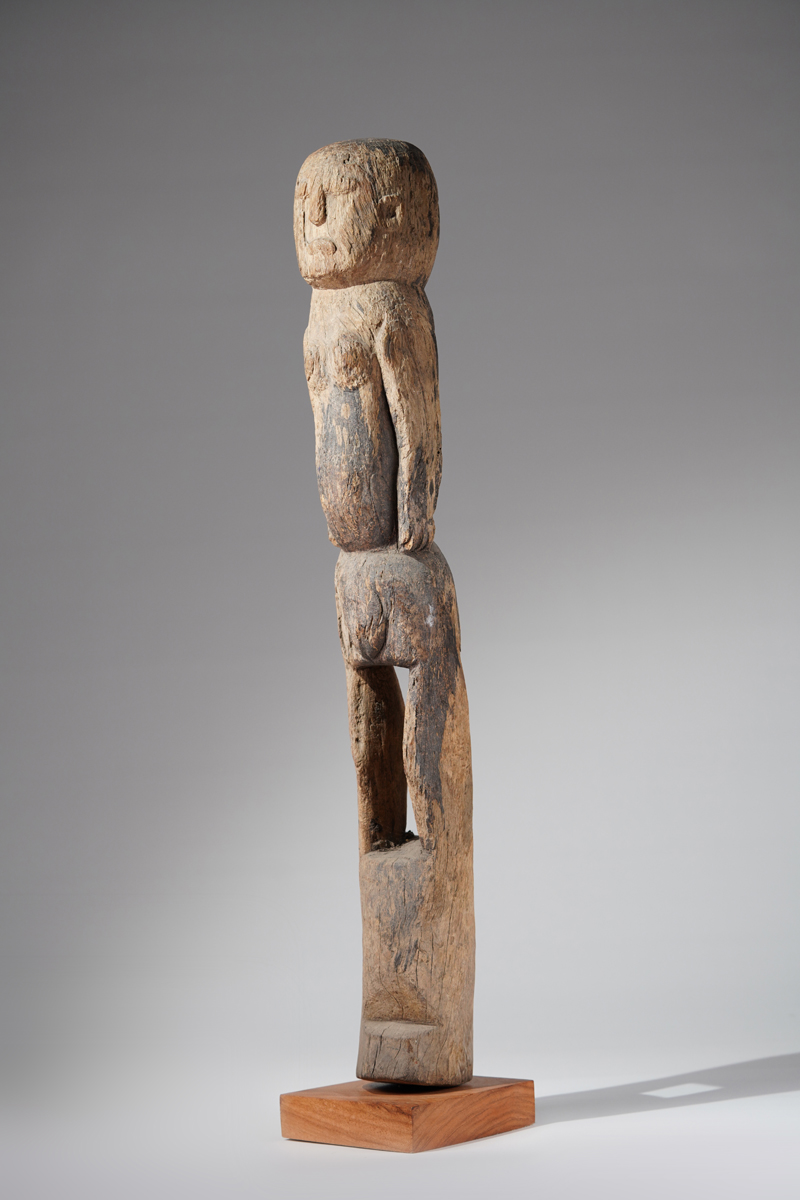 photo: wolfgang-jaenicke.com, for more information, please write us an e-mail with the identification number of the photo identification no. XBD182079.jpg |
|

