 |
 A Winiama mask, Burkina Faso, Ouahigouya region; signs of ritual use and age. Certificate of origin and provenance.
Winiama masks are integral to spiritual and social life, appearing in funerals, initiation ceremonies, agricultural rituals, and public festivals. They serve as intermediaries between the human world and the spirit realm, ensuring balance, protection, and community well-being (Roy, 1987). Unlike the masks of the Mossi and Bwa, which are often associated with centralized political structures, Winiama masks function within decentralized, lineage-based religious traditions (Bonnet, 2005).
Winiama masks are distinct for their:
• Geometric patterns and bold color schemes (red, white, and black pigments), symbolizing spiritual power and transformation.
• Highly stylized animal or human-like forms, including crocodiles, buffaloes, and owls, representing specific totemic spirits.
• Intricate carvings with zigzag and checkerboard motifs, signifying concepts such as life, death, and cosmic order (LaGamma, 2000).
The masks are often carved from lightweight wood and adorned with natural pigments derived from leaves, clay, and minerals. Their abstract forms and exaggerated features underscore their spiritual potency rather than naturalistic representation (Roy, 1987).
“The masks of the Winiama people are not mere aesthetic objects; they are embodiments of powerful spiritual entities. Each mask is believed to house a specific spirit, often linked to an ancestral force or protective deity. When worn by initiates, these masks transcend their physical form, becoming animate presences within the ritual space. Their performances serve to reaffirm communal ties, invoke ancestral blessings, and maintain the cosmic balance between the seen and unseen worlds.”
— Roy, C. D. (1987). Art of the Upper Volta Rivers. Indiana University Press, p. 112.
“The Winiama people, like other Gurunsi groups, have long maintained a ritual system in which masks play a crucial role in both initiation and agricultural ceremonies. These masks, often depicting animals such as crocodiles and buffaloes, represent protective spirits that safeguard the community from harm. When activated in ceremonial dances, they mediate between the human and supernatural realms, reinforcing the social and moral codes essential for communal harmony. Their performances, accompanied by rhythmic drumming and sacred songs, create an immersive experience that transcends the everyday world.”
— Bonnet, D. (2005). Masques du Burkina Faso. Musée Dapper, p. 67.
sold
Height: 90 cm
Weight: 2,3 kg incl. stand |
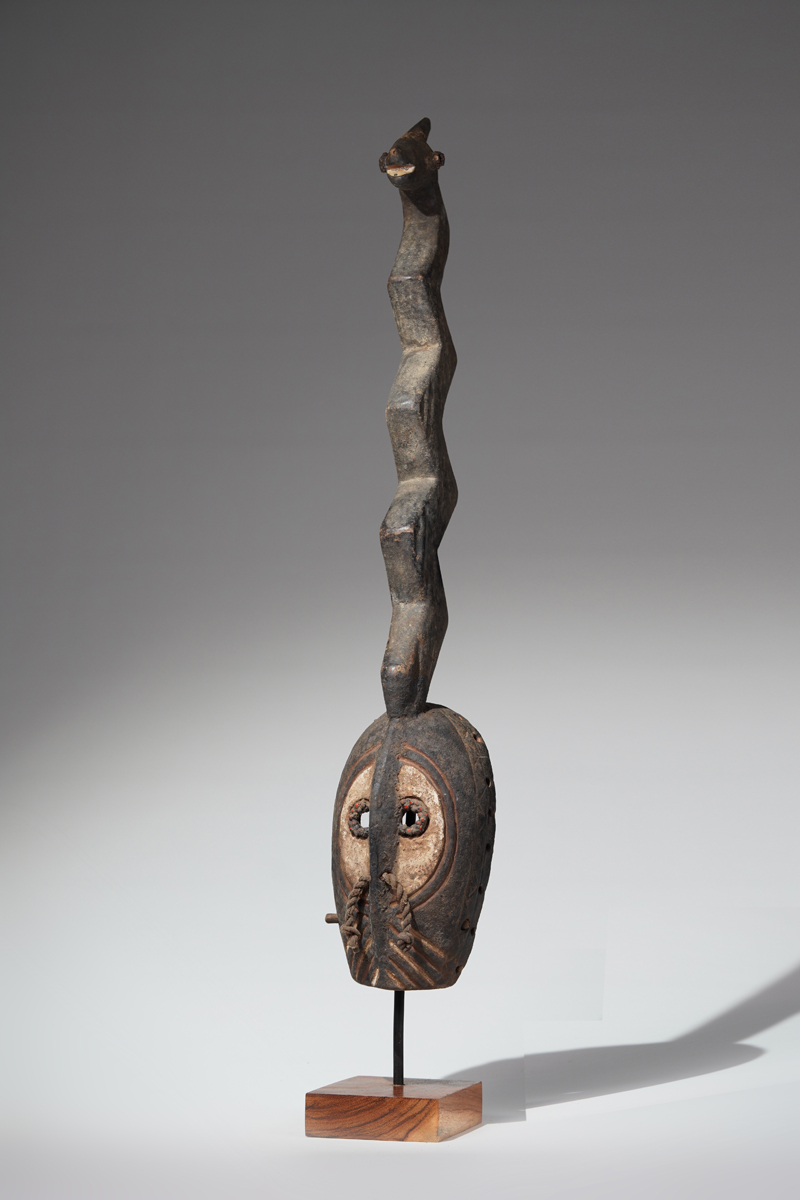 photo: wolfgang-jaenicke.com, for more information, please write us an e-mail with the identification number of the photo identification no. XBD182252.jpg
 |
|
