 |
A Baule maternity sculpture, Cote d'Ivoire, Beomi region; sitting on a stool placed on as oval base, an infant on her lap; some cracks, signs of ritual use. Certificate of origin and provenance.
“To articulate historians, the most consistent features of Baule art is a kind of peaceful containment. Faces tend to have downcast eyes and figures most often hold their ams against the body. […] Among their abundant art forms, the Baule people continue to place the greatest value on masks and figure sculptures, which remain the only sculptural art still widely used in Baule villages. While there is a difference between the Baule view of their objects and that of Western connoisseurs, there are points of agreement. Aesthetic appreciation is one: Baule artist, and individual owners of objects, certainly sometimes enjoy the beauty of these objects and the skill it took coproduce them. […]
Lit: Baule: African Art, Western Eyes. Susan M.Vogel 1997.
“Baule female figures, often referred to as blolo bla (spirit spouse), serve as powerful ritual objects within the community. They are typically created to embody the spiritual presence of a deceased individual or a spiritual being, with the intention of mediating between the human and supernatural realms. These figures, whether carved for personal or community use, are not merely aesthetic objects; they are believed to possess agency, invoking the spiritual force of the person or spirit they represent. A male figure called blolo bian often complements the female, and together, they represent the union of cosmic opposites. These figures are placed in shrines and are integral to the practice of divination and spiritual healing, often consulted by the diviner in sessions where they are seen as holding the power to channel ancestral wisdom."
Soucre: William Fagg, Art and Life in Africa (1964)
“For the Baule, a figure is never merely an image, it is always the manifestation of a spiritual presence, whether that presence is an ancestor, a deity, or an unseen force. This is why the figures are often considered to have their own vitality. When carved, they are brought into being through the carver's vision, which is itself informed by the wishes of the spirit who is to inhabit the object. The figure itself is an instrument through which the spirit communicates with the world of the living. Whether it is a male or female figure, the choice of the figure’s posture, expression, and ornamentation is integral to its power. For instance, the serene expression of the female figure is not simply a depiction of femininity; it is an embodiment of tranquility, wisdom, and protection, which the Baule consider essential attributes for a spirit spouse. The Baule create these figures as part of an ongoing relationship between the human and spiritual worlds. They are not intended to be seen as static art objects; they are interactive, living parts of a ritual world. In a sense, these figures challenge the notion of ‘art for art’s sake.’ They are functional, embedded within daily life and used in healing, divination, and rituals that have specific goals—whether for protection, fertility, or spiritual communication. As the Baule view it, the figure serves as a mirror, reflecting both the spiritual world and the social ideals of the community, showing us not just what is, but also what could be: a perfected world of harmony, power, and balance.”
— Susan Vogel, Baule: African Art, Western Eyes (1997).
sold
Height: 61 cm
Weight: 4,1 kg |
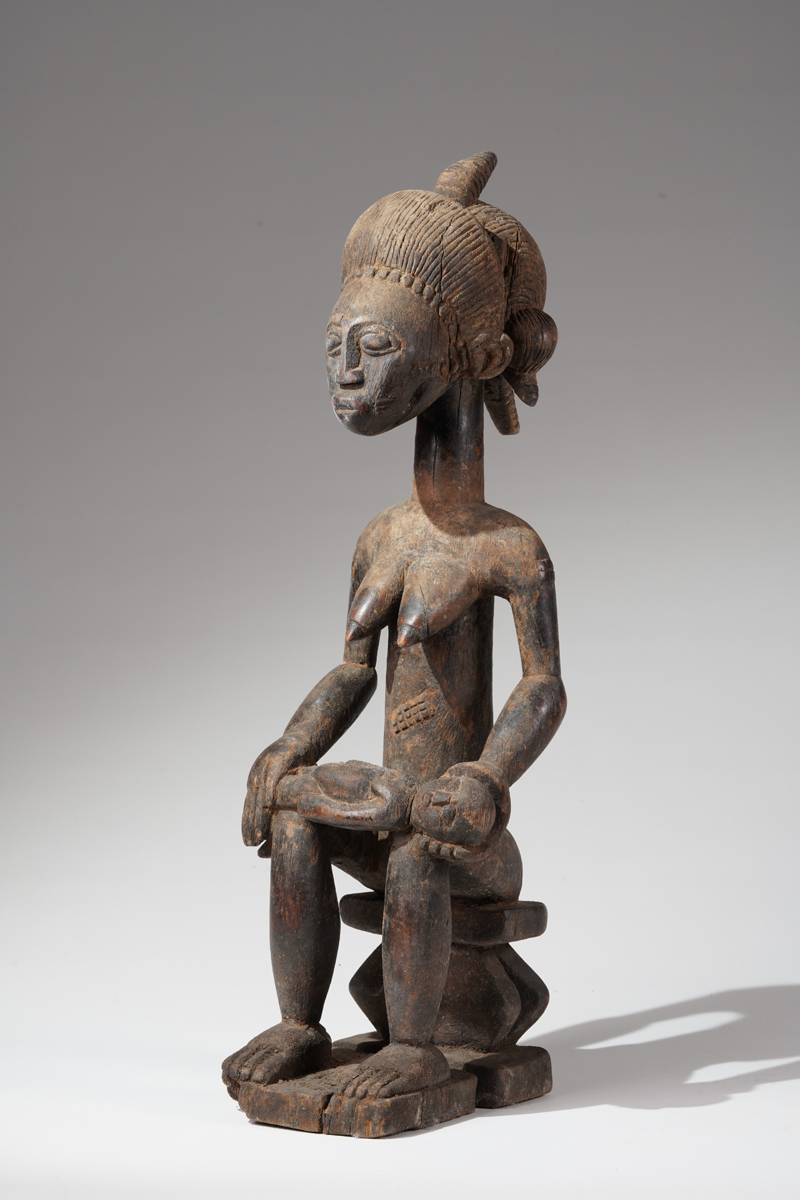 photo: wolfgang-jaenicke.com, for more information, please write us an e-mail with the identification number of the photo identification no. XBD182592.jpg
 |
|

