 |
 An Akan terracotta head, Ghana. Certificate of origin and provenance. "The Akan people of Ghana and Côte d'Ivoire have long maintained elaborate traditions of honoring their ancestors, and terracotta portrait heads stand at the center of these commemorative practices. These sculptures are not mere representations but spiritual vessels believed to house the essence of the deceased. Their placement in shrines, alongside libation vessels and other ritual objects, reinforces their function as intermediaries between the living and the ancestral world. The idealized facial features—serene expressions, carefully modeled hairstyles, and symmetrical proportions—reflect the Akan aesthetic values that equate physical beauty with moral integrity and wisdom." "Akan terracotta heads exhibit a striking balance between realism and abstraction. While they lack individualized facial features, they are adorned with elaborate details that signify rank, identity, and the cultural ideals of beauty. The fine incisions used to depict scarification patterns and hairstyles are meticulously crafted, demonstrating the technical mastery of Akan ceramic artists. These sculptures are not created for mere artistic appreciation but serve as powerful symbols of continuity, connecting past generations with the present through ritual observance and collective memory." sold Height: 23 cm |
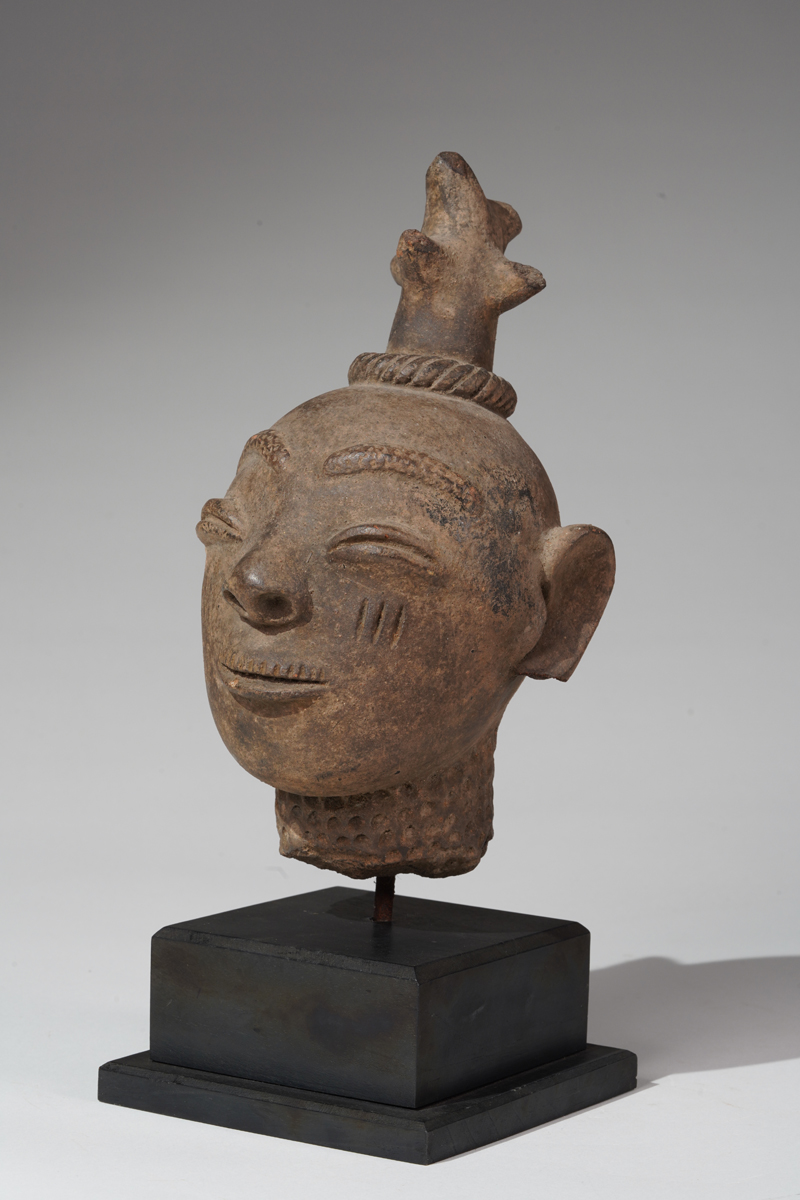 photo: wolfgang-jaenicke.com, for more information, please write us an e-mail with the identification number of the photo identification no. XBD182684.jpg |
 |